True Greatness Is Knowing Where We Are

We all have those days where we feel we will never amount to what we wish we would become. We feel small, distant, lost. We don’t know how to find our way forward along the path to find our “greatness.” Instead, we spend so much energy and time seeing all the ways we haven’t reached our life goals.

One area I want to focus on is spiritual growth. In working on our spiritual goals, our spiritual growth, this inability to focus on where we are versus where we aren’t can make it feel like we aren’t having success. We feel distant from our desires to be more connected to our faith, our religion, our trust in Gd. But are we really so far away? Perhaps we aren’t distant but how we perceive things is what is leading to think we are distant. So much of growing along the path of life comes down to the mindset we bring to the moment. I think this is illustrated in the following teaching:

Someone asked the Rebbe Shlit”a how they should deal with their feelings of lack of success. They hear so much from the Rebbe about the high and lofty spiritual levels one should reach, but they feel so far from reaching any of this! The Rebbe answered that the Zohar HaKadosh says that “he who is small is great,” therefore, by a person simply acknowledging where they are truly holding i.e. that they are “small” and not yet on these high levels they learned about, they are showing that they are truly great.

Sea of Wisdom, Parshas Bo 5784 – R. Yitzchak Meir Morgenstern

When we embrace the notion that we aren’t there yet, not in a negative way, but in a growth mindset way, we change the paradigm. It is no longer that our distance from our desired goals is a sign of what we are lacking. Rather, our place now is our “greatness” and through this current greatness, we are on the path to higher levels of spiritual growth. 

Today, and everyday, when we take stock of where we are, not where we haven’t gotten to, I hope that we can see we are in the place of today’s greatness, knowing full well we want to journey further to tomorrow’s greatness. May we embrace where we are now and find the inspiration from this spot to move along the road of becoming more and more.

Looking for help in recognizing the greatness that is you? If you or someone you know is looking to forge ahead and set new goals or trying to find a sense of meaning in life, we are here to help foster spiritual and emotional growth and change. Schedule your appointment today here. For more information, please contact New Beginnings Spiritual Coaching and Consulting LLC at 732-314-6758 ext. 100 or via email at newbeginningsspiritualcoach@gmail.com

Audio – Lessons in Tanya 51

Part two of Chapter 31 – We continue to explore how to raise up the soul when the heart is feeling numb. We explore the metaphor of exile and redemption, using the Exodus story as the paradigm for rising above our physical desires. This part also speaks to the need to not just raise the divine soul but also the animal soul to newer heights through Torah and Mitzvot, through the work of spiritual growth.

Episode 51

All episodes can also now be heard on Apple Podcasts – here

Do you want to work on taking the actions of your life and find meaning in all you do and who you are? Are you struggling with your spiritual growth. Contact New Beginnings Spiritual Coaching and Consulting LLC at 732-314-6758 ext. 100 or via email at newbeginningsspiritualcoach@gmail.com

Self-reflection/looking in the mirror

A couple of my more recent posts have explored the topic of identifying the various components of self identity. In this post, I am…, I included the beginnings of a list of different terms as to who I see myself as and as a paradigm for your personal growth. This practice, of listing the various “I ams” is a crucial component of growth. By looking in the mirror and engaging in the various elements of who we see, we can then explore the deeper characteristics that underlie each of those elements of our self-makeup.

Some of you reading this might question this method. After all, the work of claiming an “I” seemingly flies in the face of many spiritual practices. It is a common misconception that the goal of spiritual practice is an absolute self-nullification, a removal of all “I” elements of life. I would argue that this is a mistaken premise. Self-nullification, losing oneself in greater spiritual growth, is about the work of not allowing any of the identifying elements of the self to become sacred, to become the be all and end all.

Rather, what I am proposing is that the “I am” is a gateway to deep exploration and spiritual work as it relates to growth. This dawned on me in working with a couple of my clients, exploring the underlying meaning of the terms they were using to identify themselves. The exploration was to try to understand what were the drivers behind the particular term that the person used as a definition of self. When we are clear on who we are and what that means to us, we can then travel a road of who we wish to become within or without the term we are exploring.

For example, in my previous post, I identified myself as a “reader.” If I were to break this down further, I might begin by describing what I like to read or the types of books I find myself reading at the moment. I might explore what reading does for me. In fact, here is a rough outline of what saying I am a Reader is to me:

  1. explorer
  2. curious
  3. seeker of knowledge
  4. reading allows me times to escape from the challenges of life
  5. reading is a spiritual practice
  6. growth and change
  7. reading is a gateway to unexplored worlds
  8. reading is helpful in being a writer

I would then take this list and go deeper in this and related topics as it pertains to the goals the person I am working with would like to explore. For example, if I want to explore the notion of reading as a personal spiritual practice in relation to what it means when I define myself as a reader, I would work with the person to deepen their self-notion of what reading as a spiritual practice is. Is it the focus of reading? Is reading really about study and being absorbed in the depths of another’s words? Is it a form of connection to Gd (there is much in religious thought about connecting to the divine through the practice of study, of learning)? The goal of these explorations would be to help foster within the person the richness that comes from insights into the self so as to better foster the growth a person is looking for.

May each of us discover new aspects of ourselves as we consider the “I ams” we bring to the world.

Reflecting on your own path of self-discovery: Contact New Beginnings Spiritual Coaching and Consulting LLC at 732-314-6758 ext. 100 or via email at newbeginningsspiritualcoach@gmail.com.

Putting on the wrong Tallit

I came across a great line in the Kedushat Levi, of R. Levi of Berditchev (second to last piece on Parashat Shelach in standard printings), that helps to shed light on this week’s Torah portion as well as provides us with a powerful perspective on keeping in our lane as we journey through life.

In reflecting on the character of Korach, R. Levi offered an interesting perspective. He suggests that Korach’s intention was not ego but it was the desire to serve Gd in the best way he perceived, which as a member of the Levite tribe meant the desire to serve in a priestly role like his cousin Aaron and sons. While noble, this was not the role Gd had in mind for Korach or for the other Levites for that matter. As such, Korach was punished with living in the state of limbo of being swallowed alive by the earth, “to live in Sheol (which biblically is like a netherworld). In the midst of analyzing Korach’s motivation and why it was problematic, R. Levi offers the analogy that Korach’s desire was like wearing a Tallit that didn’t belong to him (Reminds me of Harry Potter and the using of a wand which isn’t yours, as the wand chooses the wizard. The wand will work but not in the way that the person’s destined wand would work).

I would suggest that Kedushat Levi offers this analogy to connect the story of Korach to the end of last week’s Torah portion, which commands the Israelites in wearing a four cornered garment with tzitzit, strings. The tzitzit are worn as a constant reminder to follow after the laws Gd commanded. Part of the commandments is an underlying idea of the rules helping one stay in one’s lane, not starting after the desires of the heart and the eyes. Presumably, if you are find yourself straying from your “path,” you find yourself in limbo, or you find yourself along a path that isn’t yours. (I would also venture to suggest this analogy of the tallit is based on one of the rabbinic reads of Korach’s challenges to Moses. Karachi is said to have argued with Moses about whether a garment of all techeilet (blueish color) would qualify for the additional command to have one of the strings being of the techeilet color).

I found this metaphor resonated with me on a deeper level as regards to how we can grow in life. Most of us, with good intentions, will often go down a path we think we should go because others have found success or because it is the presumed best way to act. Yet, as we know, each of our paths is different and we shouldn’t try to walk along the path that we aren’t destined to go. We should work to properly wear our own “tallit” and not try to fit into someone else’s Tallit.

How would we know? R. Levi offers the answer. Going down a path that is “good” but not one’s path, like Korach, leaves a person in limbo. If we find ourselves living life yet feeling this sense of being neither here nor there, perhaps it is a deeper message inside our hearts to examine if we left the path we were destined for and veered onto a path we chose because it seemed for various reasons like the right one.

Need support in walking along your destined path. Contact New Beginnings Spiritual Coaching and Consulting LLC at 732-314-6758 ext. 100 or via email at newbeginningsspiritualcoach@gmail.com.

How do you see your inner critic?

The difference between listening to the inner critic vs. seeing the inner critic for what it really is.

I came across an interesting vignette in The Five Invitations: Discovering What Death Can Teach Us about Living Fully that really struck home for me (see here for a previous post from The Five Invitations). In this story, Frank Ostaseski illustrates a principle in his discussion regarding how we are all stymied by what he refers to as our inner critic:

Once, when I was teaching about the inner critic, a woman raised her hand and asked to speak. Her frustration was palpable, her face turning red and her whole body trembling. “I can never defeat the inner critic!” she said. “It always gets the best of me. Why am I so weak?”

I pulled a chair right up next to her and stood on top of it so that I was a good four feet taller than she was. Then I pointed my finger down at her and said in a firm, loud tone, “You are bad!”

She burst into laughter. “Oh yeah, look at that!” she said. “That is what the critic is like when it has the best of me. No wonder I feel weak. I couldn’t fight back against that adult voice when I was a small child. It was too big, too powerful.”

Then I asked the woman to stand up on the chair so that she was a head taller than I was. I guided her to breathe deeply, feel her way into her body, center he awareness, and think about her innate goodness. “Now how would you respond to the inner critic when it tells you that you’re bad, you’re week?” I asked.

“Don’t speak to me that way,” she said, her voice strong and confident. “It hurts me when you talk to me like that. And it doesn’t help me do any better.”

p.144-145

This story is all too familiar. We have an idea, a gut reaction. We then start to hear all the reasons not to do something. Yes, it is important for those voices to be heard, to help us reflect on the decisions we are to make. Yet, if we always heed the inner critic, we will never find new opportunities, new growth, new adventures in life.

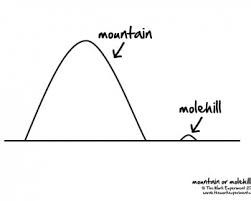
Similarly, there is a rabbinic vignette that offers a similar imagery, using the term evil inclination instead of inner critic. Both are the wily ones who try through various means to lead us from a path of growth and spirituality. In the Talmudic text below, from Tractate Sukkah 52a, we are shown a scene in which the evil inclination for those who have been able to overcome it, “the righteous,” is imagined as a mountain, symbolizing the hard work of quieting the voice of the critic, while for the “wicked”, the same critic is a like a tiny strand of hair, symbolizing that we really are in control of it if we should so choose:

כִּדְדָרֵשׁ רַבִּי יְהוּדָה: לֶעָתִיד לָבֹא, מְבִיאוֹ הַקָּדוֹשׁ בָּרוּךְ הוּא לְיֵצֶר הָרָע, וְשׁוֹחֲטוֹ בִּפְנֵי הַצַּדִּיקִים וּבִפְנֵי הָרְשָׁעִים. צַדִּיקִים נִדְמֶה לָהֶם כְּהַר גָּבוֹהַּ, וּרְשָׁעִים נִדְמֶה לָהֶם כְּחוּט הַשַּׂעֲרָה. הַלָּלוּ בּוֹכִין וְהַלָּלוּ בּוֹכִין. צַדִּיקִים בּוֹכִין וְאוֹמְרִים: הֵיאַךְ יָכוֹלְנוּ לִכְבּוֹשׁ הַר גָּבוֹהַּ כָּזֶה! וּרְשָׁעִים בּוֹכִין וְאוֹמְרִים: הֵיאַךְ לֹא יָכוֹלְנוּ לִכְבּוֹשׁ אֶת חוּט הַשַּׂעֲרָה הַזֶּה! וְאַף הַקָּדוֹשׁ בָּרוּךְ הוּא תָּמֵהַּ עִמָּהֶם, שֶׁנֶּאֱמַר: ״כֹּה אָמַר ה׳ צְבָאוֹת כִּי יִפָּלֵא בְּעֵינֵי שְׁאֵרִית הָעָם הַזֶּה בַּיָּמִים הָהֵם גַּם בְּעֵינַי יִפָּלֵא״.

The Gemara answers: This can be understood as Rabbi Yehuda taught: In the future, at the end of days, God will bring the evil inclination and slaughter it in the presence of the righteous and in the presence of the wicked. For the righteous the evil inclination appears to them as a high mountain, and for the wicked it appears to them as a mere strand of hair. These weep and those weep. The righteous weep and say: How were we able to overcome so high a mountain? And the wicked weep and say: How were we unable to overcome this strand of hair? And even the Holy One, Blessed be He, will wonder with them, as it is stated with regard to the eulogy: “So says the Lord of hosts: If it be wondrous in the eyes of the remnant of this people in those days, it should also be wondrous in My eyes” (Zechariah 8:6).

text and translation from Sefaria

Both stories offer perspective on achieving growth and change throughout life. Too often we take small challenges, the molehills, and turn them into mountains, presuming them to be harder to overcome than they really are. And in a way, they are, because we have to work hard to rise above the naysayers, the excuses, etc. At other times, we give up way to easily because we think it is so hard, and yet, if we are really able to stand above the critic or see the inclination as a mere hair to push aside, we could continue to journey forward.

May we all find the ability to recognize what our inner critic says and find ways to take the criticisms we build in a constructive manner so as to be able to overcome the stagnation of allowing the critic to succeed.

Need help exploring how to overcome the inner critic holding you back on your journey, Contact New Beginnings Spiritual Coaching and Consulting LLC at 732-314-6758 ext. 100 or via email at newbeginningsspiritualcoach@gmail.com.

Fostering Resilience through spiritual wellness

For so many of us, each day can feel like a a grind. We go about our routines, become consumed by work and find that time just flies by as if time is controlling us. How can we combat this?

I came across a short piece called Finding Purpose: Resiliency through Spiritual Wellness by attorneys Mary C. Aretha and Lynn B. Sholander. This short article focuses on how lawyers can foster spiritual wellness and meaning in a very competitive, adversarial profession. I recommend that everyone take a look, lawyer or not as the sentiments expressed are crucial to professionals in many fields.

As part of their advice for cultivating spiritual wellness, the authors speak about the value of prioritizing spiritual disciplines:

Prioritize spiritual disciplines.

If you are a person of faith, set aside time — even a few minutes each day — to engage in activities that bring you closer to the focus of your belief. This may include solitary or corporate prayer, reading or memorizing sacred texts, listening to sermons or talks, observing a regular sabbath, or attending gatherings with other believers in person or online. It could also include less traditional practices such as prayer journaling, going on prayer walks, or listening to faith-based music. Even if you don’t practice a particular religion, consider setting aside some time each day to reflect on what brings you joy

By taking the time to refocus on one’s innate beliefs and core values from one’s culture, faith, religion, spirituality, it can open the door to getting back to the self. During these moments, minutes or longer periods of time, like a Sabbath, we can remove ourselves from “professional” self, which is often our primary defining self, and cultivate the human being that we truly are. Do we take the time to remove our title and come back to the self?

Each day affords us a new beginning, a new opportunity, to use time to help foster our well being so that we can bring our best self into all we do and to who we are. May we be blessed to find the means to rejuvenate our resiliency through out spirituality.

For more information about New Beginnings Spiritual Coaching and Consulting LLC, and how we can support you on the journey through the waves of life, please check out: https://achaplainsnewjourney.wordpress.com/about/