Judging favorably

As I continue to reflect and re-engage with some of my older posts from my previous blogs (here and here), I came across a powerful story and message I originally wrote about in 2010 (see here).

Too often we may observe a situation and think we understand what is going on. Yet, we also know that it is a value to judge someone favorably, a lesson taught in Ethics of our Fathers, Pirkei Avot:

יְהוֹשֻׁעַ בֶּן פְּרַחְיָה וְנִתַּאי הָאַרְבֵּלִי קִבְּלוּ מֵהֶם. יְהוֹשֻׁעַ בֶּן פְּרַחְיָה אוֹמֵר, עֲשֵׂה לְךָ רַב, וּקְנֵה לְךָ חָבֵר, וֶהֱוֵי דָן אֶת כָּל הָאָדָם לְכַף זְכוּת:

Joshua ben Perahiah and Nittai the Arbelite received [the oral tradition] from them. Joshua ben Perahiah used to say: appoint for thyself a teacher, and acquire for thyself a companion and judge all people with the scale weighted in their favor.

Pirkei Avot 1:6

Considering the words above, we can recognize the continuum of values, through establishing a teacher for oneself and maintaining true friendships, we can set ourselves up to see the world in such a way as to recognize that we don’t always understand everything that is happening. Too often, we want to make a go at it alone and through this mode of isolation we are more vulnerable to seeing others only through the lense of one’s own eyes.

To illustrate this, I want to share a story from the book, Jewish Visions for Aging by my colleague Rabbi Dayle A. Friedman, in which she shares an example of the importance of not drawing conclusions without all the facts:

Ira, a ninety-seven year old assisted living resident, has just fallen.  He is taken to the emergency room and receives twelve stitches for a gash in his head.  The resident and attending physician have called his family, but no one has come to be with him.  Knowing that Ira has a daughter-in-law, Ricki, who is usually quite involved, the assisted-living facility staff are surprised.  They comment that perhaps Ricki isn’t as interested in Pop as she once was.

P 72

Before reading the second paragraph, take a moment and reflect on how you feel at this point. Do you find yourself relating to the feelings of the facility staff that Ricki might not be interested in her father-in-law anymore? Or, were you open to seeing that perhaps her absence is likely due to some other circumstance other than not caring as much as others thought?

When Ricki comes in the next day, she explains that she couldn’t come sooner because on the very same day on which Ira was injured, her brother died and her husband was rushed to the hospital with chest pains.  Ricki literally didn’t know what to do first: should she stay at the hospital with her husband during his cardiac catheterization; make funeral arrangements for her brother; or go to be with Pop, who must be very frightened and upset at being taken to the emergency room alone?

P 72

Ricki’s dilemma was complicated. How can we best able to support others if we are quick to presume the worst about the decisions made instead of taking the time to consider the various possibilities for a seeming choice that was made?

May we cultivate the expansive, open heart to see the good in others instead of immediately presuming the worst.

Looking to work towards seeing the best in others. Contact New Beginnings Spiritual Coaching and Consulting LLC at 732-314-6758 ext. 100 or via email at newbeginningsspiritualcoach@gmail.com.
How do you see your inner critic?

The difference between listening to the inner critic vs. seeing the inner critic for what it really is.

I came across an interesting vignette in The Five Invitations: Discovering What Death Can Teach Us about Living Fully that really struck home for me (see here for a previous post from The Five Invitations). In this story, Frank Ostaseski illustrates a principle in his discussion regarding how we are all stymied by what he refers to as our inner critic:

Once, when I was teaching about the inner critic, a woman raised her hand and asked to speak. Her frustration was palpable, her face turning red and her whole body trembling. “I can never defeat the inner critic!” she said. “It always gets the best of me. Why am I so weak?”

I pulled a chair right up next to her and stood on top of it so that I was a good four feet taller than she was. Then I pointed my finger down at her and said in a firm, loud tone, “You are bad!”

She burst into laughter. “Oh yeah, look at that!” she said. “That is what the critic is like when it has the best of me. No wonder I feel weak. I couldn’t fight back against that adult voice when I was a small child. It was too big, too powerful.”

Then I asked the woman to stand up on the chair so that she was a head taller than I was. I guided her to breathe deeply, feel her way into her body, center he awareness, and think about her innate goodness. “Now how would you respond to the inner critic when it tells you that you’re bad, you’re week?” I asked.

“Don’t speak to me that way,” she said, her voice strong and confident. “It hurts me when you talk to me like that. And it doesn’t help me do any better.”

p.144-145

This story is all too familiar. We have an idea, a gut reaction. We then start to hear all the reasons not to do something. Yes, it is important for those voices to be heard, to help us reflect on the decisions we are to make. Yet, if we always heed the inner critic, we will never find new opportunities, new growth, new adventures in life.

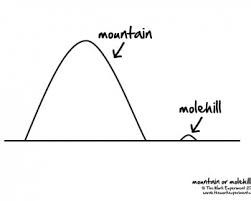
Similarly, there is a rabbinic vignette that offers a similar imagery, using the term evil inclination instead of inner critic. Both are the wily ones who try through various means to lead us from a path of growth and spirituality. In the Talmudic text below, from Tractate Sukkah 52a, we are shown a scene in which the evil inclination for those who have been able to overcome it, “the righteous,” is imagined as a mountain, symbolizing the hard work of quieting the voice of the critic, while for the “wicked”, the same critic is a like a tiny strand of hair, symbolizing that we really are in control of it if we should so choose:

כִּדְדָרֵשׁ רַבִּי יְהוּדָה: לֶעָתִיד לָבֹא, מְבִיאוֹ הַקָּדוֹשׁ בָּרוּךְ הוּא לְיֵצֶר הָרָע, וְשׁוֹחֲטוֹ בִּפְנֵי הַצַּדִּיקִים וּבִפְנֵי הָרְשָׁעִים. צַדִּיקִים נִדְמֶה לָהֶם כְּהַר גָּבוֹהַּ, וּרְשָׁעִים נִדְמֶה לָהֶם כְּחוּט הַשַּׂעֲרָה. הַלָּלוּ בּוֹכִין וְהַלָּלוּ בּוֹכִין. צַדִּיקִים בּוֹכִין וְאוֹמְרִים: הֵיאַךְ יָכוֹלְנוּ לִכְבּוֹשׁ הַר גָּבוֹהַּ כָּזֶה! וּרְשָׁעִים בּוֹכִין וְאוֹמְרִים: הֵיאַךְ לֹא יָכוֹלְנוּ לִכְבּוֹשׁ אֶת חוּט הַשַּׂעֲרָה הַזֶּה! וְאַף הַקָּדוֹשׁ בָּרוּךְ הוּא תָּמֵהַּ עִמָּהֶם, שֶׁנֶּאֱמַר: ״כֹּה אָמַר ה׳ צְבָאוֹת כִּי יִפָּלֵא בְּעֵינֵי שְׁאֵרִית הָעָם הַזֶּה בַּיָּמִים הָהֵם גַּם בְּעֵינַי יִפָּלֵא״.

The Gemara answers: This can be understood as Rabbi Yehuda taught: In the future, at the end of days, God will bring the evil inclination and slaughter it in the presence of the righteous and in the presence of the wicked. For the righteous the evil inclination appears to them as a high mountain, and for the wicked it appears to them as a mere strand of hair. These weep and those weep. The righteous weep and say: How were we able to overcome so high a mountain? And the wicked weep and say: How were we unable to overcome this strand of hair? And even the Holy One, Blessed be He, will wonder with them, as it is stated with regard to the eulogy: “So says the Lord of hosts: If it be wondrous in the eyes of the remnant of this people in those days, it should also be wondrous in My eyes” (Zechariah 8:6).

text and translation from Sefaria

Both stories offer perspective on achieving growth and change throughout life. Too often we take small challenges, the molehills, and turn them into mountains, presuming them to be harder to overcome than they really are. And in a way, they are, because we have to work hard to rise above the naysayers, the excuses, etc. At other times, we give up way to easily because we think it is so hard, and yet, if we are really able to stand above the critic or see the inclination as a mere hair to push aside, we could continue to journey forward.

May we all find the ability to recognize what our inner critic says and find ways to take the criticisms we build in a constructive manner so as to be able to overcome the stagnation of allowing the critic to succeed.

Need help exploring how to overcome the inner critic holding you back on your journey, Contact New Beginnings Spiritual Coaching and Consulting LLC at 732-314-6758 ext. 100 or via email at newbeginningsspiritualcoach@gmail.com.

Telephone Poles and leaning into what could hurt

I am in the midst of reading The Five Invitations: Discovering What Death Can Teach Us about Living Fully by Frank Ostaseski. In describing the second principle, Welcome Everything, Push Away Nothing, he discusses the value of leaning into suffering. I found the following anecdote meaningful and important for us to consider as we venture forth on any journey in life.

During a workshop in the rural Northwest, I was speaking on the possibilities that arise when we stop running away from what is difficult. One of the attendees, a burly middle-age man with broad shoulders and an even wider smile, spoke up. “That reminds me of telephone poles.”

I didn’t have a clue what he was talking about. “Telephone poles? What do you mean?” I asked.

He explained that he once had a job installing telephone poles. “They’re hard and heavy, standing up to forty feet high.” There was a critical moment after you placed a pole in the ground, he said, when a pole was unstable and might topple over. “If it hit you, it could break your back.”

His first day on the job, the man turned to his partner and said, “If this pole starts to fall, I’m running like hell.”

But the old-timer replied, “Nope, you don’t want to do that. If that pole starts to fall, you want to go right up to it. You want to get real close and put your hands on the pole. It’s the only safe place to be.

p. 86

Instinctually, we are programmed to run away from danger, from pain, from suffering. If we think about the telephone pole, it is likely we won’t outrun it and the further away we are, the harder it will hit and hurt. If we sit with the pain, “leaning-in,” experiencing and not running away from the suffering, we are more likely to find the path to absorb and move through the pain.

This message is also important for any new adventure. As we journey into the unknown, we often try to run back to our comfort zones when confronted with difficulties along the way. If we continue to push forward and not run backwards, pushing “the telephone pole up,” we will come out ahead instead of finding ourselves further away from our goals and hopes.

May we find the fortitude to remain with the suffering and carry forward what we experience and learn from those moments in life we find ourselves challenged with the difficulties of life.

If you are someone you know is going through painful, challenging times, Contact New Beginnings Spiritual Coaching and Consulting LLC at 732-314-6758 ext. 100 or via email at newbeginningsspiritualcoach@gmail.com.

The Smallest of Openings

The following reflection is from Rabbi Dr. Abraham J. Twerski’s, Living Each Day

Open for me the tiniest portal of teshuvah (repentance), even like the eye of a needle, and I shall expand it like the doors of a great palace (Shir HaShirim Rabbah)

All we are asked to do is to make a beginning in teshuvah, and Gd will then assist us in broadening it.

“But,” said the Rabbi of Kotzk in explanation of this Midrash, “it must be a thorough beginning. It may be the tiniest in magnitude, like the eye of a needle, but it must penetrate the personality through and through.

A disciple of the Rabbi of Karlin complained to him that whereas his colleagues were all making progress in their spiritual growth, he seemed to be getting nowhere.

“Alas,” said the Rabbi. “I have not yet found the key to your heart.”

“A key?” cried the disciple in anguish. “Who needs a key? Open my heart with an axe!”

“No need,” said the Rabbi. “It has just been opened.”

All that is needed is a single moment of spiritual awakening, but it must be sincere, permeating every fiber of one’s being.

P. 178

Open the door! Open your heart!

A single step is all it takes to begin on a new path. Sometimes it takes a simple movement and sometimes it takes a jolt, but with one step forward, we can begin anew.

Take the first step! Open the door to a new path and begin a process of change. Contact New Beginnings Spiritual Coaching and Consulting LLC at 732-314-6758 ext. 100 or via email at newbeginningsspiritualcoach@gmail.com

There is always another chance

One of the ideas behind New Beginnings Spiritual Coaching and Consulting LLC is to help foster the principle that each of us always has the opportunity to start anew. I have discovered in myself that losing sight of this hope can be quite detrimental in all aspects of life. Unfortunately, because starting new can seem like a daunting task, we tend to shy away from taking the risk that comes from the first step on a different path. Fortunately, we can recognize that every action is an opportunity that allows us to start new, to begin again. We need not do the same action the same way. I came across the following story in my daily reading that I think illustrates the power of desire and hope to rise above the circumstances of the moment and hope for a new opportunity even when things seems almost impossible:

Shortly before Rav Elyashiv was hospitalized with his final illness, Rabbi Rudinsky was visiting Jerusalem and offered the honor of sitting next to Rav Elyashiv during davening (prayer). Because of his advanced age (he was approx. 103) and medical condition, Rav Elyashiv had difficulty standing, and he sat throughout the davening. Rabbi Rudinsky noticed however, that at each Kaddish and during the chazzan’s (prayer leader) repetition, Rav Elyashiv would strain himself to lean forward ever so slightly in his chair.

After davening, Rabbi Rudinsky garnered the courage and “holy chutzpah” to ask the gadol (great rabbi) the reason for his exertion; surely the centenarian was exempt from rising? Rav Elyashiv explained, “Throughout my entire life, I always stood up for the recitation of Kaddish and chazarat hashatz (repetition of the Amidah). Now that I no longer have the strength to do so, I’m considered an oneis (someone who has no control over a situation), and I am patur, exempt, from standing. But a Jew is never patur from wanting; we are never exempt from our obligation to try.”

“Every time another Kaddish arrives, there is another chance for me to try…Maybe the Ribbono Shel Olam (Master of the Universe – Gd) will me strength to stand this time?”

BaDerech, by Rabbi Judah Mischel, p. 484

The lesson of this story reminds me of the famous quote, “its better to try and fail than never to try at all.” Too often we choose not to try a different road because we are afraid to fail. Our mission is to not allow this fear to be our driver. Rather, if we just try to shift a little, maybe just maybe, the shift will open up for us a different road. Its a matter in doing our part and having faith in the potential of change to occur.

For more information and to schedule a session to help foster the courage to take a new first step, contact New Beginnings Spiritual Coaching and Consulting LLC at 732-314-6758 ext. 100 or email newbeginningsspiritualcoach@gmail.com.

Placing my actions upon my heart

We all have our task lists.

These are the items we put down to check off during the day. Many of the tasks we set for ourselves are seemingly mundane. And so, we do them and then place them to the side. In the following story, I was struck by the pain of feeling like one is going through the motions of the day:

As a bachur, a young yeshiva student, Reb Mendel Futerfas learned in Tomchei Temimim, the famed Lubavitcher yeshiva. One day, he encountered Reb Chaim, one of the respected elders of the community. Seeing Reb Chaim looking uncharacteristically despondent, Mendel inquired of his well-being and asked what was wrong.

Reb Chaim stared at the young man and answered with intensity: “I am getting on in years. It won’t be long before I go before the Beis Din Shel Maalah (the heavenly court) and have to give an accounting of my every moment.” Mendel was taken aback and confused. Reb Chaim was a role model whose every move was suffused with yiras Shamayim (awe of heaven). He was well-known as an oved (someone who serves Gd) and a saintly person.

Reb Chaim saw the confusion on Mendel’s face, and said, “Let me explain. Each morning, I wake up fresh to serve Hashem and say Modeh Ani. When I’m finished, I take the Modeh Ani and put it in a large sack that I carry around with me. Then I wash negel vasser (ritual washing upon awakening) and I put that in the sack as well. I go to the mikveh (ritual bath), and then put that into the sack. After we learn Chassidus for an hour and put that in my sack. I put on tallis and tefillin and…”

Mendel, who was starting to catch on, chimed in light heartedly, “Oh so the davening goes into your sack too!” Reb Chaim was not amused. He stopped for a moment, looking down at the ground, and then continued in a heavy tone.

“I proceed with my day. I wash my hands for pas shacharis (meal with bread for breakfast), as prescribed by halachah, make Hamotzi, and eat a kzayis (olive size by volume) of bread, after which I bentch (blessing after the meal). All of that goes into the sack I carry. I come to the yeshiva and learn with bachurim (students) all morning and spend the afternoon lunch break learning with students and strengthening them in avodas hashem (worship of Gd). All that goes in the sack.”

“After Minchah and more learning and teaching, I tend to the needs of my home, and put all of that into my sack too. Following Maariv and more Torah, which I put into my sack, I prepare for bed with krias shema al hamitah (recitation of shema at bedtime). Every action and effort in kedushah (holiness) throughout the day goes into the sack, which by the end of the day is almost overflowing. I schlep it to my room and place it next to my bed as I go to sleep each night.”

“I fill one of these sacks every day, 365 days a year. And I have been doing this for more than seventy years. According to my calculations, since my Bar mitzvah, I have amassed 27,260 sacks, and filled each one to the brim.”

Mendel listened intently, and with every sentence he became more confused than before. Reb Chaim had described a life completely dedicated to Yiddishkeit!

“Young man, listen carefully,” Reb Chaim said, “I will tell you the reason for my concern.” He leaned in and delivered a punchline Mendel never forgot:

“Why did I have to put all my Torah learning, davening, mitzvos and maasim tovim (good deeds), all that I’ve done, all that I have, into a sack? Why didn’t I put it into my heart?

BaDerech, by Rabbi Judah Mischel p 465-467

Why don’t I put them into my heart? How many of us look at our lives and wish this was the question we were asking? To grow, we must not just complete tasks, but must give room for the those tasks to be impactful on who we are.

For more information and to schedule a session to work on making your checklists work for you, contact New Beginnings Spiritual Coaching and Consulting LLC at 732-314-6758 ext. 100 or email newbeginningsspiritualcoach@gmail.com.

How to stave off forgetfulness

For starters, this is not one of those quick fixes for how to remember more. I believe that much of our “forgetfulness” stems from being overwhelmed by the difficulties of life, or from the increased stressors of life. Perhaps there is a way to alleviate forgetfulness by being more attuned to ourselves and true growth and change. To illustrate, I want to share a short piece I read yesterday from Smiling Each Day by Rabbi Dr. Abraham Twerski (Rabbi Dr. Twerski published a few of these daily readers, three of which I am reading this year and as you have seen, sharing a few pieces with you):

A chassid complained to Rabbi Elimelech of Lizhensk he was suffering from forgetfulness. Rabbi Elimelech said, “Do teshuvah (repent, return from your ways – my translations) and your memory will improve.”

The chassid was bewildered. “What is the relationship of teshuvah to memory?” he asked.

“It is very simple,” Rabbi Elimelech responded. “The Talmud states that teshuvah is so great that it reaches the very throne of the Almighty (Yoma 86b). We also say in the prayer of Rosh Hashanah that ‘there is no forgetfulness before the throne of the Almighty.’ All you must do is put the two together. If you do teshuvah, you will reach the throne of the Almighty. In that status, you will have no forgetfulness.”

Rabbi Elimelech’s wit is more than supported psychologically. If we can free ourselves of the burden of our mistakes by proper teshuvah, the acuity of our minds is certain to improve.

p. 119

When we consider what “proper teshuvah” means, we realize it is about introspection and taking stock of who we are and how we got to this point. It is not merely the confession of doing wrong and pledging to do better next time. It is a whole process with the goal of real change. It is through this introspection that we should be able to overcome those challenges and stressors we inevitably carry in life. I know from my own experience, the times of calmness, the times after having unburdened myself of the heavy burdens I might find myself carrying help in my ability to remember and recall. I attribute this to a lessening of stress.

As we begin this new year of 2022, may we find a path to true and deep introspection so as find an inner calm and renewed ability to focus and through this focus find new opportunities to grow and become the person we hope to be.

Transitions can be hard to navigate alone. If you are someone in the process of creating your own new beginning, New Beginnings Spiritual Coaching and Consulting LLC is here to help. For more information, please check out: https://achaplainsnewjourney.wordpress.com/about/

Put Your Heart in It

How many of us struggle to find the inner meaning and spirit in ritual practice, whether it is something we do daily or something we do once a year. I recently read a story that illustrates the need for the heart to be a fundamental component in our actions. The story is taken from Rabbi Dr. Abraham Twerski’s (o.b.m.) daily reader Smiling Each Day (p. 20):

One Succos the Baal Shem Tove was sitting with his disciples and appeared to go into a trance. After a few moments of profound concentration, he emerged from his exalted state with a bright smile adorning his already holy countenance.

“In the celestial spheres” he announced, “there had been a great expression of joy, and I was curious as to what had brought this about.”

“It seems that a simple Jew had been traveling by foot, and in order to reach home for Succos, he took a shortcut through the forest. Unfortunately he became lost in the thicket, and soon realized, to his great dismay, that not only would he not be home with his family for the holiday, but, even more distressing to him, he would not fulfill the mitzvah of Succah! This last circumstance he simply could not bear, and as the sun began to set, he was suddenly inspired to rip off the top of his hat and cover it with branches and leaves. Being a person of little learning, he thought this would constitute a succah, and so, danced with joy that he had thought of a way to fulfill this precious mitzvah.”

The holy master concluded, “Although he of course did not fulfill the mitzvah, his intent was so pure and sincere that it caused great joy among the Heavenly host.”

From this story, Rabbi Dr. Twerski suggests that while it is important to fulfill the rituals properly, it is equally important to find the inner heart within the fulfillment. Taking this a step further, the ideal focus of our actions should include a sense that each time we perform an act, a ritual, we are doing something new, even if it is a daily practice. We always have a new opportunity to infuse our actions with heart.

As we approach the end of the fall Jewish holiday season, may the joy and meaning was have felt during this time carry us into the remainder of the year, helping us find new beginnings each and every day. May our daily routines be infused with a renewed love and joy for what we have the opportunity to do.