Many Faiths, One Truth

Years ago, I recall a hospice visit with a Presbyterian family in which we spent time during the visit holding hands and praying together, each of us from our different backgrounds, creating a holy and sacred space of care and support. The memories of this moment serve as a regular reminder of the grandeur and beauty we can create through our coming together to care for each other.

Spiritual Care, Interfaith Chaplaincy, Spiritual Life Coaching all work within a framework of working with others through the eyes of our collective human experiences of meaning making, hope and faith. The chaplain, spiritual care provider, coach enters the space recognizing the invisible boundaries that at first seem to exist in relation to the backgrounds of both parties in the sacred space. Each encounter is an intricate dance of balancing the universalistic goal of supporting and helping others with the particularisms that might arise in the space resulting from each one’s background. I offer this brief reflection because of an old post I shared here which I decided to revisit.

In May, 2010, the Dalai Lama had the following op-ed published in the NY Times (copied from here):

Many Faiths, One Truth

By TENZIN GYATSO

Published: May 24, 2010

WHEN I was a boy in Tibet, I felt that my own Buddhist religion must be the best — and that other faiths were somehow inferior. Now I see how naïve I was, and how dangerous the extremes of religious intolerance can be today.

Though intolerance may be as old as religion itself, we still see vigorous signs of its virulence. In Europe, there are intense debates about newcomers wearing veils or wanting to erect minarets and episodes of violence against Muslim immigrants. Radical atheists issue blanket condemnations of those who hold to religious beliefs. In the Middle East, the flames of war are fanned by hatred of those who adhere to a different faith.

Such tensions are likely to increase as the world becomes more interconnected and cultures, peoples and religions become ever more entwined. The pressure this creates tests more than our tolerance — it demands that we promote peaceful coexistence and understanding across boundaries.

Granted, every religion has a sense of exclusivity as part of its core identity. Even so, I believe there is genuine potential for mutual understanding. While preserving faith toward one’s own tradition, one can respect, admire and appreciate other traditions.

An early eye-opener for me was my meeting with the Trappist monk Thomas Merton in India shortly before his untimely death in 1968. Merton told me he could be perfectly faithful to Christianity, yet learn in depth from other religions like Buddhism. The same is true for me as an ardent Buddhist learning from the world’s other great religions.

A main point in my discussion with Merton was how central compassion was to the message of both Christianity and Buddhism. In my readings of the New Testament, I find myself inspired by Jesus’ acts of compassion. His miracle of the loaves and fishes, his healing and his teaching are all motivated by the desire to relieve suffering.

I’m a firm believer in the power of personal contact to bridge differences, so I’ve long been drawn to dialogues with people of other religious outlooks. The focus on compassion that Merton and I observed in our two religions strikes me as a strong unifying thread among all the major faiths. And these days we need to highlight what unifies us.

Take Judaism, for instance. I first visited a synagogue in Cochin, India, in 1965, and have met with many rabbis over the years. I remember vividly the rabbi in the Netherlands who told me about the Holocaust with such intensity that we were both in tears. And I’ve learned how the Talmud and the Bible repeat the theme of compassion, as in the passage in Leviticus that admonishes, “Love your neighbor as yourself.”

In my many encounters with Hindu scholars in India, I’ve come to see the centrality of selfless compassion in Hinduism too — as expressed, for instance, in the Bhagavad Gita, which praises those who “delight in the welfare of all beings.” I’m moved by the ways this value has been expressed in the life of great beings like Mahatma Gandhi, or the lesser-known Baba Amte, who founded a leper colony not far from a Tibetan settlement in Maharashtra State in India. There he fed and sheltered lepers who were otherwise shunned. When I received my Nobel Peace Prize, I made a donation to his colony.

Compassion is equally important in Islam — and recognizing that has become crucial in the years since Sept. 11, especially in answering those who paint Islam as a militant faith. On the first anniversary of 9/11, I spoke at the National Cathedral in Washington, pleading that we not blindly follow the lead of some in the news media and let the violent acts of a few individuals define an entire religion.

Let me tell you about the Islam I know. Tibet has had an Islamic community for around 400 years, although my richest contacts with Islam have been in India, which has the world’s second-largest Muslim population. An imam in Ladakh once told me that a true Muslim should love and respect all of Allah’s creatures. And in my understanding, Islam enshrines compassion as a core spiritual principle, reflected in the very name of God, the “Compassionate and Merciful,” that appears at the beginning of virtually each chapter of the Koran.

Finding common ground among faiths can help us bridge needless divides at a time when unified action is more crucial than ever. As a species, we must embrace the oneness of humanity as we face global issues like pandemics, economic crises and ecological disaster. At that scale, our response must be as one.

Harmony among the major faiths has become an essential ingredient of peaceful coexistence in our world. From this perspective, mutual understanding among these traditions is not merely the business of religious believers — it matters for the welfare of humanity as a whole.

In my original reflection on this piece, I found myself questioning what I perceived his primary argument to be, that through the commonality of compassion we should find the ability to rise above our particularistic beliefs to find a single unified humanity. I struggled at the time because I believed that it is from the particular backgrounds we came from that can best serve us in working together. In the original post, I wrote “While he is correct about said premise, compassion doesn’t necessarily translate into the reality of all religions being of a single truth. I think we sometimes lose track of our differences and hence this causes more conflict than would be had if we come to the table stating our stances on all topics.” Part of my claim was that so often we enter common space and apologize for who we are because we are afraid of the confrontation. Yet, if we take a deeper look at relationships, it is in the confrontation that I believe we can find compassion, care and real growth.

If we treat a space of with the compassion of respect, through listening, reflecting, sharing and being comfortable in the uncomfortable, we can foster our collective humanity. Often, we think the solution is to remove aspects of what we are bringing to the common space because of fear. Yet, by entering the space with people from other backgrounds, faiths, practices, etc. each of us has already taken the first step to building the bridge.


Judging favorably

As I continue to reflect and re-engage with some of my older posts from my previous blogs (here and here), I came across a powerful story and message I originally wrote about in 2010 (see here).

Too often we may observe a situation and think we understand what is going on. Yet, we also know that it is a value to judge someone favorably, a lesson taught in Ethics of our Fathers, Pirkei Avot:

יְהוֹשֻׁעַ בֶּן פְּרַחְיָה וְנִתַּאי הָאַרְבֵּלִי קִבְּלוּ מֵהֶם. יְהוֹשֻׁעַ בֶּן פְּרַחְיָה אוֹמֵר, עֲשֵׂה לְךָ רַב, וּקְנֵה לְךָ חָבֵר, וֶהֱוֵי דָן אֶת כָּל הָאָדָם לְכַף זְכוּת:

Joshua ben Perahiah and Nittai the Arbelite received [the oral tradition] from them. Joshua ben Perahiah used to say: appoint for thyself a teacher, and acquire for thyself a companion and judge all people with the scale weighted in their favor.

Pirkei Avot 1:6

Considering the words above, we can recognize the continuum of values, through establishing a teacher for oneself and maintaining true friendships, we can set ourselves up to see the world in such a way as to recognize that we don’t always understand everything that is happening. Too often, we want to make a go at it alone and through this mode of isolation we are more vulnerable to seeing others only through the lense of one’s own eyes.

To illustrate this, I want to share a story from the book, Jewish Visions for Aging by my colleague Rabbi Dayle A. Friedman, in which she shares an example of the importance of not drawing conclusions without all the facts:

Ira, a ninety-seven year old assisted living resident, has just fallen.  He is taken to the emergency room and receives twelve stitches for a gash in his head.  The resident and attending physician have called his family, but no one has come to be with him.  Knowing that Ira has a daughter-in-law, Ricki, who is usually quite involved, the assisted-living facility staff are surprised.  They comment that perhaps Ricki isn’t as interested in Pop as she once was.

P 72

Before reading the second paragraph, take a moment and reflect on how you feel at this point. Do you find yourself relating to the feelings of the facility staff that Ricki might not be interested in her father-in-law anymore? Or, were you open to seeing that perhaps her absence is likely due to some other circumstance other than not caring as much as others thought?

When Ricki comes in the next day, she explains that she couldn’t come sooner because on the very same day on which Ira was injured, her brother died and her husband was rushed to the hospital with chest pains.  Ricki literally didn’t know what to do first: should she stay at the hospital with her husband during his cardiac catheterization; make funeral arrangements for her brother; or go to be with Pop, who must be very frightened and upset at being taken to the emergency room alone?

P 72

Ricki’s dilemma was complicated. How can we best able to support others if we are quick to presume the worst about the decisions made instead of taking the time to consider the various possibilities for a seeming choice that was made?

May we cultivate the expansive, open heart to see the good in others instead of immediately presuming the worst.

Looking to work towards seeing the best in others. Contact New Beginnings Spiritual Coaching and Consulting LLC at 732-314-6758 ext. 100 or via email at newbeginningsspiritualcoach@gmail.com.

Seeing Total Pain

The following quote caught my eye from the introduction of Chaplaincy and Spiritual Care In the Twenty-First Century: An Introduction:

When Amy Greene, director of spiritual care at the Cleveland Clinic, was asked what she thinks people need from chaplains, she responded, “People want someone to see their total pain.”

P. 3

This quote reminds me of the following Talmudic passage:

אָמַר רַבִּי אַחָא בַּר חֲנִינָא כל הַמְבַקֵּר חוֹלֶה נוֹטֵל אֶחָד מִשִּׁשִּׁים בְּצַעֲרוֹ אָמְרִי לֵיהּ אִם כֵּן לִיעַלּוּן שִׁיתִּין וְלוֹקְמוּהּ אֲמַר לֵיהּ כְּעִישּׂוּרְיָיתָא דְּבֵי רַבִּי וּבְבֶן גִּילוֹ
Rav Aḥa bar Ḥanina said: Anyone who visits an ill person takes from him one-sixtieth of his suffering. The Sages said to him: If so, let sixty people enter to visit him, and stand him up, and restore him to health. Rav Aḥa bar Ḥanina said to them: It is like the tenths of the school of Rabbi Yehuda HaNasi, who said that each of one’s daughters inherits one-tenth of his possessions. His intent was that each daughter would receive one-tenth of the remainder after the previous daughter took her portion. Here too, each visitor takes from the ill person one-sixtieth of the suffering that remains, and consequently a degree of suffering will always remain with the ill person. Furthermore, visiting is effective in easing the suffering of the ill person only when the visitor is one born under the same constellation as the ill person.

The chaplain is tasked with seeing the whole person, mind, body and soul. The chaplain visit is focused on visiting the person, not just the illness. It is through this seeing, being present to the whole person, that has a fundamentally positive effect. By positive, I mean to say that the time together is one that intrinsically changes the despair and loneliness most often felt when experiencing “total pain.”

Looking for someone to be present to your “total pain.” Contact New Beginnings Spiritual Coaching and Consulting LLC at 732-314-6758 ext. 100 or via email at newbeginningsspiritualcoach@gmail.com.

The antagonist strikes

Recently, I shared an idea about hearing our inner critic (see here). Along the same lines, I have been reading a book, called The Wisdom of Getting Unstuck: How to emerge from and avoid the muddy middle by Rabbi Shimshon Meir Frankel, in which he describes how we get bogged down in the voice of what he refers to as the Antagonist (we can see it as a modern reference to the Yetzer Hara, the evil inclination, which is the part of ourselves that tries to take us off the path of spiritual growth). For Rabbi Frankel, this antagonist is what keeps us from achieving the best person we can become.

In chapter 23, Peace Treaty, Rabbi Frankel writes about the importance of making peace with this antagonist, and even listening to it as a guidepost. While we don’t want to allow the antagonist to control us, it can often voice something that we need to acknowledge and hear as we venture along the path to success so as to enter the this road with due diligence. This technique is complicated and requires the fortitude of having worked on removing any controls from this antagonist.

We struggle daily with this antagonistic, doubting voice. It can be frustrating to get caught in the debate inside ourselves that gets raised by this opposing voice. Yet, there is a time and place for the voice to at least pipe up in the process of change and growth. It is there to make sure that we are truly meeting our goals. Through making peace with the Antagonist we can learn how to allow this otherwise negative voice to exist without engaging it, disarming its pervasive ability to overwhelm and then control the narrative we are trying to construct.

We are here to walk along the path of spiritual, soulful growth with you. Contact New Beginnings Spiritual Coaching and Consulting LLC at 732-314-6758 ext. 100 or via email at newbeginningsspiritualcoach@gmail.com.

Putting The Soul into Learning: Talmud Torah as a Spiritual Experience

Black Fire on White Fire – the multiple levels of Torah.

Every so often, I come back to the following story (see here for the original posting). I find much comfort in the layers that I have gleaned from it. Here is one version as I recently wrote up for Congregation Ahavas Achim’s Shavuot Journal.

Hasidic stories have many layers of interpretation and points for reflection. From the simple niceties of storytelling to deep esoteric concepts, many of these stories require time and focus to explore the breadth and depth of the lessons we can glean.  One of my favorite stories describes the origins of how R. Dov Ber of Mezeritch (Maggid of Mezeritch) became a follower of the Baal Shem Tov (see Sefer Baal Shem Tov, vol. 1 pg. 7-8 or Keter Shem Tov Helek 2 23a).

(Freely translated/adapted): I heard from a Hasid, at some point R. Dov Ber began hearing about the greatness of the holy Rabbi, Baal Shem Tov, and how people would travel from far and wide to witness and receives his prayers.  R. Dov Ber was known as one who had a sharp mind and was an expert in Shas and Poskim.  Additionally, he had his hands in the wisdom of the Kabbalah.  He was curious as to what made the Baal Shem Tov so great. 

He finally decided to travel to the Baal Shem Tov in order to test him.  As he was travelling, he began having regrets, for R. Dov Ber was a matmid, (someone always immersed in study) and he was unable to maintain his learning while travelling, thus distressing him.  He finally resolved to continue, knowing that he would hear Torah when he arrived to see the Baal Shem Tov.  Alas, this was not to be. Instead, the Baal Shem Tov shared a story about a how he was travelling for days and ran out of food to provide for his wagon driver.  He then happened upon a poor non-Jew from whom he purchased bread to provide for his wagon driver.  The Baal Shem Tov also described how he ran out of food for his horses on a journey. While the stories contained tremendous wisdom, R. Dov Ber did not see the wisdom or depth of the Baal Shem Tov’s words. 

R. Dov Ber went to his assistant and told him to ready the wagons for his return trip the next morning, as it was too dark to travel on this particular night. At midnight, with everything prepped to go, R. Dov Ber was summoned to meet with the Baal Shem Tov. 

The Baal Shem Tov asked him, “Do you know how to learn?” 

He responded, “Yes.”

The Baal Shem Tov then continued saying, “I have heard that you know how to learn.  Tell me, do you have knowledge of the wisdom of the Kabbalah?”

He responded, “Yes.”

The Baal Shem Tov then asked his attendant to bring him a copy of the Etz Chaim (Kabbalat HaAri) and showed R. Dov Ber an essay, which the Baal Shem Tov asked him to explain.  R. Dov Ber took the text, reviewed it and returned to the Baal Shem Tov and explained the text to him.

The Baal Shem Tov said, “You don’t know anything.”  So R. Dov Ber went back, looked it over again and told the Baal Shem Tov, “The correct interpretation is like I already stated, so if you think you know a better explanation, please tell it to me for I will hear truth from whomever shares truth.”

The Baal Shem Tov responded, “Stand up, for this passage contains names of angels.”

As soon as he said this, the text illuminated the entire house and a fire surrounded them.  They sensed the presence of the angels mentioned in the text. 

The Baal Shem Tov then said to R. Dov Ber, “In truth, the interpretation is as you said, however your learning lacks soul (ed. Note – emphasis mine).”

At this moment, R. Dov Ber told his servant to return home and he would be staying with the Baal Shem Tov to learn from his great wisdom. 

Many of us struggle with the greater goals of Torah study. Throughout Jewish tradition, we have many philosophies and motives for study, including:

  1. Studying the works of our tradition is an act that is to be done lishma, for its own sake.
  2. Studying the Torah is a process that helps maintain the world, as we learn in Pirkei Avot 1:2, that one of the world’s pillars is the Torah. 
  3. Studying the Torah is for the sake of action, Lilmod al Minat L’Maaseh, study in order to do. 

Yet, even with these goals and ideas, I would presume that we all struggle at times to see the soulful depth of what we are learning. We struggle to keep these ideals in mind. 

If we reflect on the above story, perhaps we can garner a new appreciation for the centrality of Torah in our lives, something we reinvest in over Shavuot. R. Dov Ber did not recognize the Torah of storytelling, of the seemingly mundane. For him, Torah was merely the fixed “text” of Talmud, halacha, kabbalah. Anything outside of that was seen as mundane, unimportant. He couldn’t grasp the value in the experiential aspects of Torah study.  That is, until the Baal Shem Tov opened his eyes to the deeper Torah that comes from experiencing it, integrating it beyond the words on paper. The Baal Shem Tov showed R. Dov Ber the soul of learning.

Today, we are blessed to be able to learn anytime, anywhere, almost anything we want.  This is a blessing and a challenge. Many partake in daily set study, whether Daf Yomi, Mishna Yomi, Nach Yomi, or some other Yomi. Others have set learning based on certain desired quotas and measures that one takes upon oneself.  We can connect to great scholars around the world.  We are fortunate to be able to have access to both the texts and teachers who can help guide us through.  Yet, how many times do we despair because the study moves too fast, or because we don’t recall the material from one day to the next. 

We shouldn’t give up. As we can see from the story of R. Dov Ber, it isn’t just the ability to read a text that speaks to our growth in Torah study.  It is about how we are engaged in the study.  R. Dov Ber stayed with the Baal Shem Tov to learn what being engaged in the text meant.  For us, it is how we approach our learning. If we are consistent, if we are mindful and engaged with mind, body and soul, then we will find true success.  Not just in what we know, but in how Torah guides us in our lives. 

This is the message of Shavuot as we celebrate it today.  Shavuot, as Zman Matan Torateinu, the time of receiving our Torah, is a time to reinvest in our learning.  Many do this through staying up and learning/being engaged in learning on the first night. Others through the communal focus on study activities throughout Shavuot.  In all of these moments, we are tasked with both the study and also the experience of study so as to inspire us to strive towards deeper and more meaningful study.  May each of us experience a soulful learning this Shavuot.  

We are here to walk along the path of spiritual, soulful growth with you. Contact New Beginnings Spiritual Coaching and Consulting LLC at 732-314-6758 ext. 100 or via email at newbeginningsspiritualcoach@gmail.com.

The Journey Never Stops

On life’s journey, there are many times we reach an exit, taking us off one road and beginning us on another part of our life’s superhighway. Sometimes, we feel like we have arrived and have no need to go further. While it is important to pause at these junctures, reflect and take stock, these moments cannot be an ending.

Rabbi Dr. Abraham Twerski (o.b.m.) presented a spiritual reflection on those moments of “arrival” in yesterday’s piece from his work Smiling Each Day:

“You shall seek G-d and you shall follow Him but you must search for Him wholeheartedly” (Deuteronomy 4:29). Even after you have found G-d, you must continue to search for Him wholeheartedly. G-d is infinite, and you should not be so complacent as to think that you have already found Him. Keep searching, because there is so much more (Rabbi of Kotzk)

p. 240

May today and every day be a day in which you continue to search and step forward.

We are here to walk along the path of growth with you. Contact New Beginnings Spiritual Coaching and Consulting LLC at 732-314-6758 ext. 100 or via email at newbeginningsspiritualcoach@gmail.com.

How do you see your inner critic?

The difference between listening to the inner critic vs. seeing the inner critic for what it really is.

I came across an interesting vignette in The Five Invitations: Discovering What Death Can Teach Us about Living Fully that really struck home for me (see here for a previous post from The Five Invitations). In this story, Frank Ostaseski illustrates a principle in his discussion regarding how we are all stymied by what he refers to as our inner critic:

Once, when I was teaching about the inner critic, a woman raised her hand and asked to speak. Her frustration was palpable, her face turning red and her whole body trembling. “I can never defeat the inner critic!” she said. “It always gets the best of me. Why am I so weak?”

I pulled a chair right up next to her and stood on top of it so that I was a good four feet taller than she was. Then I pointed my finger down at her and said in a firm, loud tone, “You are bad!”

She burst into laughter. “Oh yeah, look at that!” she said. “That is what the critic is like when it has the best of me. No wonder I feel weak. I couldn’t fight back against that adult voice when I was a small child. It was too big, too powerful.”

Then I asked the woman to stand up on the chair so that she was a head taller than I was. I guided her to breathe deeply, feel her way into her body, center he awareness, and think about her innate goodness. “Now how would you respond to the inner critic when it tells you that you’re bad, you’re week?” I asked.

“Don’t speak to me that way,” she said, her voice strong and confident. “It hurts me when you talk to me like that. And it doesn’t help me do any better.”

p.144-145

This story is all too familiar. We have an idea, a gut reaction. We then start to hear all the reasons not to do something. Yes, it is important for those voices to be heard, to help us reflect on the decisions we are to make. Yet, if we always heed the inner critic, we will never find new opportunities, new growth, new adventures in life.

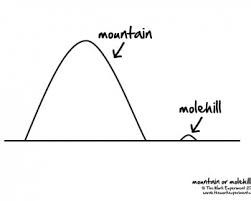
Similarly, there is a rabbinic vignette that offers a similar imagery, using the term evil inclination instead of inner critic. Both are the wily ones who try through various means to lead us from a path of growth and spirituality. In the Talmudic text below, from Tractate Sukkah 52a, we are shown a scene in which the evil inclination for those who have been able to overcome it, “the righteous,” is imagined as a mountain, symbolizing the hard work of quieting the voice of the critic, while for the “wicked”, the same critic is a like a tiny strand of hair, symbolizing that we really are in control of it if we should so choose:

כִּדְדָרֵשׁ רַבִּי יְהוּדָה: לֶעָתִיד לָבֹא, מְבִיאוֹ הַקָּדוֹשׁ בָּרוּךְ הוּא לְיֵצֶר הָרָע, וְשׁוֹחֲטוֹ בִּפְנֵי הַצַּדִּיקִים וּבִפְנֵי הָרְשָׁעִים. צַדִּיקִים נִדְמֶה לָהֶם כְּהַר גָּבוֹהַּ, וּרְשָׁעִים נִדְמֶה לָהֶם כְּחוּט הַשַּׂעֲרָה. הַלָּלוּ בּוֹכִין וְהַלָּלוּ בּוֹכִין. צַדִּיקִים בּוֹכִין וְאוֹמְרִים: הֵיאַךְ יָכוֹלְנוּ לִכְבּוֹשׁ הַר גָּבוֹהַּ כָּזֶה! וּרְשָׁעִים בּוֹכִין וְאוֹמְרִים: הֵיאַךְ לֹא יָכוֹלְנוּ לִכְבּוֹשׁ אֶת חוּט הַשַּׂעֲרָה הַזֶּה! וְאַף הַקָּדוֹשׁ בָּרוּךְ הוּא תָּמֵהַּ עִמָּהֶם, שֶׁנֶּאֱמַר: ״כֹּה אָמַר ה׳ צְבָאוֹת כִּי יִפָּלֵא בְּעֵינֵי שְׁאֵרִית הָעָם הַזֶּה בַּיָּמִים הָהֵם גַּם בְּעֵינַי יִפָּלֵא״.

The Gemara answers: This can be understood as Rabbi Yehuda taught: In the future, at the end of days, God will bring the evil inclination and slaughter it in the presence of the righteous and in the presence of the wicked. For the righteous the evil inclination appears to them as a high mountain, and for the wicked it appears to them as a mere strand of hair. These weep and those weep. The righteous weep and say: How were we able to overcome so high a mountain? And the wicked weep and say: How were we unable to overcome this strand of hair? And even the Holy One, Blessed be He, will wonder with them, as it is stated with regard to the eulogy: “So says the Lord of hosts: If it be wondrous in the eyes of the remnant of this people in those days, it should also be wondrous in My eyes” (Zechariah 8:6).

text and translation from Sefaria

Both stories offer perspective on achieving growth and change throughout life. Too often we take small challenges, the molehills, and turn them into mountains, presuming them to be harder to overcome than they really are. And in a way, they are, because we have to work hard to rise above the naysayers, the excuses, etc. At other times, we give up way to easily because we think it is so hard, and yet, if we are really able to stand above the critic or see the inclination as a mere hair to push aside, we could continue to journey forward.

May we all find the ability to recognize what our inner critic says and find ways to take the criticisms we build in a constructive manner so as to be able to overcome the stagnation of allowing the critic to succeed.

Need help exploring how to overcome the inner critic holding you back on your journey, Contact New Beginnings Spiritual Coaching and Consulting LLC at 732-314-6758 ext. 100 or via email at newbeginningsspiritualcoach@gmail.com.

Chaplains bring God to People

This is the title page from my friend and colleague and current NAJC President Rabbi Dr. Joseph S. Ozarowski BCC’s important work on Jewish Pastoral Care. The following quote and essay immediately had me thinking about his book.

Monday afternoon, during the joint NJHSA-NAJC conference, PowerNet2022, someone made the following comment:

Rabbis bring people to God.

Chaplains bring God to people.

I shared this quote via social media (h/t from friend and colleague Rabbi Daniel Braune-Friedman BCC who first posted this on Facebook) and find myself reflecting on this powerful statement. I am particularly focused on the second half of this quote as it pertains to the role of chaplain.

For me, when I hear “bring God to people,” it is the image of how the chaplain entering a room is being accompanied by something beyond the self, regardless of whether we say God, divine, spirit, etc. A chaplain is walking along a path with God when entering another individual’s sacred space. If you think about it as defining the goal upon entering the space, the Chaplain enters without “agenda,” rather just bringing the self to the support of the person, not trying to bring the person along a path. As another friend and colleague of mine Rabbi Dr. Shira Stern, BCC (at who’s lecture our quote was originally heard) shares in lectures she gives on disaster and crisis care, spiritual care could be as “simple” as providing the traumatized a water bottle (she tells it better than I could describe).

In crafting and designing my spiritual coaching business paradigm, the same point is a key component to what I provide. My method in how to best foster growth and change begins by being able to enter the space of someone by bringing my human commonality, my self and spirit into the space. By this I mean bringing a sense of being present to the moment, to the conversation. With that as a driver, I am then able to walk alongside the person, assess their goals and needs, and guide that person along a path that I believe they are already walking (even if the person doesn’t really believe they are already on a path to growth). This joining in the journey allows the individual to take further steps along a path. From this place, we then can work towards the more concrete needs of the moment, which can be anything to just continuing to be present to deep theological, spiritual reflection. Each situation is unique and needs one to be able to be broad and open in coming into a space of support and care.

Don’t walk the paths of growth and change alone: Contact New Beginnings Spiritual Coaching and Consulting LLC at 732-314-6758 ext. 100 or via email at newbeginningsspiritualcoach@gmail.com.

Crowdsourcing question – Do you look back at old journals/diaries?

One of my personal tools for growth and reflection is journaling. The ability to free flow write on paper thoughts, feelings, ideas, worries, etc. has a calming effect (see here for a short piece describing journaling as a coping tool). Journaling allows me to organize my mind when it finds itself moving in many directions at once. It is a place to free-flow ideas or just record something interesting that I came across in my readings and explorations. For those who know me, part of my journaling ritual is that, for the most part, I specifically try to only write using a fountain pen (fountain pen collecting is a bit of a hobby of mine!).

Recently, I have started to reflect on old blog posts and it got me wondering; should I venture back into my old journals and read about the person that was? What is the value of looking back? My internal debate is as such: On the one hand, I believe that as we journey forward we must be willing to shed the parts of ourselves that weigh us down and don’t allow progress. We have to work to declutter. On the other hand, I have also learned the importance of sitting with random past memories that will arise at the strangest times because within those memories we can find nuggets for where we are heading.

And so, I ask all of you: For those who journal, do you ever look back or just leave the thoughts on paper and close the book on the past?

Need spiritual and emotional support navigating the path forward in times of transition: Contact New Beginnings Spiritual Coaching and Consulting LLC at 732-314-6758 ext. 100 or via email at newbeginningsspiritualcoach@gmail.com.

Harnessing the tools of the past and reflections on Growing Together

Recently I decided to reflect on some of my older blog posts as part of my journey into discovering new beginnings. Part of my process has been discovering things from past experiences as a means of fostering new avenues of growth. Through this deliberate work I have gained insights that are helping to guide me as I continue along my path forward.

I believe the work of reflection, of reviewing the steps that have led us to a particular moment is invaluable to growth. At the same time, I do not believe this reflective work should be a means of relying on past experiences as a security blanket to calm us in those times of not knowing. Rather, it is a strengthening and revealing of tools for us to carry along while we search for new horizons.

Original post here

The beginning of the work, “The Celebration of Life,” by Norman Cousins, provides a stirring definition of how we are able to gain and clarify our understanding of an idea.  Each individual approaches an idea with a different, unique perspective.  I believe hearing and listening to everyone’s individual story and perspective is fundamental to our lives and our growth. As an aside, this would also be the basic premise behind much of analytical philosophy as well, namely the idea that word usage is subjective to the individual using that particular word.  

Cousins writes (p. 1-2):

One grows into one’s philosophy.  Year by year an individual is shaped by the sights, the sounds, the ideas around him.  Consciously or not, he is forever adding to or subtracting from the sum total of his beliefs or attitudes or responses, or whatever it is we mean when we say that a person has a certain outlook on life.  I do not mean to say that clearly defined truths of religions and philosophies are inevitably subject to the interpretation of an individual according to his or her experience.  But I would like to suggest that one of the prime glories of the human mind is that the same idea or occurrence is never absorbed in precisely the same way by any two individuals who may be exposed to it.  Each of us views a sunset, reads a book, or participates in a conversation in a different way from another, and each will take from these experiences a different meaning and memory, which will enrich the common human experience. 

In this first paragraph, Cousins presents a beautiful description that we experience life through our own eyes. Even formal situations, education, religion, sports, are communal moments of a group of individuals experiencing different things in the same place. I think we need constant reminders of this first point.

In this sense, each human being is a process – a filtering process of retention or rejection, absorption or loss.  This process gives each person individuality.  It determines whether a human being justifies the gift of human life, or whether he or she lives and dies without having been affected by the beauty of wonder, and the wonder of beauty, without having had any real awareness of kinship or human fulfillment.

Can any individual recognize and define the essence of his own individuality?  Can a camera photograph itself?  It can in a mirror, but even the mirror sees only the outside of the camera.  A mind that attempts to perceive itself can use the tools of language and logic.  But the material with which it deals is beyond mere words or reason.  The marrow of human thought or personality eludes its own product – human analysis – even with the most advanced scientific instrumentation.

At the same time, as growth and developing the self is a process, we can never even truly see everything about ourselves as well. At best, as Cousins implies, we see ourselves in a mirror, which would imply we experience ourselves less from the inside and more from how we reflect back into our minds eye. Part of how we do this is working with others to help us bring out areas of ourselves we aren’t able to completely see in ourselves. My love of what I do includes exploring with people the deeper person that the person is and can be through fostering this exploration and growth.

So, if we are to pursue our essential philosophical quest in the world – our search for integration – we need to bring together rational philosophy, spiritual belief, scientific knowledge, personal experience, and direct observation into an organic whole. 

In pursuing this integration, we turn to a device worked out more than 2,300 years ago: the Socratic dialogue.  The dialogue as a literary device goes back to Socrates.  Its function is to provide a path for the systematic exploration of ideas.  As used by the Greeks, the dialogue seemed uniquely suited to philosophical thought.  The relationship of human beings not just to each other but to the universe, the ability of people to take command of historical experience, the importance attached to abstract ideas and the need to define values and to put them to work, the reach of human beings when confronted with great challenge, the contemplation of the connection between cause and effect –  all these aspects of the human situation were central to the dialogue. 

To me, these last two paragraphs bring us to the core. To grow as a person, we cannot do it alone. We must work with others to grow, to journey, to keep becoming the person we wish to be. This dialogue for the sake of growth is an underlying perspective on the rabbinic adage from Pirkei Avot (1:7):

יְהוֹשֻׁעַ בֶּן פְּרַחְיָה וְנִתַּאי הָאַרְבֵּלִי קִבְּלוּ מֵהֶם. יְהוֹשֻׁעַ בֶּן פְּרַחְיָה אוֹמֵר, עֲשֵׂה לְךָ רַב, וּקְנֵה לְךָ חָבֵר, וֶהֱוֵי דָן אֶת כָּל הָאָדָם לְכַף זְכוּת:

Joshua ben Perahiah and Nittai the Arbelite received [the oral tradition] from them. Joshua ben Perahiah used to say: appoint for thyself a teacher, and acquire for thyself a companion and judge all men with the scale weighted in his favor.

Through appointing a rabbi/spiritual guide/therapist, connect to a companion/a confidante, one will be able to find growth both intrapersonally and interpersonally. This comes about from the conversations, the listening, reflecting and exploration we do with this person.

May each of us find growth through our individualism as members of a group.

If you are looking to explore and see yourself in a new way, Contact New Beginnings Spiritual Coaching and Consulting LLC at 732-314-6758 ext. 100 or via email at newbeginningsspiritualcoach@gmail.com.