
Climb the mountain to attain the goal

Do we really want to attain the goal we have said we wish we could do? How much are we willing to do to make it happen?

In addition to a couple of other ideas I have shared about setting and working towards our goals, see for example here and here, I wanted to share something about achieving our goals that I was reading this morning. Rabbi Dr. Abraham Twerski, in Growing Each Day, offers a perspective on our attitude towards goal attainment:

While humans do not have an instinctual goal, we do have the capacity to discover our goals by use of our intellect. We must often overcome many hurdles and obstacles to reach out goals, and we must not allow ourselves to be discouraged by the struggles we encounter. Those who do not have the courage to overcome the challenge are likely to rationalize their retreat by saying that the goal is not worth the sacrifice. Instead of admitting their reluctance, they devalue the goal.

Moses knew that the land which was promised by Gd to Israel was the spiritual goal of the Jewish people, but he knew that when confronted with the difficulties of acquiring the land, some people might retreat and rationalize their reluctance by disparaging the land.

“Only if you are ready to climb mountains,” said Moses, “will you be able to truly see what the land is like.” The truth can be appreciated only by those who are ready to sacrifice for it.

P. 129

The question we must be asking ourselves when we start a task is whether we truly want to accomplish the goal. Are we willing to climb the mountain, working hard at times to achieve our wishes and dreams? What is our motivation? This can be a challenge in itself because motivations change. How many times do we start something with excitement and eventually lose momentum, forgetting the initial motivation?

As you set a new goal for yourself, I would encourage you to ask yourself the following kinds of questions and set demarcation points to review and reflect on the questions to see what continues to drive you and what has changed:

  1. What is my goal?
  2. What do I hope to accomplish?
  3. How do I achieve my goal?
  4. What is my motivation?

And when reviewing these questions during the process, some other questions to ask are:

  1. Am I still motivated and why?
  2. What has changed and how do I adapt those changes to my goal?
  3. Is my original goal still the same goal or do I need to readjust?

May each of you find your goal and motivation to achieve your goal. May you find the resolve to climb the mountain and see.

If you are struggling to establish and pursue your goals and dreams and need help working through the underlying motivations? Or if you know someone who is working on goal setting and needs support in the process, Contact New Beginnings Spiritual Coaching and Consulting LLC at 732-314-6758 ext. 100 or via email at newbeginningsspiritualcoach@gmail.com

Self-Compassion, not Self-Loathing

As is apparent by now, I am a big fan of Rabbi Dr. Abraham Twerski, o.b.m. I have been reading his works since I was a bar mitzvah, having gotten as a Bar Mitzvah gift his daily reader, Growing Each Day. I often quote snippets from this and a couple of his other daily readers whenever a message speaks to me. Yesterday, I came across this one line which is a good reminder of the dangers of self-loathing and the importance of self-compassion:

“We may not truly realize that our own unbridled anger may be even more destructive to us than hostility to others.”

Rabbi Dr. Abraham Twerski, Living Each Day, p. 72

Anger at oneself can be even more harmful than the anger we express towards other people. This is the anger of frustration regarding not being the best or ideal person we wish to be. This is the anger that comes from a place of shame. And this anger can lead us down a dark path. Anger towards someone else, even if expressed, can be less severe because its destructive nature will depend on how the person we are angry with reacts.

To respond to this, we would do best to work on self-compassion. For me, self-compassion begins with a constant work of recognizing and being accepting of the mistakes, the times I fall short. This is an active process of recognizing the emotions that arise in those moments when the self-loathing begins. Self-compassion is not an excuse to not work to improve. Self-compassion is the tool that helps us find the avenues to be comfortable with change and improvement as we open ourselves to learn from our mistakes and to remember we can try again.

My prayer for today is we find the tools to help quell the self-anger that often arises as a means of being open to the new journeys and opportunities always unfolding in front of us.

Looking to invest time and focus on the tools we have to help cultivate self-compassion and combat self-loathing. Contact New Beginnings Spiritual Coaching and Consulting LLC at 732-314-6758 ext. 100 or via email at newbeginningsspiritualcoach@gmail.com

A balanced life perspective

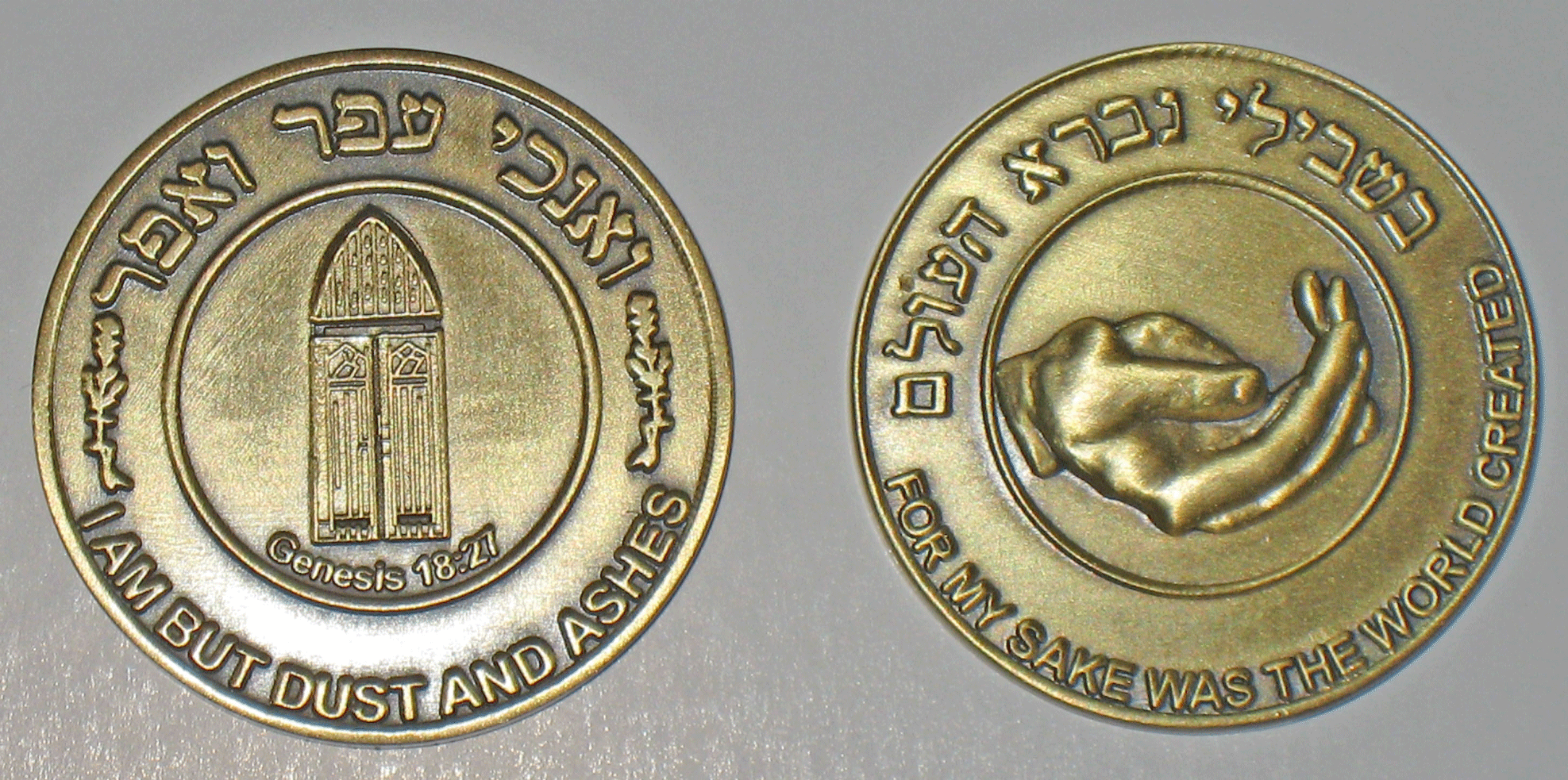
Sometimes we are reminded of a message that is deep and meaningful at the most important of times. Over the past few days, I keep coming across these two phrases, “I am but dust and ashes” and its contrast, “For my sake was the world created.” According to Rabbi Dr. Abraham Twerski, in Growing Each Day, it is said that:

Rabbi Bunim of Psis’cha said that everyone should have two pockets; one to contain, “I am but dust and ashes,” and the other to contain, “The world was created for my sake.” At certain times, we must reach into one pocket; at other times, into the other. The secret of correct living comes from knowing when to reach into which.

p. 62

I realized that this advice/message was crucial to how we all should strive to live. There are times when we feel down, feel lost, feel like we are just going through the motions of life. In those moments we could use the pick me up of recognizing that we each play a role in the role, perhaps even the most fundamental of roles. We should strive in those moments to reflect on how much our actions are of value to existence.

On the other hand, we can all get caught up in taking ourselves too seriously. It is very easy to fall into the trap of seeing ourselves as better than someone else, as the one to judge others, to point a finger and make ourselves out to be the best while others are not. In those moments we are best served remembering that we too are just human, we are imperfect and have our own flaws and challenges that we wouldn’t want others to judge us over.

I believe this is an important lesson when engaging in self-reflection and when working with a coach or a therapist. As we go through self-discovery, we can find ourselves oscillating between our great self and our lowly self, swinging along a pendulum trying to find the balance, static point. It behooves us to take steps to find ways and methods for approaching the highs and lows of life.

May we each find our balance, recognizing our importance and our humility at the same time.

If you are looking to explore and discover new approaches to the difficulties in your life, trying to find the middle path: Contact New Beginnings Spiritual Coaching and Consulting LLC at 732-314-6758 ext. 100 or via email at newbeginningsspiritualcoach@gmail.com.

Growth comes from Faith

Humility need not cause feelings of worthlessness. Although a zero may be nothing when it stands by itself, adding zeros to another digit can result in a number of astronomical magnitude.

If we stand alone, we are nothing. But when we stand together with G-d and with one another, we constitute a value of infinite proportion…

Rabbi Dr. Abraham J. Twerski’s, Living Each Day p. 42

Humility is the recognition that we need not go at it alone. It is recognizing our place in the greater cosmos, reminding ourselves to be mindful of how we are part of a collective humanity and our lot in the world is not just of our making. Humility is recognizing the gifts we have and the need to use those gifts in a way that is beneficial to all those around us.

Faith is not a passive notion of simply saying “I believe…” It is not something we just “have.” Faith is an active recognition that we are not alone. Faith is the recognition we are working in partnership with a being greater than ourselves.

I believe that one of the biggest challenges to growth is how often we believe in the idea that “I must do this alone.” While it is true that it is the “I” that has to take the first step to change, it is just as true that growth and change take a collective effort. It is through recognizing that we do not have to go forth on our own which can be the difference between success and failure.

May each of us find that sense of connectivity and togetherness along the way of our journeys.

Looking to shift to a new road on your journey. Let me help you along that process. Contact New Beginnings Spiritual Coaching and Consulting LLC at 732-314-6758 ext. 100 or via email at newbeginningsspiritualcoach@gmail.com

Self compassion as a door to compassion for others

Rosh Hashanah, the Jewish New Year, is a meaningful holiday for me. It is one of a series of opportunities in the year to take stock and to start anew. Unlike other times, such as my birthday and my wedding anniversary, part of the power of Rosh Hashanah is how together, communally, we are all together in this process of establishing a New Beginning, a new hope for the upcoming year. Through the sound of the Shofar, we are called to wake up and listen to the sounds and to the silences around us so as to better figure out what it is we hope for in the coming year.

I had the fortune to do a lot of reading and reflecting on the past two days (the beauty of being shut off from the constant barrage that comes from our connected world). And yes, while Shabbat and the holidays are about so much more than unplugging, the unplugging is a powerful byproduct.

In my reading over the holiday, I came across a piece that relates back to a book I read through this summer, Self-Compassion: The Proven Power of Being Kind to Yourself, by Dr. Kristin Neff. In a piece from Rabbi Dr. Abraham Twerski’s Growing Each Day, he suggests the following spiritual approach to understanding judgment during this period between Rosh Hashanah and Yom Kippur which I would extend to how we should see self-reflection in our daily lives:

God knows that personal interest makes us oblivious to the significance of our own misdeeds, so He contrives to make us observes in others actions and behavior similar to our own. How we react to our own acts as we see them in others determines how God will judge us. If we are considerate and lenient in our judgment, and give others the benefit of the doubt, allowing them the broadest latitude of circumstances that might have caused them to behave improperly, then God will judge us with equal leniency. But if we are self-righteous and quick to condemn others, we will be judged with equal severity.

p. 3

When we consider the work of self-compassion, one of the premises is that we tend to be quicker to forgive others mistakes than our own when the same mistake is made. We tend to be our own harshest critic. And lest you think that our self-criticism doesn’t ultimately harm our compassion for others, the more we lack in self-compassion, the harder it will be to continue to be compassionate and forgiving of others for their foibles. If we consider the above quote, we can see how our sense of personal, self-acceptance and compassion for our imperfections will open us up to increase our ability to be compassionate to others. If we are reacting to what we are witnessing, we would do well to spend a moment or two reflecting on what we see and what is being mirrored to us so we can react better to them and to ourselves.

As we continue on this journey together exploring how to foster new beginnings for ourselves, may we find ways to bring more compassion into the world for ourselves and for all those around us.

If you are looking to deepen your ability to recognize within yourself areas of desired spiritual growth: Contact New Beginnings Spiritual Coaching and Consulting LLC at 732-314-6758 ext. 100 or via email at newbeginningsspiritualcoach@gmail.com.

The Journey Never Stops

On life’s journey, there are many times we reach an exit, taking us off one road and beginning us on another part of our life’s superhighway. Sometimes, we feel like we have arrived and have no need to go further. While it is important to pause at these junctures, reflect and take stock, these moments cannot be an ending.

Rabbi Dr. Abraham Twerski (o.b.m.) presented a spiritual reflection on those moments of “arrival” in yesterday’s piece from his work Smiling Each Day:

“You shall seek G-d and you shall follow Him but you must search for Him wholeheartedly” (Deuteronomy 4:29). Even after you have found G-d, you must continue to search for Him wholeheartedly. G-d is infinite, and you should not be so complacent as to think that you have already found Him. Keep searching, because there is so much more (Rabbi of Kotzk)

p. 240

May today and every day be a day in which you continue to search and step forward.

We are here to walk along the path of growth with you. Contact New Beginnings Spiritual Coaching and Consulting LLC at 732-314-6758 ext. 100 or via email at newbeginningsspiritualcoach@gmail.com.

Living and Growing from a place of not knowing

Too often we fashion ourselves as experts in things we are quite unfamiliar with. This is a mechanism to protect the more vulnerable parts of our personality because we are afraid our not knowing is a sign of lacking when in reality no one knows everything. We feel scared when we are thrust into something we feel unprepared for and sometimes to protect ourselves we act like we know.

Rabbi Dr. Abraham Twerski, in Growing Each Day, expounded on the following Talmudic passage from Berachot 4a:

דְּאָמַר מָר: לַמֵּד לְשׁוֹנְךָ לוֹמַר ״אֵינִי יוֹדֵעַ״, שֶׁמָּא תִּתְבַּדֶּה וְתֵאָחֵז.

articulated by the Master: Accustom your tongue to say: I do not know, lest you become entangled in a web of deceit.

Rabbi Dr. Twerski suggested:

“While no human being can know everything, some people cannot admit any ignorance about anything. For them, any admission of lack of knowledge threatens their fragile egos… Furthermore, the only way we can acquire knowledge is by accepting that we do not have it. People who claim to know everything cannot learn. Therefore, many opportunities to learn pass them by, and their denying their ignorance actually increases their ignorance… (p.216)”

Saying I don’t know is not strictly an admission of not knowing. Rather it is an opening and invitation to explore. It is through this exploration that we can know, and remove the desire to “fool” ourselves or others. Unfortunately, it is common that our fears of being “seen” actually further hinder our growth and ability to make forward strides. It is that fear that keeps us stagnant and yet leaves us feeling antsy, anxious, unsettled. We are unsettled because we close ourselves off from the value of listening to others and truly listening to ourselves.

One of the core elements of my chaplaincy and now my coaching is to foster the dual listening in the space of care. By my listening to others and hopefully the individuals listening to the words they are saying, it allows us to cultivate the gaining of knowledge through exploration, questions and reflections. Together we open the gates to find new vistas to confront challenging and difficult situations.

May we be blessed to be comfortable in the uncomfortable space of not knowing.

If you are looking to explore and discover new approaches to the difficulties in your life, Contact New Beginnings Spiritual Coaching and Consulting LLC at 732-314-6758 ext. 100 or via email at newbeginningsspiritualcoach@gmail.com.

Nissan and Renewal

Yesterday marked the new month of Nissan in the Jewish calendar. According to the Torah, the month we know as Nissan is the first month of the Jewish calendar:

הַחֹ֧דֶשׁ הַזֶּ֛ה לָכֶ֖ם רֹ֣אשׁ חֳדָשִׁ֑ים רִאשׁ֥וֹן הוּא֙ לָכֶ֔ם לְחדְשֵׁ֖י הַשָּׁנָֽה׃

This month shall mark for you the beginning of the months; it shall be the first of the months of the year for you.

While this date is not celebrated or formally acknowledged as the new year (for that we wait until the 7th month, Tishrei, when we celebrate Rosh Hashanah), Nissan is an auspicious time as it was the month of the Israelite redemption and the first month commemorated by the Israelites in Egypt, which we acknowledge in a special reading from Exodus (12:1-20) on the Shabbat preceding or coinciding with the new month.

In light of the Israelites new beginning, I wanted to reflect on new beginnings and the symbolism of this new day and month. In the lunar calendar, a new month begins when the moon is no longer or almost no longer visible from Earth. The month encapsulates the amount of days the moon cycles from invisibility to full visibility to invisibility again. This cycle can be a symbol for how life goes for many of us. In the words of Rabbi Dr. Abraham J. Twerski:

Whereas the secular calendar is based on the sun, the Jewish calendar is based on the moon. Many commentaries remark that there is a symbolism in the lunar calendar. After reaching its maximum brightness, the light of the moon begins to decrease until it disappears completely. Then, out of the darkness a bright new crescent appears.

This is something to remember when circumstances in life are such that we find ourselves in utter darkness, without any visible sign whence our salvation may come. We should know that out of the depths of darkness, a new brightness can appear…

Living Each Day p. 181

While every month contains this message, in a way this idea is most exemplified by the story that places in Nissan, leading up to Passover. On the night of Passover, the main section of the seder, Maggid (telling the story) is designed as a microcosm of the first 15 days of the moon’s cycle, as we are to tell the story through the eyes of going from slavery to freedom, from darkness to night. Passover night in a way is the apex. Yet, after the apex, the climax of the Exodus, the actual leaving, the Israelites lives wax and wane, with moments of terror and fear followed by moments of redemption and hope.

Perhaps this is the lesson of the days leading to Passover. We must prepare for both the celebration and integration of what redemption means and also prepare for the realization that a redemption is also a new beginning and new opportunity. And new opportunities are not easy, not always shining with light. Sometimes the path is dark even after part is lit up.

May this be a season of renewal, of new beginnings, or finding the light when things seem dark and finding the tools to combat the waning light that often happens after reaching the next step.

Looking for methods to foster feelings of renewal: Contact New Beginnings Spiritual Coaching and Consulting LLC at 732-314-6758 ext. 100 or via email at newbeginningsspiritualcoach@gmail.com

The Smallest of Openings

The following reflection is from Rabbi Dr. Abraham J. Twerski’s, Living Each Day

Open for me the tiniest portal of teshuvah (repentance), even like the eye of a needle, and I shall expand it like the doors of a great palace (Shir HaShirim Rabbah)

All we are asked to do is to make a beginning in teshuvah, and Gd will then assist us in broadening it.

“But,” said the Rabbi of Kotzk in explanation of this Midrash, “it must be a thorough beginning. It may be the tiniest in magnitude, like the eye of a needle, but it must penetrate the personality through and through.

A disciple of the Rabbi of Karlin complained to him that whereas his colleagues were all making progress in their spiritual growth, he seemed to be getting nowhere.

“Alas,” said the Rabbi. “I have not yet found the key to your heart.”

“A key?” cried the disciple in anguish. “Who needs a key? Open my heart with an axe!”

“No need,” said the Rabbi. “It has just been opened.”

All that is needed is a single moment of spiritual awakening, but it must be sincere, permeating every fiber of one’s being.

P. 178

Open the door! Open your heart!

A single step is all it takes to begin on a new path. Sometimes it takes a simple movement and sometimes it takes a jolt, but with one step forward, we can begin anew.

Take the first step! Open the door to a new path and begin a process of change. Contact New Beginnings Spiritual Coaching and Consulting LLC at 732-314-6758 ext. 100 or via email at newbeginningsspiritualcoach@gmail.com

Humans are Spiritual

Spirituality is not what your are, but what you make of yourself. In this sense, the heavenly angels are not spiritual. Only man can be spiritual.

Rabbi Dr. Abraham J. Twerski, Living Each Day p . 168

Being our imperfect selves is the epitome of being spiritual. As we strive to manage the ups and downs of our imperfect lives, may we remember that in the struggle is the spiritual.

If you or someone you know is striving for success in growth on one’s personal spiritual journey, contact New Beginnings Spiritual Coaching and Consulting LLC at 732-314-6758 ext. 100 or email newbeginningsspiritualcoach@gmail.com.