I want to announce that I am now partnering with Robin B. Kessler, CCA. She is a Certified Clinical Aromatherapist and the Owner of RBK Aromatherapy LLC. For more information about Robin, see my Partners/Consultants page.
Below is an excerpt from Robin’s website explaining what aromatherapy is and how it can help.
What is Aromatherapy? It can be described as an art and science of utilizing naturally extracted aromatic essences from plants to balance, harmonize and promote a health of body, mind and spirit. Essential oils have been found to provide both psychological and physical benefits when used correctly and safely. It is not just using essential oils, it is using other methods like herbs and resins which can be burned or infused in carrier oils to help soothe the body and spirit.
How Can It Help me? Aromatherapy can help with Anxiety, Stress, Pain Management, Allergies, Concentration & Memory, Headaches, Skin Conditions, Confidence and much more.
In reflecting on the inclusion of aromatherapy as an offering of my coaching practice, I find myself reflecting on an aspect of the Israelite Temple service. In studying the various korbanot, sacrifices, Gd commanded the Israelites to provide as delineated throughout the Torah, including in this week’s portion, Shelach, one will notice a common theme. The phrase רֵ֤יחַ נִיחֹ֙חַ֙ לַֽיהֹוָ֔ה, an odor pleasing to Gd, repeats itself over and over as part of the descriptive nature of the sacrifice. Part of the sacrificial ritual is in the scent ascending to Gd as a sign of acceptance. Another element of the Temple rituals that also related to the olfactory senses was the ketoret, the incense offering.
In our times, without these sacrifices, we have found and created alternatives to allow these rituals to continue to play an important part in our lives. To bridge the gaps between us and our spiritual selves, we must constantly work towards enhancing our sense of wellbeing. There are many tools people choose to use, whether it is meditation, yoga, exercise, etc. One of the tools we can use is Aromatherapy.
I look forward to this opportunity to expand the offerings of New Beginnings Spiritual Coaching and Consulting LLC to further enhance the goal of supporting and helping you during your journey through the waves of life.
The difference between listening to the inner critic vs. seeing the inner critic for what it really is.
I came across an interesting vignette in The Five Invitations: Discovering What Death Can Teach Us about Living Fully that really struck home for me (see here for a previous post from The Five Invitations). In this story, Frank Ostaseski illustrates a principle in his discussion regarding how we are all stymied by what he refers to as our inner critic:
Once, when I was teaching about the inner critic, a woman raised her hand and asked to speak. Her frustration was palpable, her face turning red and her whole body trembling. “I can never defeat the inner critic!” she said. “It always gets the best of me. Why am I so weak?”
I pulled a chair right up next to her and stood on top of it so that I was a good four feet taller than she was. Then I pointed my finger down at her and said in a firm, loud tone, “You are bad!”
She burst into laughter. “Oh yeah, look at that!” she said. “That is what the critic is like when it has the best of me. No wonder I feel weak. I couldn’t fight back against that adult voice when I was a small child. It was too big, too powerful.”
Then I asked the woman to stand up on the chair so that she was a head taller than I was. I guided her to breathe deeply, feel her way into her body, center he awareness, and think about her innate goodness. “Now how would you respond to the inner critic when it tells you that you’re bad, you’re week?” I asked.
“Don’t speak to me that way,” she said, her voice strong and confident. “It hurts me when you talk to me like that. And it doesn’t help me do any better.”
p.144-145
This story is all too familiar. We have an idea, a gut reaction. We then start to hear all the reasons not to do something. Yes, it is important for those voices to be heard, to help us reflect on the decisions we are to make. Yet, if we always heed the inner critic, we will never find new opportunities, new growth, new adventures in life.
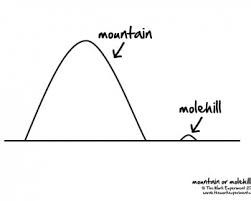
Similarly, there is a rabbinic vignette that offers a similar imagery, using the term evil inclination instead of inner critic. Both are the wily ones who try through various means to lead us from a path of growth and spirituality. In the Talmudic text below, from Tractate Sukkah 52a, we are shown a scene in which the evil inclination for those who have been able to overcome it, “the righteous,” is imagined as a mountain, symbolizing the hard work of quieting the voice of the critic, while for the “wicked”, the same critic is a like a tiny strand of hair, symbolizing that we really are in control of it if we should so choose:
The Gemara answers: This can be understood as Rabbi Yehuda taught: In the future, at the end of days, God will bring the evil inclination and slaughter it in the presence of the righteous and in the presence of the wicked. For the righteous the evil inclination appears to them as a high mountain, and for the wicked it appears to them as a mere strand of hair. These weep and those weep. The righteous weep and say: How were we able to overcome so high a mountain? And the wicked weep and say: How were we unable to overcome this strand of hair? And even the Holy One, Blessed be He, will wonder with them, as it is stated with regard to the eulogy: “So says the Lord of hosts: If it be wondrous in the eyes of the remnant of this people in those days, it should also be wondrous in My eyes” (Zechariah 8:6).
text and translation from Sefaria
Both stories offer perspective on achieving growth and change throughout life. Too often we take small challenges, the molehills, and turn them into mountains, presuming them to be harder to overcome than they really are. And in a way, they are, because we have to work hard to rise above the naysayers, the excuses, etc. At other times, we give up way to easily because we think it is so hard, and yet, if we are really able to stand above the critic or see the inclination as a mere hair to push aside, we could continue to journey forward.
May we all find the ability to recognize what our inner critic says and find ways to take the criticisms we build in a constructive manner so as to be able to overcome the stagnation of allowing the critic to succeed.
This is the title page from my friend and colleague and current NAJC President Rabbi Dr. Joseph S. Ozarowski BCC’s important work on Jewish Pastoral Care. The following quote and essay immediately had me thinking about his book.
Monday afternoon, during the joint NJHSA-NAJC conference, PowerNet2022, someone made the following comment:
Rabbis bring people to God.
Chaplains bring God to people.
I shared this quote via social media (h/t from friend and colleague Rabbi Daniel Braune-Friedman BCC who first posted this on Facebook) and find myself reflecting on this powerful statement. I am particularly focused on the second half of this quote as it pertains to the role of chaplain.
For me, when I hear “bring God to people,” it is the image of how the chaplain entering a room is being accompanied by something beyond the self, regardless of whether we say God, divine, spirit, etc. A chaplain is walking along a path with God when entering another individual’s sacred space. If you think about it as defining the goal upon entering the space, the Chaplain enters without “agenda,” rather just bringing the self to the support of the person, not trying to bring the person along a path. As another friend and colleague of mine Rabbi Dr. Shira Stern, BCC (at who’s lecture our quote was originally heard) shares in lectures she gives on disaster and crisis care, spiritual care could be as “simple” as providing the traumatized a water bottle (she tells it better than I could describe).
In crafting and designing my spiritual coaching business paradigm, the same point is a key component to what I provide. My method in how to best foster growth and change begins by being able to enter the space of someone by bringing my human commonality, my self and spirit into the space. By this I mean bringing a sense of being present to the moment, to the conversation. With that as a driver, I am then able to walk alongside the person, assess their goals and needs, and guide that person along a path that I believe they are already walking (even if the person doesn’t really believe they are already on a path to growth). This joining in the journey allows the individual to take further steps along a path. From this place, we then can work towards the more concrete needs of the moment, which can be anything to just continuing to be present to deep theological, spiritual reflection. Each situation is unique and needs one to be able to be broad and open in coming into a space of support and care.
One of my personal tools for growth and reflection is journaling. The ability to free flow write on paper thoughts, feelings, ideas, worries, etc. has a calming effect (see here for a short piece describing journaling as a coping tool). Journaling allows me to organize my mind when it finds itself moving in many directions at once. It is a place to free-flow ideas or just record something interesting that I came across in my readings and explorations. For those who know me, part of my journaling ritual is that, for the most part, I specifically try to only write using a fountain pen (fountain pen collecting is a bit of a hobby of mine!).
Recently, I have started to reflect on old blog posts and it got me wondering; should I venture back into my old journals and read about the person that was? What is the value of looking back? My internal debate is as such: On the one hand, I believe that as we journey forward we must be willing to shed the parts of ourselves that weigh us down and don’t allow progress. We have to work to declutter. On the other hand, I have also learned the importance of sitting with random past memories that will arise at the strangest times because within those memories we can find nuggets for where we are heading.
And so, I ask all of you: For those who journal, do you ever look back or just leave the thoughts on paper and close the book on the past?
Recently I decided to reflect on some of my older blog posts as part of my journey into discovering new beginnings. Part of my process has been discovering things from past experiences as a means of fostering new avenues of growth. Through this deliberate work I have gained insights that are helping to guide me as I continue along my path forward.
I believe the work of reflection, of reviewing the steps that have led us to a particular moment is invaluable to growth. At the same time, I do not believe this reflective work should be a means of relying on past experiences as a security blanket to calm us in those times of not knowing. Rather, it is a strengthening and revealing of tools for us to carry along while we search for new horizons.
The beginning of the work, “The Celebration of Life,” by Norman Cousins, provides a stirring definition of how we are able to gain and clarify our understanding of an idea. Each individual approaches an idea with a different, unique perspective. I believe hearing and listening to everyone’s individual story and perspective is fundamental to our lives and our growth. As an aside, this would also be the basic premise behind much of analytical philosophy as well, namely the idea that word usage is subjective to the individual using that particular word.
Cousins writes (p. 1-2):
One grows into one’s philosophy. Year by year an individual is shaped by the sights, the sounds, the ideas around him. Consciously or not, he is forever adding to or subtracting from the sum total of his beliefs or attitudes or responses, or whatever it is we mean when we say that a person has a certain outlook on life. I do not mean to say that clearly defined truths of religions and philosophies are inevitably subject to the interpretation of an individual according to his or her experience. But I would like to suggest that one of the prime glories of the human mind is that the same idea or occurrence is never absorbed in precisely the same way by any two individuals who may be exposed to it. Each of us views a sunset, reads a book, or participates in a conversation in a different way from another, and each will take from these experiences a different meaning and memory, which will enrich the common human experience.
In this first paragraph, Cousins presents a beautiful description that we experience life through our own eyes. Even formal situations, education, religion, sports, are communal moments of a group of individuals experiencing different things in the same place. I think we need constant reminders of this first point.
In this sense, each human being is a process – a filtering process of retention or rejection, absorption or loss. This process gives each person individuality. It determines whether a human being justifies the gift of human life, or whether he or she lives and dies without having been affected by the beauty of wonder, and the wonder of beauty, without having had any real awareness of kinship or human fulfillment.
Can any individual recognize and define the essence of his own individuality? Can a camera photograph itself? It can in a mirror, but even the mirror sees only the outside of the camera. A mind that attempts to perceive itself can use the tools of language and logic. But the material with which it deals is beyond mere words or reason. The marrow of human thought or personality eludes its own product – human analysis – even with the most advanced scientific instrumentation.
At the same time, as growth and developing the self is a process, we can never even truly see everything about ourselves as well. At best, as Cousins implies, we see ourselves in a mirror, which would imply we experience ourselves less from the inside and more from how we reflect back into our minds eye. Part of how we do this is working with others to help us bring out areas of ourselves we aren’t able to completely see in ourselves. My love of what I do includes exploring with people the deeper person that the person is and can be through fostering this exploration and growth.
So, if we are to pursue our essential philosophical quest in the world – our search for integration – we need to bring together rational philosophy, spiritual belief, scientific knowledge, personal experience, and direct observation into an organic whole.
In pursuing this integration, we turn to a device worked out more than 2,300 years ago: the Socratic dialogue. The dialogue as a literary device goes back to Socrates. Its function is to provide a path for the systematic exploration of ideas. As used by the Greeks, the dialogue seemed uniquely suited to philosophical thought. The relationship of human beings not just to each other but to the universe, the ability of people to take command of historical experience, the importance attached to abstract ideas and the need to define values and to put them to work, the reach of human beings when confronted with great challenge, the contemplation of the connection between cause and effect – all these aspects of the human situation were central to the dialogue.
To me, these last two paragraphs bring us to the core. To grow as a person, we cannot do it alone. We must work with others to grow, to journey, to keep becoming the person we wish to be. This dialogue for the sake of growth is an underlying perspective on the rabbinic adage from Pirkei Avot (1:7):
Joshua ben Perahiah and Nittai the Arbelite received [the oral tradition] from them. Joshua ben Perahiah used to say: appoint for thyself a teacher, and acquire for thyself a companion and judge all men with the scale weighted in his favor.
Through appointing a rabbi/spiritual guide/therapist, connect to a companion/a confidante, one will be able to find growth both intrapersonally and interpersonally. This comes about from the conversations, the listening, reflecting and exploration we do with this person.
May each of us find growth through our individualism as members of a group.
Too often we fashion ourselves as experts in things we are quite unfamiliar with. This is a mechanism to protect the more vulnerable parts of our personality because we are afraid our not knowing is a sign of lacking when in reality no one knows everything. We feel scared when we are thrust into something we feel unprepared for and sometimes to protect ourselves we act like we know.
Rabbi Dr. Abraham Twerski, in Growing Each Day, expounded on the following Talmudic passage from Berachot 4a:
articulated by the Master: Accustom your tongue to say: I do not know, lest you become entangled in a web of deceit.
Rabbi Dr. Twerski suggested:
“While no human being can know everything, some people cannot admit any ignorance about anything. For them, any admission of lack of knowledge threatens their fragile egos… Furthermore, the only way we can acquire knowledge is by accepting that we do not have it. People who claim to know everything cannot learn. Therefore, many opportunities to learn pass them by, and their denying their ignorance actually increases their ignorance… (p.216)”
Saying I don’t know is not strictly an admission of not knowing. Rather it is an opening and invitation to explore. It is through this exploration that we can know, and remove the desire to “fool” ourselves or others. Unfortunately, it is common that our fears of being “seen” actually further hinder our growth and ability to make forward strides. It is that fear that keeps us stagnant and yet leaves us feeling antsy, anxious, unsettled. We are unsettled because we close ourselves off from the value of listening to others and truly listening to ourselves.
One of the core elements of my chaplaincy and now my coaching is to foster the dual listening in the space of care. By my listening to others and hopefully the individuals listening to the words they are saying, it allows us to cultivate the gaining of knowledge through exploration, questions and reflections. Together we open the gates to find new vistas to confront challenging and difficult situations.
May we be blessed to be comfortable in the uncomfortable space of not knowing.
If you are looking to explore and discover new approaches to the difficulties in your life, Contact New Beginnings Spiritual Coaching and Consulting LLC at 732-314-6758 ext. 100 or via email at newbeginningsspiritualcoach@gmail.com.
Song and music are manifestations of a great inner joy that cannot be contained inwardly. A person, overcome with joy, breaks out in song. Song and music are also infectious; they call forth a response in the listener, and often touch upon the innermost feelings of a person, making him want to join in the singing. This is especially so in the case of sacred music, which inspires higher feelings, and often touches upon the very heartstrings of the soul.
What is your soundtrack? How does music help uplift your mood?
Most of us have our soundtracks, bands, etc. for our daily commutes. Sometimes the music changes depending on our mood and where we are headed. The same is true in life. How many of us wonder what the soundtrack of our lives would sound like? As we journey, what are the sounds of the day?
The following reflection is from Rabbi Dr. Abraham J. Twerski’s, Living Each Day
Open for me the tiniest portal of teshuvah (repentance), even like the eye of a needle, and I shall expand it like the doors of a great palace (Shir HaShirim Rabbah)
All we are asked to do is to make a beginning in teshuvah, and Gd will then assist us in broadening it.
“But,” said the Rabbi of Kotzk in explanation of this Midrash, “it must be a thorough beginning. It may be the tiniest in magnitude, like the eye of a needle, but it must penetrate the personality through and through.
A disciple of the Rabbi of Karlin complained to him that whereas his colleagues were all making progress in their spiritual growth, he seemed to be getting nowhere.
“Alas,” said the Rabbi. “I have not yet found the key to your heart.”
“A key?” cried the disciple in anguish. “Who needs a key? Open my heart with an axe!”
“No need,” said the Rabbi. “It has just been opened.”
All that is needed is a single moment of spiritual awakening, but it must be sincere, permeating every fiber of one’s being.
P. 178
Open the door! Open your heart!
A single step is all it takes to begin on a new path. Sometimes it takes a simple movement and sometimes it takes a jolt, but with one step forward, we can begin anew.
One of the challenges of growth relates to wishing we had something we think we are missing a feeling. When we are deep in sadness we feel as though we have no happiness. When we are frustrated constantly, we look to those who seem content and wish we had a more relaxed demeanor. Who doesn’t ask themselves “how do I acquire that positive feeling?”
Fear not: The positive emotions and character traits you are looking for already live inside of you. True growth comes from unveiling what is already inside. We do not have to search outside of ourselves to acquire change. We can, ourselves or often with the help of others, search inside ourselves, investigate the path we have taken and finding the tools necessary that we collected along the old path to help forge a New Beginning.
As a chaplain/spiritual care provider for many years, working in hospice and senior care, my philosophy of care and support has been to be with others and foster the revelation of the already developed and nurtured feelings they carried deep down. I believe that if we examine our lived experiences, we will find the tools necessary to handle most challenges, from grief and loss to traumas and tragedies as well as the unexpected shadows that often come from good times. It is through the self-discovery that so many are able to walk forward step by step during the times when it feels like we are stagnant.
New Beginnings Spiritual Coaching and Consulting LLC is based on this same principle. I am here to foster this approach to personal growth in whatever stage of life one finds oneself. If you or someone you know is looking to unveil what is covered up inside and learn how to incorporate these newly revealed aspects of yourself, contact New Beginnings Spiritual Coaching and Consulting LLC at 732-314-6758 ext. 100 or via email at newbeginningsspiritualcoach@gmail.com
One of the ideas behind New Beginnings Spiritual Coaching and Consulting LLC is to help foster the principle that each of us always has the opportunity to start anew. I have discovered in myself that losing sight of this hope can be quite detrimental in all aspects of life. Unfortunately, because starting new can seem like a daunting task, we tend to shy away from taking the risk that comes from the first step on a different path. Fortunately, we can recognize that every action is an opportunity that allows us to start new, to begin again. We need not do the same action the same way. I came across the following story in my daily reading that I think illustrates the power of desire and hope to rise above the circumstances of the moment and hope for a new opportunity even when things seems almost impossible:
Shortly before Rav Elyashiv was hospitalized with his final illness, Rabbi Rudinsky was visiting Jerusalem and offered the honor of sitting next to Rav Elyashiv during davening (prayer). Because of his advanced age (he was approx. 103) and medical condition, Rav Elyashiv had difficulty standing, and he sat throughout the davening. Rabbi Rudinsky noticed however, that at each Kaddish and during the chazzan’s (prayer leader) repetition, Rav Elyashiv would strain himself to lean forward ever so slightly in his chair.
After davening, Rabbi Rudinsky garnered the courage and “holy chutzpah” to ask the gadol (great rabbi) the reason for his exertion; surely the centenarian was exempt from rising? Rav Elyashiv explained, “Throughout my entire life, I always stood up for the recitation of Kaddish and chazarat hashatz (repetition of the Amidah). Now that I no longer have the strength to do so, I’m considered an oneis (someone who has no control over a situation), and I am patur, exempt, from standing. But a Jew is never patur from wanting; we are never exempt from our obligation to try.”
“Every time another Kaddish arrives, there is another chance for me to try…Maybe the Ribbono Shel Olam (Master of the Universe – Gd) will me strength to stand this time?”
The lesson of this story reminds me of the famous quote, “its better to try and fail than never to try at all.” Too often we choose not to try a different road because we are afraid to fail. Our mission is to not allow this fear to be our driver. Rather, if we just try to shift a little, maybe just maybe, the shift will open up for us a different road. Its a matter in doing our part and having faith in the potential of change to occur.
For more information and to schedule a session to help foster the courage to take a new first step, contact New Beginnings Spiritual Coaching and Consulting LLC at 732-314-6758 ext. 100 or email newbeginningsspiritualcoach@gmail.com.






 New beginnings: A blog about spirituality, chaplaincy and renewal