The biggest barrier to change is the line “I’ve always been this way.” By saying that, we are allowing the past to control who we are in the now and who we hope to be in the future. If we can allow the past to be a place we turn to learn lessons of what to do/not to do and for tools we might need to draw on in similar situations going forward, we are taking control of the past instead of allowing the past to take control of us and keep you stagnant.
When reflections of past events come to mind at seemingly random moments, it is an opportunity for reflection. I have shared previously how it is important to not ignore the recollections. Rather, when these memories rise up, it is part of the inner work we are in need of doing to take the nexts steps we are striving to take.
If we can see the past as the lessons to be learned and not as the blueprint for who we are to be today, we can then set ourselves up so that each day is a new opportunity for growth, for blessing, for a new beginning.
The above picture is from last summer, on a beach in Florida. It was at the beach that I was originally inspired with the motto for New Beginnings Spiritual Coaching and Consulting LLC, “Helping you on the journey through the waves of life.”
I find myself reflecting on this picture today, thinking about the wonders of the world. Many of us find comfort and spirituality in the workings of nature, truly seeing the beauty and grandeur of the world. By observing the movement of the trees, the waves of the ocean, hearing the sounds of the birds, we can find our connection in the cycle of life.
For me, looking at this picture of the waves, I am reminded about how life is a series of ebbs and flows. Each wave carries sediment, and leaves it at the shore, while also dragging sand back into the ocean. Each step of life is a combination of leaving something behind and also carrying something forward.
Often we feel like we are traveling on a dark road with no end in sight. We can’t begin to figure out where the destination is. All we see is the uncertainty that lies ahead. How can we overcome the inevitable fear we feel on this long, unknown path? One way is to work to change the image we see before us. Perhaps, this next images changes the mood.
Imagine this brighter image. Yes, it is an open road, but with the sun, we will hopefully have a better sense of where we are able to go.
The first step on the journey to change and find our path is to “turn on the light.” This is not a simple practice. It is one which takes time and effort to find the “switch.” Yet, once we shift our perception, we can then begin to progress to the next destination along the road of life.
Often, as we are trying to find our way along our personal journeys, we search for tools to help us attain a greater focus on where we are going. I want to share one tool which I recently read about in The Awakened Brain: The New Science of Spirituality and Our Quest for an Inspired Life by Lisa Miller, PhD. The method is called Three Doors. The goal is described as helping to “show that when we’re using the lens of achieving awareness alone, we see boulders blocking our path, but when we engage our awakened attention, the boulders are actually stepping-stones that show us the path forward (P. 180).” This method resonates for me because it puts into focus the importance of reflecting on what was to help guide us forward while also allowing the what was to not prevent our next steps, something I have written about in other posts, including this early one Let the Broken Pieces Fall.
Three Doors Exercise (p. 180-181):
On a sheet of paper or in your journal, draw the road of your life
Identify a place on the road where you faced a hurdle: a loss, a disappointment, a death; a time when the thing you wanted – a job, a relationship, an award or accomplishment, an acceptance letter from a particular school – seemed lined up, in reach; and then somehow, unexpectedly, the door slammed, and you didn’t get what you wanted or what you thought you were going to get. Draw the slammed door on the road.
Now consider what happened as a result of that loss or disappointment that wouldn’t have happened otherwise. Because the door closed, and because you didn’t claw ahead trying to force it back open, because you stopped and looked around, you saw a new door you hadn’t noticed before. What new insight of connection or path emerged, what new doorway opened, when the first door closed? Add the open door, leading to the new landscape along the road.
Next, can you locate a messenger or helper who showed up and, with or without knowing they played a role, somehow supported or guided you? Perhaps it was someone you’d never met before or someone you knew well; someone who showed up in person or called you or sent you a letter, or someone you thought of at a crucial moment. Who were the messengers or helpers who pointed you to the open door? Draw the messenger(s) on the road.
Repeat steps 2 through 4 twice more, so that your road of life shows three doors that closed and three that opened, and who showed up along the way to you on your path.
As I was reflecting on this exercise, I recall times when I have worked through a similar map to recognize how certain moments continue to line up in ways that have helped navigate me along a certain path towards were I am today. The catch is that an exercise like this cannot be done just one. It needs to be repeated multiple times during our lives to capture a greater sense of how the trials and tribulations of our journeys have led us to where we are at the moments we reflect on where to go next.
May each of us be attentive enough to see how a closed door is not an ending but is merely a marking point to take another exit along the journey each of us is going on.
I came across a great line in the Kedushat Levi, of R. Levi of Berditchev (second to last piece on Parashat Shelach in standard printings), that helps to shed light on this week’s Torah portion as well as provides us with a powerful perspective on keeping in our lane as we journey through life.
In reflecting on the character of Korach, R. Levi offered an interesting perspective. He suggests that Korach’s intention was not ego but it was the desire to serve Gd in the best way he perceived, which as a member of the Levite tribe meant the desire to serve in a priestly role like his cousin Aaron and sons. While noble, this was not the role Gd had in mind for Korach or for the other Levites for that matter. As such, Korach was punished with living in the state of limbo of being swallowed alive by the earth, “to live in Sheol (which biblically is like a netherworld). In the midst of analyzing Korach’s motivation and why it was problematic, R. Levi offers the analogy that Korach’s desire was like wearing a Tallit that didn’t belong to him (Reminds me of Harry Potter and the using of a wand which isn’t yours, as the wand chooses the wizard. The wand will work but not in the way that the person’s destined wand would work).
I would suggest that Kedushat Levi offers this analogy to connect the story of Korach to the end of last week’s Torah portion, which commands the Israelites in wearing a four cornered garment with tzitzit, strings. The tzitzit are worn as a constant reminder to follow after the laws Gd commanded. Part of the commandments is an underlying idea of the rules helping one stay in one’s lane, not starting after the desires of the heart and the eyes. Presumably, if you are find yourself straying from your “path,” you find yourself in limbo, or you find yourself along a path that isn’t yours. (I would also venture to suggest this analogy of the tallit is based on one of the rabbinic reads of Korach’s challenges to Moses. Karachi is said to have argued with Moses about whether a garment of all techeilet (blueish color) would qualify for the additional command to have one of the strings being of the techeilet color).
I found this metaphor resonated with me on a deeper level as regards to how we can grow in life. Most of us, with good intentions, will often go down a path we think we should go because others have found success or because it is the presumed best way to act. Yet, as we know, each of our paths is different and we shouldn’t try to walk along the path that we aren’t destined to go. We should work to properly wear our own “tallit” and not try to fit into someone else’s Tallit.
How would we know? R. Levi offers the answer. Going down a path that is “good” but not one’s path, like Korach, leaves a person in limbo. If we find ourselves living life yet feeling this sense of being neither here nor there, perhaps it is a deeper message inside our hearts to examine if we left the path we were destined for and veered onto a path we chose because it seemed for various reasons like the right one.
Recently, I shared an idea about hearing our inner critic (see here). Along the same lines, I have been reading a book, called The Wisdom of Getting Unstuck: How to emerge from and avoid the muddy middle by Rabbi Shimshon Meir Frankel, in which he describes how we get bogged down in the voice of what he refers to as the Antagonist (we can see it as a modern reference to the Yetzer Hara, the evil inclination, which is the part of ourselves that tries to take us off the path of spiritual growth). For Rabbi Frankel, this antagonist is what keeps us from achieving the best person we can become.
In chapter 23, Peace Treaty, Rabbi Frankel writes about the importance of making peace with this antagonist, and even listening to it as a guidepost. While we don’t want to allow the antagonist to control us, it can often voice something that we need to acknowledge and hear as we venture along the path to success so as to enter the this road with due diligence. This technique is complicated and requires the fortitude of having worked on removing any controls from this antagonist.
We struggle daily with this antagonistic, doubting voice. It can be frustrating to get caught in the debate inside ourselves that gets raised by this opposing voice. Yet, there is a time and place for the voice to at least pipe up in the process of change and growth. It is there to make sure that we are truly meeting our goals. Through making peace with the Antagonist we can learn how to allow this otherwise negative voice to exist without engaging it, disarming its pervasive ability to overwhelm and then control the narrative we are trying to construct.
On life’s journey, there are many times we reach an exit, taking us off one road and beginning us on another part of our life’s superhighway. Sometimes, we feel like we have arrived and have no need to go further. While it is important to pause at these junctures, reflect and take stock, these moments cannot be an ending.
Rabbi Dr. Abraham Twerski (o.b.m.) presented a spiritual reflection on those moments of “arrival” in yesterday’s piece from his work Smiling Each Day:
“You shall seek G-d and you shall follow Him but you must search for Him wholeheartedly” (Deuteronomy 4:29). Even after you have found G-d, you must continue to search for Him wholeheartedly. G-d is infinite, and you should not be so complacent as to think that you have already found Him. Keep searching, because there is so much more (Rabbi of Kotzk)
p. 240
May today and every day be a day in which you continue to search and step forward.
The difference between listening to the inner critic vs. seeing the inner critic for what it really is.
I came across an interesting vignette in The Five Invitations: Discovering What Death Can Teach Us about Living Fully that really struck home for me (see here for a previous post from The Five Invitations). In this story, Frank Ostaseski illustrates a principle in his discussion regarding how we are all stymied by what he refers to as our inner critic:
Once, when I was teaching about the inner critic, a woman raised her hand and asked to speak. Her frustration was palpable, her face turning red and her whole body trembling. “I can never defeat the inner critic!” she said. “It always gets the best of me. Why am I so weak?”
I pulled a chair right up next to her and stood on top of it so that I was a good four feet taller than she was. Then I pointed my finger down at her and said in a firm, loud tone, “You are bad!”
She burst into laughter. “Oh yeah, look at that!” she said. “That is what the critic is like when it has the best of me. No wonder I feel weak. I couldn’t fight back against that adult voice when I was a small child. It was too big, too powerful.”
Then I asked the woman to stand up on the chair so that she was a head taller than I was. I guided her to breathe deeply, feel her way into her body, center he awareness, and think about her innate goodness. “Now how would you respond to the inner critic when it tells you that you’re bad, you’re week?” I asked.
“Don’t speak to me that way,” she said, her voice strong and confident. “It hurts me when you talk to me like that. And it doesn’t help me do any better.”
p.144-145
This story is all too familiar. We have an idea, a gut reaction. We then start to hear all the reasons not to do something. Yes, it is important for those voices to be heard, to help us reflect on the decisions we are to make. Yet, if we always heed the inner critic, we will never find new opportunities, new growth, new adventures in life.
Similarly, there is a rabbinic vignette that offers a similar imagery, using the term evil inclination instead of inner critic. Both are the wily ones who try through various means to lead us from a path of growth and spirituality. In the Talmudic text below, from Tractate Sukkah 52a, we are shown a scene in which the evil inclination for those who have been able to overcome it, “the righteous,” is imagined as a mountain, symbolizing the hard work of quieting the voice of the critic, while for the “wicked”, the same critic is a like a tiny strand of hair, symbolizing that we really are in control of it if we should so choose:
The Gemara answers: This can be understood as Rabbi Yehuda taught: In the future, at the end of days, God will bring the evil inclination and slaughter it in the presence of the righteous and in the presence of the wicked. For the righteous the evil inclination appears to them as a high mountain, and for the wicked it appears to them as a mere strand of hair. These weep and those weep. The righteous weep and say: How were we able to overcome so high a mountain? And the wicked weep and say: How were we unable to overcome this strand of hair? And even the Holy One, Blessed be He, will wonder with them, as it is stated with regard to the eulogy: “So says the Lord of hosts: If it be wondrous in the eyes of the remnant of this people in those days, it should also be wondrous in My eyes” (Zechariah 8:6).
text and translation from Sefaria
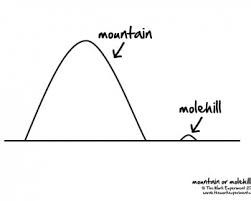
Both stories offer perspective on achieving growth and change throughout life. Too often we take small challenges, the molehills, and turn them into mountains, presuming them to be harder to overcome than they really are. And in a way, they are, because we have to work hard to rise above the naysayers, the excuses, etc. At other times, we give up way to easily because we think it is so hard, and yet, if we are really able to stand above the critic or see the inclination as a mere hair to push aside, we could continue to journey forward.
May we all find the ability to recognize what our inner critic says and find ways to take the criticisms we build in a constructive manner so as to be able to overcome the stagnation of allowing the critic to succeed.
This is the title page from my friend and colleague and current NAJC President Rabbi Dr. Joseph S. Ozarowski BCC’s important work on Jewish Pastoral Care. The following quote and essay immediately had me thinking about his book.
Monday afternoon, during the joint NJHSA-NAJC conference, PowerNet2022, someone made the following comment:
Rabbis bring people to God.
Chaplains bring God to people.
I shared this quote via social media (h/t from friend and colleague Rabbi Daniel Braune-Friedman BCC who first posted this on Facebook) and find myself reflecting on this powerful statement. I am particularly focused on the second half of this quote as it pertains to the role of chaplain.
For me, when I hear “bring God to people,” it is the image of how the chaplain entering a room is being accompanied by something beyond the self, regardless of whether we say God, divine, spirit, etc. A chaplain is walking along a path with God when entering another individual’s sacred space. If you think about it as defining the goal upon entering the space, the Chaplain enters without “agenda,” rather just bringing the self to the support of the person, not trying to bring the person along a path. As another friend and colleague of mine Rabbi Dr. Shira Stern, BCC (at who’s lecture our quote was originally heard) shares in lectures she gives on disaster and crisis care, spiritual care could be as “simple” as providing the traumatized a water bottle (she tells it better than I could describe).
In crafting and designing my spiritual coaching business paradigm, the same point is a key component to what I provide. My method in how to best foster growth and change begins by being able to enter the space of someone by bringing my human commonality, my self and spirit into the space. By this I mean bringing a sense of being present to the moment, to the conversation. With that as a driver, I am then able to walk alongside the person, assess their goals and needs, and guide that person along a path that I believe they are already walking (even if the person doesn’t really believe they are already on a path to growth). This joining in the journey allows the individual to take further steps along a path. From this place, we then can work towards the more concrete needs of the moment, which can be anything to just continuing to be present to deep theological, spiritual reflection. Each situation is unique and needs one to be able to be broad and open in coming into a space of support and care.
One of my personal tools for growth and reflection is journaling. The ability to free flow write on paper thoughts, feelings, ideas, worries, etc. has a calming effect (see here for a short piece describing journaling as a coping tool). Journaling allows me to organize my mind when it finds itself moving in many directions at once. It is a place to free-flow ideas or just record something interesting that I came across in my readings and explorations. For those who know me, part of my journaling ritual is that, for the most part, I specifically try to only write using a fountain pen (fountain pen collecting is a bit of a hobby of mine!).
Recently, I have started to reflect on old blog posts and it got me wondering; should I venture back into my old journals and read about the person that was? What is the value of looking back? My internal debate is as such: On the one hand, I believe that as we journey forward we must be willing to shed the parts of ourselves that weigh us down and don’t allow progress. We have to work to declutter. On the other hand, I have also learned the importance of sitting with random past memories that will arise at the strangest times because within those memories we can find nuggets for where we are heading.
And so, I ask all of you: For those who journal, do you ever look back or just leave the thoughts on paper and close the book on the past?









 New beginnings: A blog about spirituality, chaplaincy and renewal