Aiming for the Center of the Dartboard.

Lately, I have been writing and reflecting a lot on focusing on the process, on imperfection and on the need to take growth as single steps along the path to the place we hope to reach. I find myself working daily to take this more positive approach, learning to appreciate how in a way it is all progress, both my successes and my failures. In light of these thoughts I have previously shared, I want to share a short message based on a discussion I’m involved in on Whatsapp.

Life can often seem like a game of darts. The bullseye is the goal we set before us. The dart is the tasks and tools are our disposal as we aim to reach the goal. When we aim and throw, we are ultimately hoping that the effort will lead us directly to the end goal, to the bullseye. And of course, we always want to hit the bullseye but sometimes we miss. Sometimes we miss by a little and sometimes completely. Yet, missing the target shouldn’t stop us from throwing the next dart. The challenge is, do we find the way to come back to the focus, the concentration of previous throws or do we allow the frustration to get in the way, increasing the odds of further misses?

It is difficult to fail, to miss, to be imperfect. I believe that many of the barriers we place before ourselves stems from this one fear, the fear of failure. If we fail, people will believe we are frauds. In truth, if we fail, it is not because we are frauds, rather, it is because there is no perfection and there will be times when we miss the target. And this goes for everyone around us as well.

As I sit here writing these words, I am reminded of the following read regarding the beginning of this week’s Torah portion, Vaetchanan.

וָאֶתְחַנַּ֖ן אֶל־יְהֹוָ֑ה בָּעֵ֥ת הַהִ֖וא לֵאמֹֽר׃

I pleaded with Gd at that time, saying,

אֲדֹנָ֣י יֱהֹוִ֗ה אַתָּ֤ה הַֽחִלּ֙וֹתָ֙ לְהַרְא֣וֹת אֶֽת־עַבְדְּךָ֔ אֶ֨ת־גדְלְךָ֔ וְאֶת־יָדְךָ֖ הַחֲזָקָ֑ה אֲשֶׁ֤ר מִי־אֵל֙ בַּשָּׁמַ֣יִם וּבָאָ֔רֶץ אֲשֶׁר־יַעֲשֶׂ֥ה כְמַעֲשֶׂ֖יךָ וְכִגְבוּרֹתֶֽךָ׃

“O lord Gd, You who let Your servant see the first works of Your greatness and Your mighty hand, You whose powerful deeds no god in heaven or on earth can equal!

אֶעְבְּרָה־נָּ֗א וְאֶרְאֶה֙ אֶת־הָאָ֣רֶץ הַטּוֹבָ֔ה אֲשֶׁ֖ר בְּעֵ֣בֶר הַיַּרְדֵּ֑ן הָהָ֥ר הַטּ֛וֹב הַזֶּ֖ה וְהַלְּבָנֹֽן׃

Let me, I pray, cross over and see the good land on the other side of the Jordan, that good hill country, and the Lebanon.”

וַיִּתְעַבֵּ֨ר יְהֹוָ֥ה בִּי֙ לְמַ֣עַנְכֶ֔ם וְלֹ֥א שָׁמַ֖ע אֵלָ֑י וַיֹּ֨אמֶר יְהֹוָ֤ה אֵלַי֙ רַב־לָ֔ךְ אַל־תּ֗וֹסֶף דַּבֵּ֥ר אֵלַ֛י ע֖וֹד בַּדָּבָ֥ר הַזֶּֽה׃

But Gd was wrathful with me on your account and would not listen to me. Gd said to me, “Enough! Never speak to Me of this matter again!

Deuteronomy 3:23-26

Moses tells the people he prayed to Gd to overturn the punishment of not being able to enter Israel and that Gd said “no.” There is even a suggested idea that Moses didn’t just pray once or twice but 515 times (based on the numerical value of וָאֶתְחַנַּ֖ן), always receiving “no” for an answer (see Midrash Aggadah, Deuteronomy 3:23:13). Moses admits he failed (yes, he also does also cast blame on the people for Gd’s anger and decision to keep the “punishment” that resulted from the Israelites second complaint about not having water and Moses responded inappropriately with anger (see Numbers 20:1-13)). Nevertheless, for Moses to admit that Gd said no, when so often his prayers ended up with Gd heeding the request, is itself a valuable lesson along the lines of .

There is no perfect person. We are all imperfect in some way. The imperfections, the failures are not excuses to not try, or try and try again. Yes, there are times when we must exit the one path and walk along another. But even this is not a failure, it is a transition to the next opportunity, to a new goal, A New Beginning.

May we each learn how to aim for the center, hit the target or miss the target, aim again or aim differently to hit the next target.

Looking for the tools to aim for the bullseye of your life: Contact New Beginnings Spiritual Coaching and Consulting LLC at 732-314-6758 ext. 100 or via email at newbeginningsspiritualcoach@gmail.com.

From Despair to Hope: Seven Weeks until Rosh Hashanah

What can we do to change our mindset from feeling the sense of divine distance to divine nearness? What is the path to be ready to “greet the King in the field” which is a theme of the month of Elul, the month preceding Rosh Hashanah?

Yesterday was the commemoration known as Tisha B’Av (usually falling out on the 9th day of the Hebrew calendar month Av but due to the 9th being Shabbat, the fast day was pushed off until Sunday, the 10th of Av). Tisha B’Av is a day of collective mourning in the Jewish community, focused first and foremost on the destruction of the First and Second Temples in Jerusalem (586 BCE and 70 CE respectively) and then tying in all other tragedies that we have experienced throughout Jewish History. It is a day we lament and try to grapple with “why” and with “how.” After expressing many prayers and reflections that focus on these pain questions, we begin to search and look for some form of collective hope.

Coming out of Tisha B’Av, while having touched on this sense of hope, there remains the sense of Gd being distant, far away. It is hard to find how the tiny amount of hope will help lead us forward from feeling Gd is hiding to the sense of Gd’s presence we look to feel in seven weeks, when we change our tune and acknowledge Gd as the ruler of all humanity, coronating Gd as we do yearly on Rosh Hashanah.

What can we do to change our mindset from feeling the sense of divine distance to divine nearness? What is the path to be ready to “greet the King in the field” which is a theme of the month of Elul, the month preceding Rosh Hashanah?

It isn’t a coincidence that just like how the time period of Passover to Shavuot seven weeks period which is supposed to be a time of getting ready to receive the Torah anew, this 7 week period between Tisha B’Av and Rosh Hashanah is also a preparation period. The preparation begins by rising up from the depths of pain by taking one single step at a time. By taking the first step, we begin the journey and process.

Breaking it down further, there are two main periods we have in front of us as we get ready for Rosh Hashanah. The first three weeks from today until the beginning of Elul are about opening up our hearts and souls to the notion of reconnecting. We do this through study, through readings that offer comfort (nechama) and that awaken us to the notion we are never abandoned.

We then enter Elul. Starting from the first day of the month, we sound the shofar daily as a wake up call to work on ourselves (teshuva). The work we do is to take steps in our desire for self-improvement and growth, with the specific purpose of preparing for the new beginning Rosh Hashanah sets before us. We cannot just enter this period, waiting for the alarm call. We have the opportunity over the next three weeks to set the alarm so that when it goes off, one’s heart and soul is ready to hear the sounds emanating from the shofar. We shouldn’t just wait for the alarm but need to set it and prepare for it in the first three weeks leading up to Elul.

May these next 7 weeks be a time of growth and introspection and a time of finding hope out of the depths of despair.

Looking for help along your journey from despair to hope? Contact New Beginnings Spiritual Coaching and Consulting LLC at 732-314-6758 ext. 100 or via email at newbeginningsspiritualcoach@gmail.com.

Keep writing the story

“I never expected this to be the outcome.”

“Things just didn’t work out the way i imagined.”

Often we have moments in our lives when we feel that the story is “over,” feeling as though we have reached the ending of the book that is our story. In the moment of feeling stagnant, we believe that now life is destined to be a certain way because we have made our choices and are no longer in the driver’s seat of where we would like to head. In these moments of despair, when we feel that the outcome is inevitable, that we go from being in “control” to being the passive passenger along for the ride, resigning ourselves to “fate.” We feel a sense of sadness, loss, anger and frustration at our lot. Perhaps we begin to spiral into despair and depression. These feelings become further roadblocks and barriers on our life’s highway. Perhaps we feel we are on the wrong path.

How do we overcome this sensation, this feeling, this set of traps along the path?

First, I am a strong believer in the importance of naming and sitting with the emotions that rise up. One of the challenges to overcoming sadness, anger and other “negative” emotions is we try to squash them, try to avoid them or compartmentalize them. We thus end up in two fights, the fight against the emotion and the fight with ourselves to avoid feeling bad. Yes, we all want to feel good, happy and positive. Yet, many times, we don’t. It is in those moments when engaging the emotion in a constructive manner is crucial. In those moments of pain, the variety of feelings are there to help foster growth, even if it is painful.

Second, in those moments of despair and feeling like there is no further one can go, we need to reframe the narrative. As the above quote says, “Keep writing, your story is worth it.” If we think of our lives as a big canvas that is telling a story, then the end is not the end until the inevitable end of life. Yes, situations end, changes occur. One chapter ends, not the book. In those moments of feeling “this is not how I expected it to be,” we can take a different tack and sit with the sense of ending as if it is a stop along the path so as to get the next set of directions. It is hard to imagine, but in reality each day, no matter our station in life, is an opportunity to shift our journey, taking different roads along the highway of life. I recall countless interviews with centenarians who have suggested a secret to their longevity was the learning of something new everyday. Underlying that message is the drive to seize an opportunity to write our own story instead of allowing the story to write us.

Keep writing your story. The ending hasn’t been written yet.

Want help crafting the next chapters of your story! Contact New Beginnings Spiritual Coaching and Consulting LLC at 732-314-6758 ext. 100 or via email at newbeginningsspiritualcoach@gmail.com.

Gaps and Gains

I recently read The Gap and The Gain: The High Achievers’ Guide to Happiness, Confidence, and Success. This book offers a model for success based on the idea that we should see the gains we have made and build off of them instead of always seeing the gaps along the way.

Many of us, as we strive towards setting and fulfilling tasks towards our ideal goal, we often find ourselves in a place of struggle because we feel unfulfilled. The authors, Dan Sullivan and Dr. Benjamin Hardy suggest this frustration results from the cycle on the left of picture, in which we are measuring our goals by how far we are from the ideal instead of measuring them from how far we have come. The gap and the gain they describe is illustrated below:

This is a new way of the age old question of whether we see the glass is half full or half empty:

Daily we accomplish a lot, though often we take it for granted because we are focused on what we haven’t done instead of reflecting on how far we have come during the day. One of the suggestions the book presents is the importance of taking stock at night of all the gains of the day. By just taking 5-10 minutes to reflect and/or journal what we have done during the day, we will find a sense of accomplishment and gratitude for the opportunities the day brought us.

Our journey in life needs the self-reinforcement and kindness this practice can afford us. If we begin to offer ourselves the kindness and positive reinforcement we more easily offer to others, seeing the growth and gains we have made instead of “punishing” ourselves for what we didn’t do, we can find more meaning and hope in this often challenging world.

May each of us acknowledge our Gains and build from those foundations to strive forward in reaching our goals.

Only seeing the gaps and looking to recognize the gains! Contact New Beginnings Spiritual Coaching and Consulting LLC at 732-314-6758 ext. 100 or via email at newbeginningsspiritualcoach@gmail.com.

Spiritual Nourishment

I was recently reading Restoring the Healer: Spiritual Self-Care for Health Care Professionals by William Dorman. This book offered a health care chaplain’s perspective on methods for how to best care for oneself so as to be engaged and effective in the helping of our patients, families and those for whom we have been tasked to care. One particular piece struck me from this book. The author writes:

These patients are like manna in the desert during your bleak and tiresome days. They energize you. They nurture your heart and soul. In the years to come, you will draw inspiration, stamina, and encouragement from your memories of these patients. Healers share an old adage: “ I get more from that patient than I am able to give him or her.”

Restoring the Healer p. 23-4

I found the metaphor of Manna poignant, as it is a sustenance of the spirit that we find at times. I recall one of my early hospice patients, a woman who was struggling with cancer. In one of our visits, she told me that I would always remember her as the person I cut my teeth on.

She was right!

For that patient, and the others who have taught and inspired me over the years, this quote sums up what they meant for me.

This message goes further than health care. What is your spiritual sustenance in those challenging times? From where do you draw your inspiration? What carries you through those difficult days?

Struggling to find your inspiration, your spiritual sustenance? Contact New Beginnings Spiritual Coaching and Consulting LLC at 732-314-6758 ext. 100 or via email at newbeginningsspiritualcoach@gmail.com.

Preparing for the unknown

How many of us can relate to this image?

Often we feel like we are traveling on a dark road with no end in sight. We can’t begin to figure out where the destination is. All we see is the uncertainty that lies ahead. How can we overcome the inevitable fear we feel on this long, unknown path? One way is to work to change the image we see before us. Perhaps, this next images changes the mood.

Imagine this brighter image. Yes, it is an open road, but with the sun, we will hopefully have a better sense of where we are able to go.

The first step on the journey to change and find our path is to “turn on the light.” This is not a simple practice. It is one which takes time and effort to find the “switch.” Yet, once we shift our perception, we can then begin to progress to the next destination along the road of life.

Don’t want to walk this path alone. Contact New Beginnings Spiritual Coaching and Consulting LLC at 732-314-6758 ext. 100 or via email at newbeginningsspiritualcoach@gmail.com.

Drawing the road map of exits

Often, as we are trying to find our way along our personal journeys, we search for tools to help us attain a greater focus on where we are going. I want to share one tool which I recently read about in The Awakened Brain: The New Science of Spirituality and Our Quest for an Inspired Life by Lisa Miller, PhD. The method is called Three Doors. The goal is described as helping to “show that when we’re using the lens of achieving awareness alone, we see boulders blocking our path, but when we engage our awakened attention, the boulders are actually stepping-stones that show us the path forward (P. 180).” This method resonates for me because it puts into focus the importance of reflecting on what was to help guide us forward while also allowing the what was to not prevent our next steps, something I have written about in other posts, including this early one Let the Broken Pieces Fall.

Three Doors Exercise (p. 180-181):

  1. On a sheet of paper or in your journal, draw the road of your life
  2. Identify a place on the road where you faced a hurdle: a loss, a disappointment, a death; a time when the thing you wanted – a job, a relationship, an award or accomplishment, an acceptance letter from a particular school – seemed lined up, in reach; and then somehow, unexpectedly, the door slammed, and you didn’t get what you wanted or what you thought you were going to get. Draw the slammed door on the road.
  3. Now consider what happened as a result of that loss or disappointment that wouldn’t have happened otherwise. Because the door closed, and because you didn’t claw ahead trying to force it back open, because you stopped and looked around, you saw a new door you hadn’t noticed before. What new insight of connection or path emerged, what new doorway opened, when the first door closed? Add the open door, leading to the new landscape along the road.
  4. Next, can you locate a messenger or helper who showed up and, with or without knowing they played a role, somehow supported or guided you? Perhaps it was someone you’d never met before or someone you knew well; someone who showed up in person or called you or sent you a letter, or someone you thought of at a crucial moment. Who were the messengers or helpers who pointed you to the open door? Draw the messenger(s) on the road.
  5. Repeat steps 2 through 4 twice more, so that your road of life shows three doors that closed and three that opened, and who showed up along the way to you on your path.

As I was reflecting on this exercise, I recall times when I have worked through a similar map to recognize how certain moments continue to line up in ways that have helped navigate me along a certain path towards were I am today. The catch is that an exercise like this cannot be done just one. It needs to be repeated multiple times during our lives to capture a greater sense of how the trials and tribulations of our journeys have led us to where we are at the moments we reflect on where to go next.

May each of us be attentive enough to see how a closed door is not an ending but is merely a marking point to take another exit along the journey each of us is going on.

Need help visioning and drawing the road map of your life. Contact New Beginnings Spiritual Coaching and Consulting LLC at 732-314-6758 ext. 100 or via email at newbeginningsspiritualcoach@gmail.com.

Putting on the wrong Tallit

I came across a great line in the Kedushat Levi, of R. Levi of Berditchev (second to last piece on Parashat Shelach in standard printings), that helps to shed light on this week’s Torah portion as well as provides us with a powerful perspective on keeping in our lane as we journey through life.

In reflecting on the character of Korach, R. Levi offered an interesting perspective. He suggests that Korach’s intention was not ego but it was the desire to serve Gd in the best way he perceived, which as a member of the Levite tribe meant the desire to serve in a priestly role like his cousin Aaron and sons. While noble, this was not the role Gd had in mind for Korach or for the other Levites for that matter. As such, Korach was punished with living in the state of limbo of being swallowed alive by the earth, “to live in Sheol (which biblically is like a netherworld). In the midst of analyzing Korach’s motivation and why it was problematic, R. Levi offers the analogy that Korach’s desire was like wearing a Tallit that didn’t belong to him (Reminds me of Harry Potter and the using of a wand which isn’t yours, as the wand chooses the wizard. The wand will work but not in the way that the person’s destined wand would work).

I would suggest that Kedushat Levi offers this analogy to connect the story of Korach to the end of last week’s Torah portion, which commands the Israelites in wearing a four cornered garment with tzitzit, strings. The tzitzit are worn as a constant reminder to follow after the laws Gd commanded. Part of the commandments is an underlying idea of the rules helping one stay in one’s lane, not starting after the desires of the heart and the eyes. Presumably, if you are find yourself straying from your “path,” you find yourself in limbo, or you find yourself along a path that isn’t yours. (I would also venture to suggest this analogy of the tallit is based on one of the rabbinic reads of Korach’s challenges to Moses. Karachi is said to have argued with Moses about whether a garment of all techeilet (blueish color) would qualify for the additional command to have one of the strings being of the techeilet color).

I found this metaphor resonated with me on a deeper level as regards to how we can grow in life. Most of us, with good intentions, will often go down a path we think we should go because others have found success or because it is the presumed best way to act. Yet, as we know, each of our paths is different and we shouldn’t try to walk along the path that we aren’t destined to go. We should work to properly wear our own “tallit” and not try to fit into someone else’s Tallit.

How would we know? R. Levi offers the answer. Going down a path that is “good” but not one’s path, like Korach, leaves a person in limbo. If we find ourselves living life yet feeling this sense of being neither here nor there, perhaps it is a deeper message inside our hearts to examine if we left the path we were destined for and veered onto a path we chose because it seemed for various reasons like the right one.

Need support in walking along your destined path. Contact New Beginnings Spiritual Coaching and Consulting LLC at 732-314-6758 ext. 100 or via email at newbeginningsspiritualcoach@gmail.com.

Many Faiths, One Truth

Years ago, I recall a hospice visit with a Presbyterian family in which we spent time during the visit holding hands and praying together, each of us from our different backgrounds, creating a holy and sacred space of care and support. The memories of this moment serve as a regular reminder of the grandeur and beauty we can create through our coming together to care for each other.

Spiritual Care, Interfaith Chaplaincy, Spiritual Life Coaching all work within a framework of working with others through the eyes of our collective human experiences of meaning making, hope and faith. The chaplain, spiritual care provider, coach enters the space recognizing the invisible boundaries that at first seem to exist in relation to the backgrounds of both parties in the sacred space. Each encounter is an intricate dance of balancing the universalistic goal of supporting and helping others with the particularisms that might arise in the space resulting from each one’s background. I offer this brief reflection because of an old post I shared here which I decided to revisit.

In May, 2010, the Dalai Lama had the following op-ed published in the NY Times (copied from here):

Many Faiths, One Truth

By TENZIN GYATSO

Published: May 24, 2010

WHEN I was a boy in Tibet, I felt that my own Buddhist religion must be the best — and that other faiths were somehow inferior. Now I see how naïve I was, and how dangerous the extremes of religious intolerance can be today.

Though intolerance may be as old as religion itself, we still see vigorous signs of its virulence. In Europe, there are intense debates about newcomers wearing veils or wanting to erect minarets and episodes of violence against Muslim immigrants. Radical atheists issue blanket condemnations of those who hold to religious beliefs. In the Middle East, the flames of war are fanned by hatred of those who adhere to a different faith.

Such tensions are likely to increase as the world becomes more interconnected and cultures, peoples and religions become ever more entwined. The pressure this creates tests more than our tolerance — it demands that we promote peaceful coexistence and understanding across boundaries.

Granted, every religion has a sense of exclusivity as part of its core identity. Even so, I believe there is genuine potential for mutual understanding. While preserving faith toward one’s own tradition, one can respect, admire and appreciate other traditions.

An early eye-opener for me was my meeting with the Trappist monk Thomas Merton in India shortly before his untimely death in 1968. Merton told me he could be perfectly faithful to Christianity, yet learn in depth from other religions like Buddhism. The same is true for me as an ardent Buddhist learning from the world’s other great religions.

A main point in my discussion with Merton was how central compassion was to the message of both Christianity and Buddhism. In my readings of the New Testament, I find myself inspired by Jesus’ acts of compassion. His miracle of the loaves and fishes, his healing and his teaching are all motivated by the desire to relieve suffering.

I’m a firm believer in the power of personal contact to bridge differences, so I’ve long been drawn to dialogues with people of other religious outlooks. The focus on compassion that Merton and I observed in our two religions strikes me as a strong unifying thread among all the major faiths. And these days we need to highlight what unifies us.

Take Judaism, for instance. I first visited a synagogue in Cochin, India, in 1965, and have met with many rabbis over the years. I remember vividly the rabbi in the Netherlands who told me about the Holocaust with such intensity that we were both in tears. And I’ve learned how the Talmud and the Bible repeat the theme of compassion, as in the passage in Leviticus that admonishes, “Love your neighbor as yourself.”

In my many encounters with Hindu scholars in India, I’ve come to see the centrality of selfless compassion in Hinduism too — as expressed, for instance, in the Bhagavad Gita, which praises those who “delight in the welfare of all beings.” I’m moved by the ways this value has been expressed in the life of great beings like Mahatma Gandhi, or the lesser-known Baba Amte, who founded a leper colony not far from a Tibetan settlement in Maharashtra State in India. There he fed and sheltered lepers who were otherwise shunned. When I received my Nobel Peace Prize, I made a donation to his colony.

Compassion is equally important in Islam — and recognizing that has become crucial in the years since Sept. 11, especially in answering those who paint Islam as a militant faith. On the first anniversary of 9/11, I spoke at the National Cathedral in Washington, pleading that we not blindly follow the lead of some in the news media and let the violent acts of a few individuals define an entire religion.

Let me tell you about the Islam I know. Tibet has had an Islamic community for around 400 years, although my richest contacts with Islam have been in India, which has the world’s second-largest Muslim population. An imam in Ladakh once told me that a true Muslim should love and respect all of Allah’s creatures. And in my understanding, Islam enshrines compassion as a core spiritual principle, reflected in the very name of God, the “Compassionate and Merciful,” that appears at the beginning of virtually each chapter of the Koran.

Finding common ground among faiths can help us bridge needless divides at a time when unified action is more crucial than ever. As a species, we must embrace the oneness of humanity as we face global issues like pandemics, economic crises and ecological disaster. At that scale, our response must be as one.

Harmony among the major faiths has become an essential ingredient of peaceful coexistence in our world. From this perspective, mutual understanding among these traditions is not merely the business of religious believers — it matters for the welfare of humanity as a whole.

In my original reflection on this piece, I found myself questioning what I perceived his primary argument to be, that through the commonality of compassion we should find the ability to rise above our particularistic beliefs to find a single unified humanity. I struggled at the time because I believed that it is from the particular backgrounds we came from that can best serve us in working together. In the original post, I wrote “While he is correct about said premise, compassion doesn’t necessarily translate into the reality of all religions being of a single truth. I think we sometimes lose track of our differences and hence this causes more conflict than would be had if we come to the table stating our stances on all topics.” Part of my claim was that so often we enter common space and apologize for who we are because we are afraid of the confrontation. Yet, if we take a deeper look at relationships, it is in the confrontation that I believe we can find compassion, care and real growth.

If we treat a space of with the compassion of respect, through listening, reflecting, sharing and being comfortable in the uncomfortable, we can foster our collective humanity. Often, we think the solution is to remove aspects of what we are bringing to the common space because of fear. Yet, by entering the space with people from other backgrounds, faiths, practices, etc. each of us has already taken the first step to building the bridge.

How do you see your inner critic?

The difference between listening to the inner critic vs. seeing the inner critic for what it really is.

I came across an interesting vignette in The Five Invitations: Discovering What Death Can Teach Us about Living Fully that really struck home for me (see here for a previous post from The Five Invitations). In this story, Frank Ostaseski illustrates a principle in his discussion regarding how we are all stymied by what he refers to as our inner critic:

Once, when I was teaching about the inner critic, a woman raised her hand and asked to speak. Her frustration was palpable, her face turning red and her whole body trembling. “I can never defeat the inner critic!” she said. “It always gets the best of me. Why am I so weak?”

I pulled a chair right up next to her and stood on top of it so that I was a good four feet taller than she was. Then I pointed my finger down at her and said in a firm, loud tone, “You are bad!”

She burst into laughter. “Oh yeah, look at that!” she said. “That is what the critic is like when it has the best of me. No wonder I feel weak. I couldn’t fight back against that adult voice when I was a small child. It was too big, too powerful.”

Then I asked the woman to stand up on the chair so that she was a head taller than I was. I guided her to breathe deeply, feel her way into her body, center he awareness, and think about her innate goodness. “Now how would you respond to the inner critic when it tells you that you’re bad, you’re week?” I asked.

“Don’t speak to me that way,” she said, her voice strong and confident. “It hurts me when you talk to me like that. And it doesn’t help me do any better.”

p.144-145

This story is all too familiar. We have an idea, a gut reaction. We then start to hear all the reasons not to do something. Yes, it is important for those voices to be heard, to help us reflect on the decisions we are to make. Yet, if we always heed the inner critic, we will never find new opportunities, new growth, new adventures in life.

Similarly, there is a rabbinic vignette that offers a similar imagery, using the term evil inclination instead of inner critic. Both are the wily ones who try through various means to lead us from a path of growth and spirituality. In the Talmudic text below, from Tractate Sukkah 52a, we are shown a scene in which the evil inclination for those who have been able to overcome it, “the righteous,” is imagined as a mountain, symbolizing the hard work of quieting the voice of the critic, while for the “wicked”, the same critic is a like a tiny strand of hair, symbolizing that we really are in control of it if we should so choose:

כִּדְדָרֵשׁ רַבִּי יְהוּדָה: לֶעָתִיד לָבֹא, מְבִיאוֹ הַקָּדוֹשׁ בָּרוּךְ הוּא לְיֵצֶר הָרָע, וְשׁוֹחֲטוֹ בִּפְנֵי הַצַּדִּיקִים וּבִפְנֵי הָרְשָׁעִים. צַדִּיקִים נִדְמֶה לָהֶם כְּהַר גָּבוֹהַּ, וּרְשָׁעִים נִדְמֶה לָהֶם כְּחוּט הַשַּׂעֲרָה. הַלָּלוּ בּוֹכִין וְהַלָּלוּ בּוֹכִין. צַדִּיקִים בּוֹכִין וְאוֹמְרִים: הֵיאַךְ יָכוֹלְנוּ לִכְבּוֹשׁ הַר גָּבוֹהַּ כָּזֶה! וּרְשָׁעִים בּוֹכִין וְאוֹמְרִים: הֵיאַךְ לֹא יָכוֹלְנוּ לִכְבּוֹשׁ אֶת חוּט הַשַּׂעֲרָה הַזֶּה! וְאַף הַקָּדוֹשׁ בָּרוּךְ הוּא תָּמֵהַּ עִמָּהֶם, שֶׁנֶּאֱמַר: ״כֹּה אָמַר ה׳ צְבָאוֹת כִּי יִפָּלֵא בְּעֵינֵי שְׁאֵרִית הָעָם הַזֶּה בַּיָּמִים הָהֵם גַּם בְּעֵינַי יִפָּלֵא״.

The Gemara answers: This can be understood as Rabbi Yehuda taught: In the future, at the end of days, God will bring the evil inclination and slaughter it in the presence of the righteous and in the presence of the wicked. For the righteous the evil inclination appears to them as a high mountain, and for the wicked it appears to them as a mere strand of hair. These weep and those weep. The righteous weep and say: How were we able to overcome so high a mountain? And the wicked weep and say: How were we unable to overcome this strand of hair? And even the Holy One, Blessed be He, will wonder with them, as it is stated with regard to the eulogy: “So says the Lord of hosts: If it be wondrous in the eyes of the remnant of this people in those days, it should also be wondrous in My eyes” (Zechariah 8:6).

text and translation from Sefaria

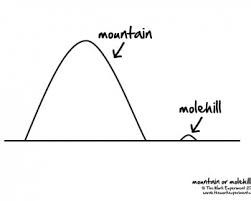
Both stories offer perspective on achieving growth and change throughout life. Too often we take small challenges, the molehills, and turn them into mountains, presuming them to be harder to overcome than they really are. And in a way, they are, because we have to work hard to rise above the naysayers, the excuses, etc. At other times, we give up way to easily because we think it is so hard, and yet, if we are really able to stand above the critic or see the inclination as a mere hair to push aside, we could continue to journey forward.

May we all find the ability to recognize what our inner critic says and find ways to take the criticisms we build in a constructive manner so as to be able to overcome the stagnation of allowing the critic to succeed.

Need help exploring how to overcome the inner critic holding you back on your journey, Contact New Beginnings Spiritual Coaching and Consulting LLC at 732-314-6758 ext. 100 or via email at newbeginningsspiritualcoach@gmail.com.