Recently, I shared an idea about hearing our inner critic (see here). Along the same lines, I have been reading a book, called The Wisdom of Getting Unstuck: How to emerge from and avoid the muddy middle by Rabbi Shimshon Meir Frankel, in which he describes how we get bogged down in the voice of what he refers to as the Antagonist (we can see it as a modern reference to the Yetzer Hara, the evil inclination, which is the part of ourselves that tries to take us off the path of spiritual growth). For Rabbi Frankel, this antagonist is what keeps us from achieving the best person we can become.
In chapter 23, Peace Treaty, Rabbi Frankel writes about the importance of making peace with this antagonist, and even listening to it as a guidepost. While we don’t want to allow the antagonist to control us, it can often voice something that we need to acknowledge and hear as we venture along the path to success so as to enter the this road with due diligence. This technique is complicated and requires the fortitude of having worked on removing any controls from this antagonist.
We struggle daily with this antagonistic, doubting voice. It can be frustrating to get caught in the debate inside ourselves that gets raised by this opposing voice. Yet, there is a time and place for the voice to at least pipe up in the process of change and growth. It is there to make sure that we are truly meeting our goals. Through making peace with the Antagonist we can learn how to allow this otherwise negative voice to exist without engaging it, disarming its pervasive ability to overwhelm and then control the narrative we are trying to construct.
On life’s journey, there are many times we reach an exit, taking us off one road and beginning us on another part of our life’s superhighway. Sometimes, we feel like we have arrived and have no need to go further. While it is important to pause at these junctures, reflect and take stock, these moments cannot be an ending.
Rabbi Dr. Abraham Twerski (o.b.m.) presented a spiritual reflection on those moments of “arrival” in yesterday’s piece from his work Smiling Each Day:
“You shall seek G-d and you shall follow Him but you must search for Him wholeheartedly” (Deuteronomy 4:29). Even after you have found G-d, you must continue to search for Him wholeheartedly. G-d is infinite, and you should not be so complacent as to think that you have already found Him. Keep searching, because there is so much more (Rabbi of Kotzk)
p. 240
May today and every day be a day in which you continue to search and step forward.
The difference between listening to the inner critic vs. seeing the inner critic for what it really is.
I came across an interesting vignette in The Five Invitations: Discovering What Death Can Teach Us about Living Fully that really struck home for me (see here for a previous post from The Five Invitations). In this story, Frank Ostaseski illustrates a principle in his discussion regarding how we are all stymied by what he refers to as our inner critic:
Once, when I was teaching about the inner critic, a woman raised her hand and asked to speak. Her frustration was palpable, her face turning red and her whole body trembling. “I can never defeat the inner critic!” she said. “It always gets the best of me. Why am I so weak?”
I pulled a chair right up next to her and stood on top of it so that I was a good four feet taller than she was. Then I pointed my finger down at her and said in a firm, loud tone, “You are bad!”
She burst into laughter. “Oh yeah, look at that!” she said. “That is what the critic is like when it has the best of me. No wonder I feel weak. I couldn’t fight back against that adult voice when I was a small child. It was too big, too powerful.”
Then I asked the woman to stand up on the chair so that she was a head taller than I was. I guided her to breathe deeply, feel her way into her body, center he awareness, and think about her innate goodness. “Now how would you respond to the inner critic when it tells you that you’re bad, you’re week?” I asked.
“Don’t speak to me that way,” she said, her voice strong and confident. “It hurts me when you talk to me like that. And it doesn’t help me do any better.”
p.144-145
This story is all too familiar. We have an idea, a gut reaction. We then start to hear all the reasons not to do something. Yes, it is important for those voices to be heard, to help us reflect on the decisions we are to make. Yet, if we always heed the inner critic, we will never find new opportunities, new growth, new adventures in life.
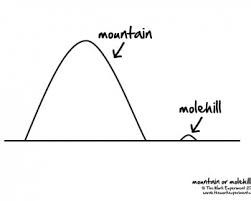
Similarly, there is a rabbinic vignette that offers a similar imagery, using the term evil inclination instead of inner critic. Both are the wily ones who try through various means to lead us from a path of growth and spirituality. In the Talmudic text below, from Tractate Sukkah 52a, we are shown a scene in which the evil inclination for those who have been able to overcome it, “the righteous,” is imagined as a mountain, symbolizing the hard work of quieting the voice of the critic, while for the “wicked”, the same critic is a like a tiny strand of hair, symbolizing that we really are in control of it if we should so choose:
The Gemara answers: This can be understood as Rabbi Yehuda taught: In the future, at the end of days, God will bring the evil inclination and slaughter it in the presence of the righteous and in the presence of the wicked. For the righteous the evil inclination appears to them as a high mountain, and for the wicked it appears to them as a mere strand of hair. These weep and those weep. The righteous weep and say: How were we able to overcome so high a mountain? And the wicked weep and say: How were we unable to overcome this strand of hair? And even the Holy One, Blessed be He, will wonder with them, as it is stated with regard to the eulogy: “So says the Lord of hosts: If it be wondrous in the eyes of the remnant of this people in those days, it should also be wondrous in My eyes” (Zechariah 8:6).
text and translation from Sefaria
Both stories offer perspective on achieving growth and change throughout life. Too often we take small challenges, the molehills, and turn them into mountains, presuming them to be harder to overcome than they really are. And in a way, they are, because we have to work hard to rise above the naysayers, the excuses, etc. At other times, we give up way to easily because we think it is so hard, and yet, if we are really able to stand above the critic or see the inclination as a mere hair to push aside, we could continue to journey forward.
May we all find the ability to recognize what our inner critic says and find ways to take the criticisms we build in a constructive manner so as to be able to overcome the stagnation of allowing the critic to succeed.
This is the title page from my friend and colleague and current NAJC President Rabbi Dr. Joseph S. Ozarowski BCC’s important work on Jewish Pastoral Care. The following quote and essay immediately had me thinking about his book.
Monday afternoon, during the joint NJHSA-NAJC conference, PowerNet2022, someone made the following comment:
Rabbis bring people to God.
Chaplains bring God to people.
I shared this quote via social media (h/t from friend and colleague Rabbi Daniel Braune-Friedman BCC who first posted this on Facebook) and find myself reflecting on this powerful statement. I am particularly focused on the second half of this quote as it pertains to the role of chaplain.
For me, when I hear “bring God to people,” it is the image of how the chaplain entering a room is being accompanied by something beyond the self, regardless of whether we say God, divine, spirit, etc. A chaplain is walking along a path with God when entering another individual’s sacred space. If you think about it as defining the goal upon entering the space, the Chaplain enters without “agenda,” rather just bringing the self to the support of the person, not trying to bring the person along a path. As another friend and colleague of mine Rabbi Dr. Shira Stern, BCC (at who’s lecture our quote was originally heard) shares in lectures she gives on disaster and crisis care, spiritual care could be as “simple” as providing the traumatized a water bottle (she tells it better than I could describe).
In crafting and designing my spiritual coaching business paradigm, the same point is a key component to what I provide. My method in how to best foster growth and change begins by being able to enter the space of someone by bringing my human commonality, my self and spirit into the space. By this I mean bringing a sense of being present to the moment, to the conversation. With that as a driver, I am then able to walk alongside the person, assess their goals and needs, and guide that person along a path that I believe they are already walking (even if the person doesn’t really believe they are already on a path to growth). This joining in the journey allows the individual to take further steps along a path. From this place, we then can work towards the more concrete needs of the moment, which can be anything to just continuing to be present to deep theological, spiritual reflection. Each situation is unique and needs one to be able to be broad and open in coming into a space of support and care.
One of my personal tools for growth and reflection is journaling. The ability to free flow write on paper thoughts, feelings, ideas, worries, etc. has a calming effect (see here for a short piece describing journaling as a coping tool). Journaling allows me to organize my mind when it finds itself moving in many directions at once. It is a place to free-flow ideas or just record something interesting that I came across in my readings and explorations. For those who know me, part of my journaling ritual is that, for the most part, I specifically try to only write using a fountain pen (fountain pen collecting is a bit of a hobby of mine!).
Recently, I have started to reflect on old blog posts and it got me wondering; should I venture back into my old journals and read about the person that was? What is the value of looking back? My internal debate is as such: On the one hand, I believe that as we journey forward we must be willing to shed the parts of ourselves that weigh us down and don’t allow progress. We have to work to declutter. On the other hand, I have also learned the importance of sitting with random past memories that will arise at the strangest times because within those memories we can find nuggets for where we are heading.
And so, I ask all of you: For those who journal, do you ever look back or just leave the thoughts on paper and close the book on the past?
Recently I decided to reflect on some of my older blog posts as part of my journey into discovering new beginnings. Part of my process has been discovering things from past experiences as a means of fostering new avenues of growth. Through this deliberate work I have gained insights that are helping to guide me as I continue along my path forward.
I believe the work of reflection, of reviewing the steps that have led us to a particular moment is invaluable to growth. At the same time, I do not believe this reflective work should be a means of relying on past experiences as a security blanket to calm us in those times of not knowing. Rather, it is a strengthening and revealing of tools for us to carry along while we search for new horizons.
The beginning of the work, “The Celebration of Life,” by Norman Cousins, provides a stirring definition of how we are able to gain and clarify our understanding of an idea. Each individual approaches an idea with a different, unique perspective. I believe hearing and listening to everyone’s individual story and perspective is fundamental to our lives and our growth. As an aside, this would also be the basic premise behind much of analytical philosophy as well, namely the idea that word usage is subjective to the individual using that particular word.
Cousins writes (p. 1-2):
One grows into one’s philosophy. Year by year an individual is shaped by the sights, the sounds, the ideas around him. Consciously or not, he is forever adding to or subtracting from the sum total of his beliefs or attitudes or responses, or whatever it is we mean when we say that a person has a certain outlook on life. I do not mean to say that clearly defined truths of religions and philosophies are inevitably subject to the interpretation of an individual according to his or her experience. But I would like to suggest that one of the prime glories of the human mind is that the same idea or occurrence is never absorbed in precisely the same way by any two individuals who may be exposed to it. Each of us views a sunset, reads a book, or participates in a conversation in a different way from another, and each will take from these experiences a different meaning and memory, which will enrich the common human experience.
In this first paragraph, Cousins presents a beautiful description that we experience life through our own eyes. Even formal situations, education, religion, sports, are communal moments of a group of individuals experiencing different things in the same place. I think we need constant reminders of this first point.
In this sense, each human being is a process – a filtering process of retention or rejection, absorption or loss. This process gives each person individuality. It determines whether a human being justifies the gift of human life, or whether he or she lives and dies without having been affected by the beauty of wonder, and the wonder of beauty, without having had any real awareness of kinship or human fulfillment.
Can any individual recognize and define the essence of his own individuality? Can a camera photograph itself? It can in a mirror, but even the mirror sees only the outside of the camera. A mind that attempts to perceive itself can use the tools of language and logic. But the material with which it deals is beyond mere words or reason. The marrow of human thought or personality eludes its own product – human analysis – even with the most advanced scientific instrumentation.
At the same time, as growth and developing the self is a process, we can never even truly see everything about ourselves as well. At best, as Cousins implies, we see ourselves in a mirror, which would imply we experience ourselves less from the inside and more from how we reflect back into our minds eye. Part of how we do this is working with others to help us bring out areas of ourselves we aren’t able to completely see in ourselves. My love of what I do includes exploring with people the deeper person that the person is and can be through fostering this exploration and growth.
So, if we are to pursue our essential philosophical quest in the world – our search for integration – we need to bring together rational philosophy, spiritual belief, scientific knowledge, personal experience, and direct observation into an organic whole.
In pursuing this integration, we turn to a device worked out more than 2,300 years ago: the Socratic dialogue. The dialogue as a literary device goes back to Socrates. Its function is to provide a path for the systematic exploration of ideas. As used by the Greeks, the dialogue seemed uniquely suited to philosophical thought. The relationship of human beings not just to each other but to the universe, the ability of people to take command of historical experience, the importance attached to abstract ideas and the need to define values and to put them to work, the reach of human beings when confronted with great challenge, the contemplation of the connection between cause and effect – all these aspects of the human situation were central to the dialogue.
To me, these last two paragraphs bring us to the core. To grow as a person, we cannot do it alone. We must work with others to grow, to journey, to keep becoming the person we wish to be. This dialogue for the sake of growth is an underlying perspective on the rabbinic adage from Pirkei Avot (1:7):
Joshua ben Perahiah and Nittai the Arbelite received [the oral tradition] from them. Joshua ben Perahiah used to say: appoint for thyself a teacher, and acquire for thyself a companion and judge all men with the scale weighted in his favor.
Through appointing a rabbi/spiritual guide/therapist, connect to a companion/a confidante, one will be able to find growth both intrapersonally and interpersonally. This comes about from the conversations, the listening, reflecting and exploration we do with this person.
May each of us find growth through our individualism as members of a group.
Too often we fashion ourselves as experts in things we are quite unfamiliar with. This is a mechanism to protect the more vulnerable parts of our personality because we are afraid our not knowing is a sign of lacking when in reality no one knows everything. We feel scared when we are thrust into something we feel unprepared for and sometimes to protect ourselves we act like we know.
Rabbi Dr. Abraham Twerski, in Growing Each Day, expounded on the following Talmudic passage from Berachot 4a:
articulated by the Master: Accustom your tongue to say: I do not know, lest you become entangled in a web of deceit.
Rabbi Dr. Twerski suggested:
“While no human being can know everything, some people cannot admit any ignorance about anything. For them, any admission of lack of knowledge threatens their fragile egos… Furthermore, the only way we can acquire knowledge is by accepting that we do not have it. People who claim to know everything cannot learn. Therefore, many opportunities to learn pass them by, and their denying their ignorance actually increases their ignorance… (p.216)”
Saying I don’t know is not strictly an admission of not knowing. Rather it is an opening and invitation to explore. It is through this exploration that we can know, and remove the desire to “fool” ourselves or others. Unfortunately, it is common that our fears of being “seen” actually further hinder our growth and ability to make forward strides. It is that fear that keeps us stagnant and yet leaves us feeling antsy, anxious, unsettled. We are unsettled because we close ourselves off from the value of listening to others and truly listening to ourselves.
One of the core elements of my chaplaincy and now my coaching is to foster the dual listening in the space of care. By my listening to others and hopefully the individuals listening to the words they are saying, it allows us to cultivate the gaining of knowledge through exploration, questions and reflections. Together we open the gates to find new vistas to confront challenging and difficult situations.
May we be blessed to be comfortable in the uncomfortable space of not knowing.
If you are looking to explore and discover new approaches to the difficulties in your life, Contact New Beginnings Spiritual Coaching and Consulting LLC at 732-314-6758 ext. 100 or via email at newbeginningsspiritualcoach@gmail.com.
I used to be a rollercoaster junkie. Any amusement park I went to I would spend my day riding one rollercoaster after another, seeking the next thrill, the next controlled risk. Nothing could stop me.
As often happens, as we get a bit older, we shy away from many thrills and risks. So there we were, during Chol HaMoed, at Sea World Orlando, and I decided I needed a thrill, a risk. Still, even though I had made up my mind, I was feeling nervous and worried. The ride warnings were telling me “just don’t” but my adventurous, live life side said “try.” Yet, it wasn’t until my nephews grabbed me by the arm to ride the Mako rollercoaster that I finally committed to “stepping back in time” and going for it.
The rollercoaster was wild. If you didn’t watched the video on top, watch it. The coaster was intense, leaving me with a sore neck and a bit woozy. Yet, was completely worth it! What a ride! Of course, it ended up being the only rollercoaster I went on all day (hey, I still have limits).
As I was sitting around reflecting on this moment, reminding myself of all the fun I used to have riding rollercoaster after rollercoaster, loops, no loops, wooden, you name it, I also found a hidden Passover message in the ride and the risk.
Passover celebrates the beginning of the Israelite journey out of Egypt. Beginnings are like the initial plunge of a rollercoaster. The new start seems very slow, an upwards grind, fighting “gravity.” The anticipation of the thrill as well as the accompanying fear grows as it travels higher and higher. And then, wham! the plunge, the moment of truth. When the Israelites leave Egypt, each part of the journey is like the grinding ascent, it’s a slow path to a moment. And once they reach that moment, there is no turning back.
For them, leaving Egypt was the initial plunge, the risk. Passover acknowledges the initial powerful, plunge into the unknown. Even if you can see the path of the rollercoaster, until you are on it, I would say you don’t know it. The Israelites knew the journey was to get to Israel, but how they would get there is the question. And along this journey there weren’t plunges, ups and downs and turns sideways, upside down, etc. we know the story is long, and we know Passover is just a moment and it is the moment all wrapped into one.
Life is similar. When we embark on the next rollercoaster, the next risk, we build up and up until the moment we choose to commit. We then take the plunge. We don’t know how it works ends, how it gets you there, but we know an end of the ride will be waiting. Every journey has this process.
The rabbis offer an approach to framing the beginning and end. We begin with the negative, the difficulties, the grinding upward mobility and end with the praises, the hope, etc., or in their words מתחיל בגנות ומסיים בשבח. Each journey begins from jettisoning the negative weight of what was and building up to the new, positive weight going forward. And when you take the step forward, the twists and turns makes for the thrill of the ride. So…
Lately, it seems we are all caught up in a storm that just won’t end. Between a pandemic, social upheaval, war, terrorism and not to mention our individual challenges we face during life, it feels like we are just being blown around without a rudder. It can be difficult to catch out breath, to feel calm, to find our focus.
Yesterday, in the course of a conversation about life’s challenges, someone shared:
“Don’t let the storm take you off course.”
I found these words to be the right fit at the right time. It is so easy for us to veer off our paths because of all the things happening outside of our control. We watch the news, we doom scroll through social media, looking for the next thing to worry about. How many of us begin the day thinking, ‘what bad news will I find today?’ These are not new things to experience. Yet, I know that most of us have been living in such a heightened state of concern these past couple of years that it is almost the norm.
Still, in those quiet moments, when we are not overwhelmed, when we look to our goals, our dreams, our hopes, we must not allow the uncontrollable take control. We care, we are empathetic to the plight of others. We try to do for those suffering, for those in horrific situations. And, as we are taught, if we don’t help ourselves, we will struggle to help others (a fundamental principle in any caring profession and perhaps the number one rule to limit the compassion fatigue we are bound to experience).
My hope today is that whatever storm you are feeling, whether it is the global problems we are experiencing or your own personal storm, that you continue to see your path and not get pushed off course.
Today, I was reminded of a valuable lesson about process and fostering new beginnings. When we set out on the road to a destination, most of us are anxious to arrive as soon as possible. While it is true that there are times when we have a deadline to reach or a timeframe that we must adhere to, many of our journeys are less structured and not time bound. This can be quite challenging.
When the journey seems to be going nowhere, or it feels like we are spinning our wheels, it can be of value to stop and take stock of the steps taken so far. Don’t just wait until you have reached a “destination” because each step is a destination to cherish.It is also of value to remember that while we are planting the seeds and must do the work associated with cultivating those seeds, we are not alone in working the path.
As you go on your journey, keep planting! Without the seeds in the ground, we cannot grow and develop our paths.





 New beginnings: A blog about spirituality, chaplaincy and renewal