Perspective – Is Prolonged grieving a “disorder?”

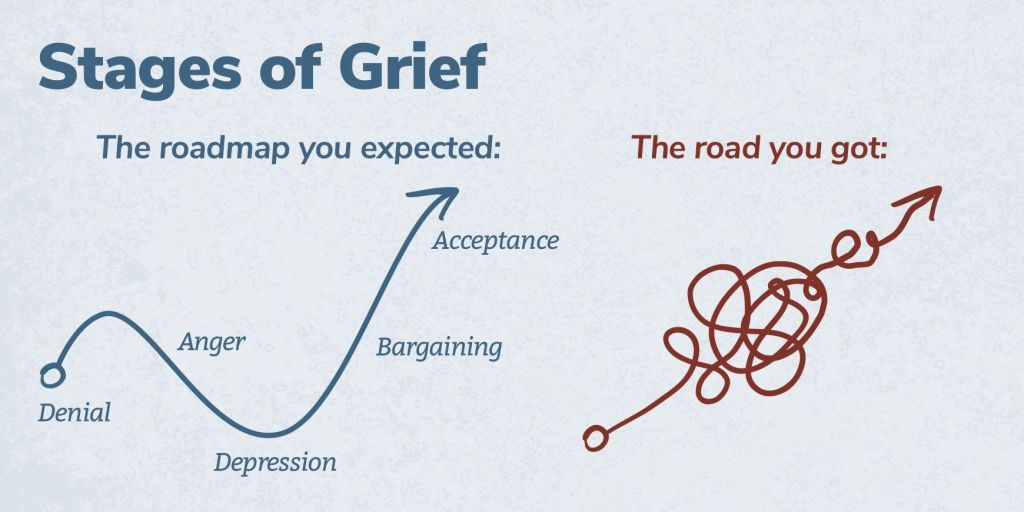
Grief is not a straight line – It is a back and forth journey

Death is the inevitable conclusion of life. Perhaps we could even go so far as to suggest that death always accompanies us. While this is a morbid outlook, suggesting a life in which we are constantly looking over our shoulder for the Angel of Death to tap us as “next,” the recognition of our impermanence is also a prime driver to our continued striving to live life fully. Regardless of whether the recognition of death has a positive or negative impact, death being a constant in life is practically unavoidable. (This is not the same as embracing death as a good. This is acknowledging a fact we must also encounter).

As much as death is a part of life, grieving is the natural response to death. Grieving is the experience of an opening of the emotional floodgates. We might even suggest that grieving is the merging of all emotions. People are angry, sad, guilt-ridden, and also relieved, content, and serene in the face of death. We can and do experience all these emotions at times after the death of someone important to our lives. The complexity of our emotions can be overwhelming. The challenge is embracing all of these emotions in a way that allows us to integrate the change that death causes in our lives. I believe that one of the major struggles we face in mourning a loved one is the internal struggle we experience because we don’t like feeling out of sorts that result from the onslaught of thoughts, images and emotions we face. As such, we try to “ignore” them or fight against them. In my experience, this struggle is often part of what underlies the sense people have of not “moving on,” “getting better,” etc.

With this premise, I want to add my perspective to the recent discussion about the inclusion in the DSM-5 (here) of a new diagnosis called “prolonged grief disorder (for a working definition, see here).” This diagnosis was debated in a recent article in the New York Times, How Long Should It Take to Grieve? Psychiatry has come up with an answer (NYT link). According to the article, prolonged grief disorder would apply to anyone who is “incapacitated, pining and ruminating after a year of loss, and unable to return to previous activities.” The issue of providing a timeframe has been the center of much debate within the greater debate about whether “complicated” grief should be considered a mental disorder, instead of being seen as a “fundamental aspect of our human experience.”

In reflecting on prolonged grief, I was reminded of a topic that has fascinated me for years. Many write about grief and mourning in a theoretical manner and the in a different way when describing the personal experience. One version of this which I would like to offer is the story of Maimonides and his experience of his brother’s death. Maimonides, the great 12th century Rabbi and Jewish thinker, in his laws of mourning, wrote the following:

אַל יִתְקַשֶּׁה אָדָם עַל מֵתוֹ יֶתֶר מִדַּאי. שֶׁנֶּאֱמַר “אַל תִּבְכּוּ לְמֵת וְאַל תָּנֻדוּ לוֹ”. כְּלוֹמַר יֶתֶר מִדַּאי שֶׁזֶּהוּ מִנְהָגוֹ שֶׁל עוֹלָם. וְהַמְצַעֵר [עַצְמוֹ יוֹתֵר] עַל מִנְהָגוֹ שֶׁל עוֹלָם הֲרֵי זֶה טִפֵּשׁ. אֶלָּא כֵּיצַד יַעֲשֶׂה. שְׁלֹשָׁה לִבְכִי. שִׁבְעָה לְהֶסְפֵּד. שְׁלֹשִׁים יוֹם לְתִסְפֹּרֶת וְלִשְׁאָר הַחֲמִשָּׁה דְּבָרִים:

One should not grieve too much over his deceased relative, as it is written : “Weep not for him who is dead, wail not over him” (Jeremiah 22:10); that is, weep not for him too much, since this is the way of the world. He who grieves too much over what is bound to happen is a fool. What measure of mourning should one follow? Three days for weeping, seven for lamenting, thirty days for abstaining from a haircut, and the rest of the five things.

Mishneh Torah – Hilkhot Avel 13:11

Maimonides, in essence, is proposing a time frame and window in which “grieving” is normal. From a purely ritualistic and theoretical perspective, this statement should is a prescription for mourning. His premise is; considering death is inevitable to life, why should we get bogged down for too long in sadness. It seems foolish. Yet, before judging the above, there is another side to Maimonides. While Maimonides the legal scholar is offering a prescription to “normal” grief, in a letter Maimonides wrote to a judge by the name of Yefet, we meet Maimonides the person:

“A few months after we departed from [the Land of Israel], my father and master died (may the memory of the righteous be a blessing). Letters of condolences arrived from the furthest west and from the land of Edom…yet you disregarded this. Furthermore, I suffered many well-known calamities in Egypt, including sickness, financial loss and the attempt by informers to have me killed.

The worst disaster that struck me of late, worse than anything I had ever experienced from the time I was born until this day, was the demise of that upright man (may the memory of the righteous be a blessing), who drowned in the Indian Ocean while in possession of much money belonging to me, to him and to others, leaving a young daughter and his widow in my care. For about a year from the day the evil tidings reached me I remained prostrate in bed with a severe inflammation, fever and mental confusion, and well nigh perished.

From then until this day, that is about eight years, I have been in a state of disconsolate mourning. How can I be consoled? For he was my son; he grew up upon my knees; he was my brother, my pupil. It was he who did business in the marketplace, earning a livelihood, while I dwelled in security. He had a ready grasp of Talmud and a superb mastery of grammar. My only joy was to see him. “The sun has set on all joy.” [Isa. 24:11.] For he has gone on to eternal life, leaving me dismayed in a foreign land. Whenever I see his handwriting or one of his books my heart is churned inside me and my sorrow is rekindled… And were it not for the Torah, which is my delight, and for scientific matters, which let me forget my sorrow, “I would have perished in my affliction” [Ps. 119:92].

https://jewishlink.news/features/26304-a-letter-from-rambam-about-the-death-of-his-brother-david

The same man who wrote about limiting one’s grief might also be a prime example of “prolonged grief disorder” as diagnosed today. I would be hard pressed to prove this “diagnosis.” Simply put, to reconcile Maimonides the scholar and Maimonides the person is that from a legalistic perspective the ideal is to follow the prescribed ritual as a means of guiding one through grief. Even his harsh comment in which he suggests that the one who excessively mourns is a fool is perhaps a statement imploring people to realize that ritual used effectively must have boundaries and be limited. Yet, in the lived experience, this is neither easy nor what most experience.

To conclude, I would suggest this insight from Maimonides theoretical vs. lived experience can be a guide in thinking about the phrase of “Prolonged Grief Disorder.” The challenge of diagnosing grief as a “disorder” because of action/inaction after a certain period is that for many, the real grief journey doesn’t truly begin until after a year has past. I believe this to be the case because it is only after having cycled through a year and all the events of the year that one has experienced the loss in its various iterations. The question is how does one live in the midst of this new reality. How does a person integrate the death into one’s life? Throughout the first year post death, we are encountering a life without the person, both in our day to day living and during the big moments, holidays, celebrations, etc. After going through this cycle once, the majority should find the emotional pain less acute both in the day to day as well as during these moments. The sadness will remain. The empty chair/s will always remain. The DSM diagnosis is not rejecting that our emotional response to death won’t remain with sadness, tears, etc. It is a functional diagnostic coding tool to extend mental health care to those who experience difficulty in the transitions that grieving should offer in integrating the death into the life we want to continue living.

If you or someone you know is experiencing challenges related to grief and loss: Contact New Beginnings Spiritual Coaching and Consulting LLC at 732-314-6758 ext. 100 or via email at newbeginningsspiritualcoach@gmail.com

Rollercoasters and post Pesach reflections – taking a holiday message into our lives.

Mako Rollercoaster

I used to be a rollercoaster junkie. Any amusement park I went to I would spend my day riding one rollercoaster after another, seeking the next thrill, the next controlled risk. Nothing could stop me.

As often happens, as we get a bit older, we shy away from many thrills and risks. So there we were, during Chol HaMoed, at Sea World Orlando, and I decided I needed a thrill, a risk. Still, even though I had made up my mind, I was feeling nervous and worried. The ride warnings were telling me “just don’t” but my adventurous, live life side said “try.” Yet, it wasn’t until my nephews grabbed me by the arm to ride the Mako rollercoaster that I finally committed to “stepping back in time” and going for it.

The rollercoaster was wild. If you didn’t watched the video on top, watch it. The coaster was intense, leaving me with a sore neck and a bit woozy. Yet, was completely worth it! What a ride! Of course, it ended up being the only rollercoaster I went on all day (hey, I still have limits).

As I was sitting around reflecting on this moment, reminding myself of all the fun I used to have riding rollercoaster after rollercoaster, loops, no loops, wooden, you name it, I also found a hidden Passover message in the ride and the risk.

Passover celebrates the beginning of the Israelite journey out of Egypt. Beginnings are like the initial plunge of a rollercoaster. The new start seems very slow, an upwards grind, fighting “gravity.” The anticipation of the thrill as well as the accompanying fear grows as it travels higher and higher. And then, wham! the plunge, the moment of truth. When the Israelites leave Egypt, each part of the journey is like the grinding ascent, it’s a slow path to a moment. And once they reach that moment, there is no turning back.

For them, leaving Egypt was the initial plunge, the risk. Passover acknowledges the initial powerful, plunge into the unknown. Even if you can see the path of the rollercoaster, until you are on it, I would say you don’t know it. The Israelites knew the journey was to get to Israel, but how they would get there is the question. And along this journey there weren’t plunges, ups and downs and turns sideways, upside down, etc. we know the story is long, and we know Passover is just a moment and it is the moment all wrapped into one.

Life is similar. When we embark on the next rollercoaster, the next risk, we build up and up until the moment we choose to commit. We then take the plunge. We don’t know how it works ends, how it gets you there, but we know an end of the ride will be waiting. Every journey has this process.

The rabbis offer an approach to framing the beginning and end. We begin with the negative, the difficulties, the grinding upward mobility and end with the praises, the hope, etc., or in their words מתחיל בגנות ומסיים בשבח. Each journey begins from jettisoning the negative weight of what was and building up to the new, positive weight going forward. And when you take the step forward, the twists and turns makes for the thrill of the ride. So…

Take the plunge!

Need help riding the rails of new challenges: Contact New Beginnings Spiritual Coaching and Consulting LLC at 732-314-6758 ext. 100 or via email at newbeginningsspiritualcoach@gmail.com

Four sons as four different experiences of the Seder

The four sons described in the haggadah represent different approaches to engaging with each other and ourselves during the seder.  In reflecting on this section of the haggadah, we most often focus our attention on the chacham, the “wise” son and the rasha, the “wicked” son, comparing and contrasting the questions they raise and the answers given.  This debate is an essential element of engaging with the haggadah, in that we must struggle between our hyperfocus on carefully fulfilling the various rituals of the seder while also wondering what is tonight’s value and worth. 

            After the wise and wicked, we come to the third and fourth sons, the tam, the “simple” child and the one who doesn’t know what to ask. At first glance, most of us presume these “sons” are merely unable to reflect on the depth of Passover’s meaning.  For the simple son, this means asking a direct and simple question, “what is this.” And for the one who doesn’t know how to ask, our picture is usually of a young child, with the lesson being that we are responsible to teach the story to all, regardless of how they are able to engage.

            However, if we take a step back from our pre-conceived ideas about these four sons, perhaps our approach on the seder night can change as well. The Haggadah’s text doesn’t indicate if any of the four children is really so distinct from the other.  All we have are the single word descriptions related to the type of question posed. Imagine all four sons being about the same age, the same type and having been educated in the same way.  How do we know that these four are really so much different?  Since we recognize that the four sons is a paradigm for four different ways to approach the seder, we can presume there is a commonality between the four.  As such, allow me to offer a nuanced, variant way to read the four sons.

            Wise son:  The wise son, in asking about various details of the halachot for Pesach night, is the person whose relationship to the seder night is to the formal and intricate details of the night’s rituals.  Notice that this is the only son for whom we do not quote from the Torah.  Instead, the answer given is to review the laws of Pesach all the way until the idea of not eating after the afikoman.  This is a means of encouraging the experience of Pesach being tied into the rituals of the night. Yet, while the intricacies are of value, the wise son’s question seems to be missing a whole other element, relating to the story of Pesach night.  Nevertheless, we don’t try to steer this child into a different conversation.  Rather, we meet the child in their “wisdom.”

            Wicked son:  The wicked son is always a complicated topic as we read the question, in which he asks “what is this worship to you,” in a more negative tone than the wise son’s similarly phrased question of “what are all the laws, statutes and rules that Gd commanded you.” Leaving aside the various debates about why the distinction is made between the two questions, I want to focus on the response.  Sometimes, we sit at the Seder and honestly feel left out, feel alienated, feel like it isn’t speaking to “us.”  It can get to the point where we just wonder what’s the point of all the fuss on Passover night.  As such, the wicked son is saying, why are we bothering with all this, it doesn’t relate to me.  The response is jarring, not to run off the “wicked” son, but to respond to the despondency and frustration with a harsh reality check.  For this son, like the wise son, we engage the person where they are at in the moment.  This person won’t relate to the discussion of the laws of the night, nor for that matter a whole review of the story, at least until such time as the “wicked” son is able to become reengaged in how this story of our redemption is a story that should relate to him.

            As we can see from these first two sons, for many at the seder, the engagement with the seder is a deep, profound and also challenging experience. Yet, as is becoming clear, even in the dialogue of the wise and wicked, we are not just beholden to the script but must have the flexibility to engage with the person where they are at. I think this becomes more pronounced when we reflect on the simple son and the son who doesn’t know how to ask. 

Simple Son and Son who doesn’t know how to ask: Often times, we wait and wait for the perfect, deep, profound question. On Passover night, many a times we contrive to come up with the philosophical question that allows for a long conversation around the table during Maggid. And while that is a lofty goal, perhaps there is another way to approach the Seder. If we approach the Seder “unprepared” then we can approach it as more of the experience of the night rather than the intellectual undertaking that it often becomes. In certain ways, the wise and wicked sons both seem to lose sight of the experience of the night. Meanwhile, the simple and the one who doesn’t know how to ask, provide two examples of how important the overall experience of spontaneity at the seder can be in relation to the impact of preparation and reflection before joining together Passover night.

The simple son’s question of “what is this” implies not simplicity from ignorance but rather, the question of, “as we sit here tonight, what is the lesson of the night?  What is the message we are to walk away with?”  The answer given, “With the strength of [His] hand did the Lord take us out from Egypt, from the house of slaves’ (Exodus 13:14),” indicates that the primary lesson of the night about Gd redeeming us, bringing us out of the slavery towards freedom, is the ultimate take away message.  We might forget the long debates, the details of the arguments, but we should never lose sight of this most fundamental lesson. 

            Regarding the one who doesn’t know how to ask, the answer, strangely, is the same verse we offer the wicked son, “And you will speak to your son on that day saying, for the sake of this, did the Lord do [this] for me in my going out of Egypt (Exodus 13:8).”  We deliver this verse is a softer way to this last son, not because the last son is a small child who just is too young to know what to ask.  Rather, like the simple son, the one who doesn’t know how to ask is sitting at the seder, experiencing the rituals, reading the haggadah and presumes that there is nothing more they need to ask.  Yet, the goal is to personalize the experience. We invite this person to join in by introducing the idea that just like Gd did for me, so too Gd does for you.  We are not denying the experience in the moment of this last type of person.  Rather, we want to make sure this last son is engaged in the seder as an experience of the present, not just of the past, so we personalize it. 

            When we look at the four sons in this way, we can now see the commonality of the types.  All four are engaging in how to best experience the seder.  Each approaches it from a different vantage point.  And we respond from where that person is at.  Yet, I would also suggest that within the various answers we are also trying to expand the experience beyond where the person is most comfortable.  With the wise and wicked, we offer extreme answers to both engage and to push them to go beyond themselves. 

Most of us have moments of all four types during the Seder.  The four sons become the blueprint for how each of these modes of thought can be brought together to enhance our Seder night.  As such, whether we feel wise, wicked, simple or just can’t seem to find the question, we can and should engage one another in ways that invites the different parts of ourselves to truly be able to fulfill, “In every generation a person is obligated to see themselves as if they left Egypt.”

Nissan and Renewal

Yesterday marked the new month of Nissan in the Jewish calendar. According to the Torah, the month we know as Nissan is the first month of the Jewish calendar:

הַחֹ֧דֶשׁ הַזֶּ֛ה לָכֶ֖ם רֹ֣אשׁ חֳדָשִׁ֑ים רִאשׁ֥וֹן הוּא֙ לָכֶ֔ם לְחדְשֵׁ֖י הַשָּׁנָֽה׃

This month shall mark for you the beginning of the months; it shall be the first of the months of the year for you.

While this date is not celebrated or formally acknowledged as the new year (for that we wait until the 7th month, Tishrei, when we celebrate Rosh Hashanah), Nissan is an auspicious time as it was the month of the Israelite redemption and the first month commemorated by the Israelites in Egypt, which we acknowledge in a special reading from Exodus (12:1-20) on the Shabbat preceding or coinciding with the new month.

In light of the Israelites new beginning, I wanted to reflect on new beginnings and the symbolism of this new day and month. In the lunar calendar, a new month begins when the moon is no longer or almost no longer visible from Earth. The month encapsulates the amount of days the moon cycles from invisibility to full visibility to invisibility again. This cycle can be a symbol for how life goes for many of us. In the words of Rabbi Dr. Abraham J. Twerski:

Whereas the secular calendar is based on the sun, the Jewish calendar is based on the moon. Many commentaries remark that there is a symbolism in the lunar calendar. After reaching its maximum brightness, the light of the moon begins to decrease until it disappears completely. Then, out of the darkness a bright new crescent appears.

This is something to remember when circumstances in life are such that we find ourselves in utter darkness, without any visible sign whence our salvation may come. We should know that out of the depths of darkness, a new brightness can appear…

Living Each Day p. 181

While every month contains this message, in a way this idea is most exemplified by the story that places in Nissan, leading up to Passover. On the night of Passover, the main section of the seder, Maggid (telling the story) is designed as a microcosm of the first 15 days of the moon’s cycle, as we are to tell the story through the eyes of going from slavery to freedom, from darkness to night. Passover night in a way is the apex. Yet, after the apex, the climax of the Exodus, the actual leaving, the Israelites lives wax and wane, with moments of terror and fear followed by moments of redemption and hope.

Perhaps this is the lesson of the days leading to Passover. We must prepare for both the celebration and integration of what redemption means and also prepare for the realization that a redemption is also a new beginning and new opportunity. And new opportunities are not easy, not always shining with light. Sometimes the path is dark even after part is lit up.

May this be a season of renewal, of new beginnings, or finding the light when things seem dark and finding the tools to combat the waning light that often happens after reaching the next step.

Looking for methods to foster feelings of renewal: Contact New Beginnings Spiritual Coaching and Consulting LLC at 732-314-6758 ext. 100 or via email at newbeginningsspiritualcoach@gmail.com

It’s storming – Don’t lose yourself

Lately, it seems we are all caught up in a storm that just won’t end. Between a pandemic, social upheaval, war, terrorism and not to mention our individual challenges we face during life, it feels like we are just being blown around without a rudder. It can be difficult to catch out breath, to feel calm, to find our focus.

Yesterday, in the course of a conversation about life’s challenges, someone shared:

“Don’t let the storm take you off course.”

I found these words to be the right fit at the right time. It is so easy for us to veer off our paths because of all the things happening outside of our control. We watch the news, we doom scroll through social media, looking for the next thing to worry about. How many of us begin the day thinking, ‘what bad news will I find today?’ These are not new things to experience. Yet, I know that most of us have been living in such a heightened state of concern these past couple of years that it is almost the norm.

Still, in those quiet moments, when we are not overwhelmed, when we look to our goals, our dreams, our hopes, we must not allow the uncontrollable take control. We care, we are empathetic to the plight of others. We try to do for those suffering, for those in horrific situations. And, as we are taught, if we don’t help ourselves, we will struggle to help others (a fundamental principle in any caring profession and perhaps the number one rule to limit the compassion fatigue we are bound to experience).

My hope today is that whatever storm you are feeling, whether it is the global problems we are experiencing or your own personal storm, that you continue to see your path and not get pushed off course.

Need help staying on course in the midst of your storm: Contact New Beginnings Spiritual Coaching and Consulting LLC at 732-314-6758 ext. 100 or via email at newbeginningsspiritualcoach@gmail.com

Process and new beginnings

Today, I was reminded of a valuable lesson about process and fostering new beginnings. When we set out on the road to a destination, most of us are anxious to arrive as soon as possible. While it is true that there are times when we have a deadline to reach or a timeframe that we must adhere to, many of our journeys are less structured and not time bound. This can be quite challenging.

When the journey seems to be going nowhere, or it feels like we are spinning our wheels, it can be of value to stop and take stock of the steps taken so far. Don’t just wait until you have reached a “destination” because each step is a destination to cherish.It is also of value to remember that while we are planting the seeds and must do the work associated with cultivating those seeds, we are not alone in working the path.

As you go on your journey, keep planting! Without the seeds in the ground, we cannot grow and develop our paths.

Looking for help in cultivating the seeds planted along the way: Contact New Beginnings Spiritual Coaching and Consulting LLC at 732-314-6758 ext. 100 or via email at newbeginningsspiritualcoach@gmail.com

What is your soundtrack?

Song and music are manifestations of a great inner joy that cannot be contained inwardly. A person, overcome with joy, breaks out in song. Song and music are also infectious; they call forth a response in the listener, and often touch upon the innermost feelings of a person, making him want to join in the singing. This is especially so in the case of sacred music, which inspires higher feelings, and often touches upon the very heartstrings of the soul.

My Prayer, vol. 1 P. 205

What is your soundtrack? How does music help uplift your mood?

Most of us have our soundtracks, bands, etc. for our daily commutes. Sometimes the music changes depending on our mood and where we are headed. The same is true in life. How many of us wonder what the soundtrack of our lives would sound like? As we journey, what are the sounds of the day?

Let us help in finding the “soundtrack” for your journey. Contact New Beginnings Spiritual Coaching and Consulting LLC at 732-314-6758 ext. 100 or via email at newbeginningsspiritualcoach@gmail.com

Purim 2022/5782 – Incomplete Joy/Complete Joy

Tonight begins the holiday of Purim, which focuses on the story told in Megillat Esther, set in Persia approximately 2500 years ago. Purim is a festive, fun, topsy turvy day, celebrating Jewish survival from the midst of an evil, genocidal decree. The victory and survival bring about a tremendous sense of relief and joy. This is best described in Esther 8:16:

לַיְּהוּדִ֕ים הָֽיְתָ֥ה אוֹרָ֖ה וְשִׂמְחָ֑ה וְשָׂשֹׂ֖ן וִיקָֽר׃

The Jews enjoyed light and gladness, happiness and honor.

Yet, if we take the story as a whole, something is missing. The book of Esther ends with the Jews in the same place as they were at the beginning, remaining under King Ahasuerus’s rule in Persia instead of returning to Israel and rebuilding the Second Temple.  In fact, the story ends with the anti-climatic moment of the Ahasuerus placing a tax upon all who live in his land, showing how surviving a genocidal decree doesn’t mean being free from the whims of weak leadership and potential oppression.  How can we celebrate while also sitting with this sense of incompleteness?

I would like to suggest that celebration is warranted, even if the story seems incomplete. In the moment of triumph, we can feel a tremendous burden lifted off our shoulders, leading to a sense of exhilaration or a sense of relief.  I contend most of us can find many experiences in our lives where this sense of relief in the moment might even lead us to a temporary happiness.

For the Jews of Shushan, surviving Haman’s decree provided this sense of relief.  As such, they celebrated their newly found “new lease on life.” Their celebration was one of communal care and support, guaranteeing all could celebrate through the giving of Mishloah Manot (gifts to friends) and Matanot L’Evyonim (gifts to the poor).  Subsequently, this celebration was established as a yearly practice, as being able to celebrate Purim was proof of continued survival, and the importance to taking the time to reflect on the moment. 

At the same time, 2500 years later, with the fortune of hindsight, we are led to question what were the long term gains of this survival.  They continued to be under foreign rule.  Eventually, the lightness, the relief goes away, and the reality of life returns, with all its trials and tribulations.  Yet, by establishing Purim, we are acknowledging the value in celebrating even a good that might not be complete, recognizing that it is right to celebrate momentary victories even when they remain incomplete.

This is a fundamental life lesson. While keeping the end goal in front of us is important to our journeys, if we don’t take stock in the middle, enjoying the pieces of the story each of us is writing, then we miss opportunities to reinvigorate and reinvest ourselves in our growth. May this Purim be a reminder of the importance of taking the time to celebrate the steps along the path the goals we have set for ourselves.

Updated from the piece I originally wrote here:

Find the joy in the steps along the path to change. Contact New Beginnings Spiritual Coaching and Consulting LLC at 732-314-6758 ext. 100 or via email at newbeginningsspiritualcoach@gmail.com

The power of a pause

We are constantly doing. It is hard to stop and reflect. We think that if we stop we won’t progress. If we don’t pause to reflect and to truly listen to our inner voice, so much will be lost.

The book of Leviticus, VaYikra, begins with Gd calling to Moses as an invitation to teach Moses the vast array of laws related to sacrifices. Verse 1:1 states:

וַיִּקְרָ֖א אֶל־מֹשֶׁ֑ה וַיְדַבֵּ֤ר יְהֹוָה֙ אֵלָ֔יו מֵאֹ֥הֶל מוֹעֵ֖ד לֵאמֹֽר׃

Gd called to Moses and spoke to him from the Tent of Meeting, saying:

When Gd is speaking to Moses, the Torah usually says, Gd spoke to Moses, similar to the language in the middle of verse one, after the initial call. As such, the first words, Gd called to Moses, seem superfluous. The great medieval commentator Rashi offers a pedagogical/psychological answer to this seeming redundancy.

ויקרא אל משה AND HE CALLED UNTO MOSES — This implies that the Voice went on and reached his (Moses’s) ears only but all the other Israelites did not hear it). One might think that for the subsections there was also such a call! It, however, states, “[And the Lord called unto Moses] and spake (וידבר) [to him]”, thus intimating that a דבור, a complete section had (was preceded by) a call (e. g., in our text chapters 1—4), but not the subsections. And what purpose did these subsections serve (i. e., why are the larger sections broken up into smaller ones)? To give Moses an interval for reflection between one division and another and between one subject and another — something which is all the more necessary for an ordinary man receiving instruction from an ordinary man (Sifra, Vayikra Dibbura d’Nedavah, Chapter 1 9).

There is a distinction between calling and speaking that hints towards the importance of allowing a lesson to resonate before moving on. In the Torah’s context, the verse is saying: Moses was called to Gd to be taught a series of laws. This call was an overarching invitation to be in the same space. Once Moses enters the space, Gd speaks to him. Yet, Gd doesn’t just teach everything in one breath. Rather, it is broken into different lessons. Via this picture, we can see, as Rashi indicates, the importance of teaching ideas in manageable parts while recognizing that there is an overarching subject. This message is of such importance that Rashi repeats the same idea 10 verses laters, stating:

ואם מן הצאן AND IF [HIS OFFERING BE] OF THE SHEEP — The ו (of אם) adds something to the former subject (i. e. shows that this is a continuation of it). Why, then, is there a break between the two paragraphs (i. e. why does the following form a separate paragraph)? In order to give Moses an interval between the one section and the next section to reflect upon what has already been said (Sifra, Vayikra Dibbura d’Nedavah, Section 5 1).

Rashi Vayikra 1:10

From a literal perspective, the breaks are just breaks. They indicate a change in subject. Breaks are a means of clear, structured writing. Yet, in this comment, we see that a break is more than that. It is a lesson about life. When we want to change, we can’t just do it all at once. We must go step by step and allow the change to time have to percolate. There is as much to learn in the break as there is in the words themselves.

All new beginnings take time and energy because if we do too much too quick, we are more likely to lose all momentum. If we break things down into smaller, subsections, we have a higher chance of success.

Take the first step! Open the door to a new path and begin a process of change. Contact New Beginnings Spiritual Coaching and Consulting LLC at 732-314-6758 ext. 100 or via email at newbeginningsspiritualcoach@gmail.com

The Smallest of Openings

The following reflection is from Rabbi Dr. Abraham J. Twerski’s, Living Each Day

Open for me the tiniest portal of teshuvah (repentance), even like the eye of a needle, and I shall expand it like the doors of a great palace (Shir HaShirim Rabbah)

All we are asked to do is to make a beginning in teshuvah, and Gd will then assist us in broadening it.

“But,” said the Rabbi of Kotzk in explanation of this Midrash, “it must be a thorough beginning. It may be the tiniest in magnitude, like the eye of a needle, but it must penetrate the personality through and through.

A disciple of the Rabbi of Karlin complained to him that whereas his colleagues were all making progress in their spiritual growth, he seemed to be getting nowhere.

“Alas,” said the Rabbi. “I have not yet found the key to your heart.”

“A key?” cried the disciple in anguish. “Who needs a key? Open my heart with an axe!”

“No need,” said the Rabbi. “It has just been opened.”

All that is needed is a single moment of spiritual awakening, but it must be sincere, permeating every fiber of one’s being.

P. 178

Open the door! Open your heart!

A single step is all it takes to begin on a new path. Sometimes it takes a simple movement and sometimes it takes a jolt, but with one step forward, we can begin anew.

Take the first step! Open the door to a new path and begin a process of change. Contact New Beginnings Spiritual Coaching and Consulting LLC at 732-314-6758 ext. 100 or via email at newbeginningsspiritualcoach@gmail.com