I read a short quote from the book HaYom Yom, which is a book compiled by the Rebbe, Rabbi Menachem Mendel Schneerson, of righteous memory, in 1942, upon the instructions of his father-in-law, the Previous Rebbe. Hayom Yom is an anthology of Chasidic aphorisms and customs arranged according to the days of the year. It has since become a beloved classic work and a source of daily inspiration.
The quote says:
Where a lantern is placed, those who seek light gather around – for light attracts.
The inspiration for this piece came from a question posed on a WhatsApp group I am part of with friends from my year of study in Israel over 20 years ago.
Genesis 47:8-9 describes a conversation between Pharaoh and Jacob after Jacob and his family arrive in Egypt.
And Jacob answered Pharaoh, “The days of the years of my sojourn [on earth] are one hundred and thirty. Few and hard have been the days of the years of my life, nor do they come up to the life spans of my fathers during their sojourns.”
Rabbi Samson Raphael Hirsch suggests that underlying the question and answer posed in these verses is a lesson about how we view our lives. As he states:
“V. 8 – Still today, royalty, whose time naturally is extremely previous at audiences, as a rule just throw out a few short words or enquiries, the replies to which they are in reality entirely indifferent. But it must be rare indeed for a king to have understood to secure more delicacy in a few interrogative words than Pharaoh did here. And even more seldom has the person addressed expressed more wisdom in a short reply, than Jacob did here. When one counts by years, one does not reckon any more the days. It is only with a few select people that each day is full of importance and is considered by them as having a special meaning. A really true human being does not lives years but days…”
After elaborating on the underlying philosophy behind Pharaoh’s question, Rabbi Hirsch presents his take on Jacob’s response:
” V. 9 – In his reply Jacob differentiates between living and existing. ‘You ask after the days of the years of my life. I have not lived much. I have sojourned on earth during one hundred and thirty years. The days of the years that I can really call my life (on which I really fully carried out all that I should) were in reality only few, and they were just the bitterest and those most full of worry…'”
R. Hirsch is suggesting in his in depth analysis of this dialogue a question for each of us to reflect on. Are we living or merely existing? Do we find each day meaningful in some way or is life merely a series of “groundhog” like days? We desire to make an impact, to live meaningful, fulfilling lives.
In fostering a new beginning, a primary goal is to change the direction of the path we have been cultivating because it seems monotonous. We can do this through a variety of means. We can foster our desire to help others, to reconnect to those we care about, to come back to a latent spirituality and creativity that might have been purposefully left dormant for years.
May each of us experience life as daily living and not merely as existence.
If you or someone you know is trying to foster a renewed sense of living life to the fullest, New Beginnings Spiritual Coaching and Consulting LLC is here to help. For more information, please check out: https://achaplainsnewjourney.wordpress.com/about/
Blessed are You, Adonoy our God, King of the Universe, Who gives strength to the weary.
Many of us recite this in the midst of feeling tired, either physically or emotionally, yet within this blessing is a moment of the inspiration to feel energized for the day ahead. I read a short piece that I believe helps frame the deeper sense of this blessing.
Consider: two persons, one young and the other old, walking the same road, or climbing the same mountain, with the goal far out of sight; who will reach it: the young one, starting out with full strength, but with little hope, or the old one, lacking in strength, but full of hope? The youth will soon get out of breath, and, despairing of ever attaining the goal, will give it up in frustration. But the old man will steadily forge ahead constantly renewing his strength by hope and confidence. This is what the prophet tells us: Physical strength will be of no avail, where there is no hope, but “they that hope in Gd will renew their strength (Isaiah 40:31).”
And so, when we start a new day, which may be a difficult one, it is good to bear in mind that it is Gd “who gives strength to the weary.” With hope and trust in Gd, no road is too long or too hard, and no obstacles are too difficult.
My Prayer Volume 1 by Rabbi Nissan Mindel pg. 34-35
So often we burn bright and burn out too fast because we get caught up in the moment and lose sight of the goal and the steadiness goal setting can provide us. If we take a moment to trust that the process is going at the pace it needs to and that we are along the right path, we can maintain the strength needed to forge ahead. The strength comes from the hope in the correctness of the path. This doesn’t mean the path is always the right one, but the path, right or wrong, will lead to the next crossroads and to the next new beginning. In one sense, every day is this opportunity. And so we recognize that when we are weary there is a strength we can draw on each day to strive forward.
For more information about New Beginnings Spiritual Coaching and Consulting LLC, and how we can support you on the journey through the waves of life, please check out: https://achaplainsnewjourney.wordpress.com/about/
I recently started reading and reflecting on a book called Transitions: Making Sense of Life’s Changes by William Bridges. I plan to share some of my thoughts on this book in a series of posts. For now, I want to begin with one of the first points the author makes in reflecting on transitions.
Rule number one: When you’re in transition, you find yourself coming back in new ways to old activities.
p. 7
As we work to make changes, or we find ourselves in the midst of a change , many of us will fall back on the familiar to help navigate the new road. While change presumes a break from the past, and this break is a necessity to affect true transition and change, it is within the familiar that we find our inner strength and resolve to move forward.
For more information about New Beginnings Spiritual Coaching and Consulting LLC, and how we can support you on the journey through the waves of life, please check out: https://achaplainsnewjourney.wordpress.com/about/
There is a relationship between the flame of the candle and prayer. According to Rabbi Nissan Mindel in his introduction to My Prayer:
Our soul has, in fact, been called the “candle of G‑d.” The flame of a candle is restless, striving upwards, to break away, as it were, from the wick and body of the candle; for such is the nature of fire—to strive upwards. Our soul, too, strives upwards, like the flame of the candle. Such is its nature, whether we are conscious of it, or not. This is also one of the reasons why a Jew naturally sways while praying. For prayer is the means whereby we attach ourselves to G‑d, with a soulful attachment of “spirit to spirit,” and in doing so our soul, as it were, flutters and soars upward, to be united with G‑d.
The ideal of prayer is the revelation of what is already living deep within ourselves. By reflecting, saying words and through a bit of movement, we are investing our whole selves into the process. Through this, we can bring light into our day.
Tonight, as you are watching the flames of the Chanukkah lights swaying, reflect on the candle as a symbol of the yearning of your soul, your spirit, to bring light into the world through the words and actions of prayer.
For more information about New Beginnings Spiritual Coaching and Consulting LLC, and how we can support you on the journey through the waves of life, please check out: https://achaplainsnewjourney.wordpress.com/about/
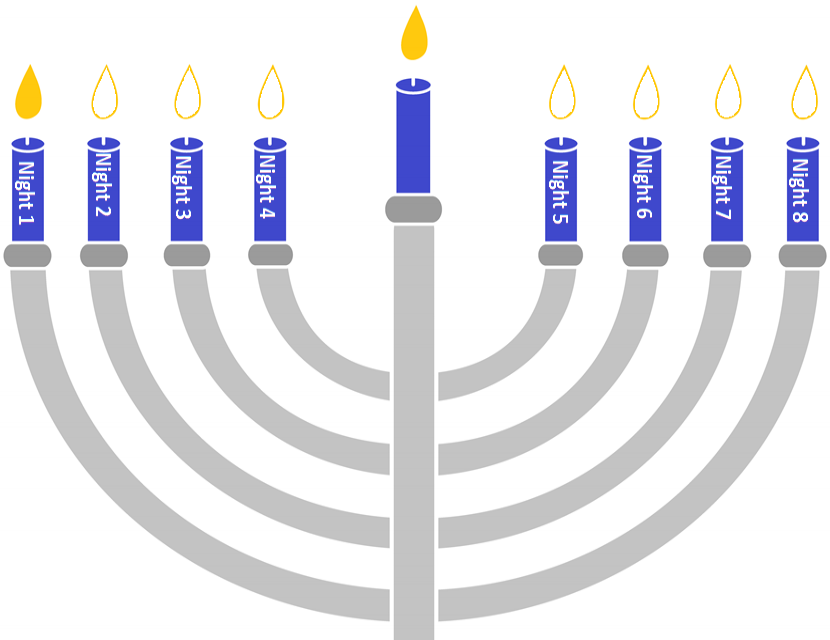
Last night we began the eight day celebration of Hanukkah. The traditional story of Hanukkah describes how the Hasmoneans, upon recapturing the Temple Mount from the Seleucid Greeks, where left without the ability to light the menorah in the Temple. Fortunately, after much searching, they came across a single jug of oil, which would have been sufficient to last for one day. Miraculously, the oil burned for eight days until they could get more pure olive oil to light the menorah on a daily basis as part of the Temple ritual.
One of the famous questions about this miraculous event is why do we light for eight nights when the miracle was that while they had enough for one night, the oil lasted an additional seven nights? One answer to this question is presented in Growing Each Day by Rabbi Dr. Abraham Twerski. He states:
…They did light the Menorah anyway, reasoning that it was best to do what was within their ability to do and to postpone worrying about the next day until such worry was appropriate. This decision elicited a Divine response and the Menorah stayed lit for that day and for seven more.
This miracle was thus initiated by the Jews themselves, and the incident was set down as a teaching for all future generations: concentrate your efforts on what you can do and do it! Leave the rest to God.
While even our best and most sincere efforts do not necessarily bring about miracles, the teaching is nevertheless valid. Even the likelihood of failure in the future should not discourage us from any constructive action that we can take now.
pg. 86
Whenever we are faced with “not enough,” many of us will freeze and give up instead of forging ahead and having the confidence that our efforts will be of value. While there are no guarantees, this is an example of better to have tried and failed than to have failed to try at all. As one strives for new beginnings, it is important to always remember the journey begins with one step, one flame, one light.
Happy Hanukkah!
For more information about New Beginnings Spiritual Coaching and Consulting LLC, and how we can support you on the journey through the waves of life, please check out: https://achaplainsnewjourney.wordpress.com/about/
In today’s piece in Growing Each Day, Rabbi Dr. Abraham Twerski suggests the value in taking ownership of one’s feelings and thoughts. He states:
We tend to disown those thoughts, feelings and actions that we dislike. Something we saw, read, or heard upset us, we like to think, and caused us to think, feel or act in certain way. We forget that we have considerable say in what we choose to see or to hear.
Psychiatry and psychology have contributed to this abdication of responsibility. Their emphasis on the impact of early-life events on our emotions has been taken to mean that these factors determine our psyche, and that we are but helpless victims of the past…
p.74
There is much value in getting a deeper understanding of how our journeys have led us to be the person we have become. Rabbi Twerski is reminding us that while we might have grown and changed, part of growth is being able to own who we have become and and then keep working to better ourselves as a result of knowing who we are.
He goes on to offer the following vignette
A man once complained to his rabbi that alien thoughts were interfering with his prayer and meditation. The rabbi shrugged his shoulders. “I don’t know why you refer to them as alien,” he said. “They are your own.”
If we stop disavowing our feelings and actions, we may be able to do something about them.
p. 74
From first hand experience, I can speak to the value of examining how past events in my life which have come back to the forefront of thought can help open up new vistas for new growth opportunities. As we strive for a new beginning in our day to day life, may we find how who we are has helped guide us to this moment and this opportunity for new growth goals and new opportunities.
For so many of us, each day can feel like a a grind. We go about our routines, become consumed by work and find that time just flies by as if time is controlling us. How can we combat this?
I came across a short piece called Finding Purpose: Resiliency through Spiritual Wellness by attorneys Mary C. Aretha and Lynn B. Sholander. This short article focuses on how lawyers can foster spiritual wellness and meaning in a very competitive, adversarial profession. I recommend that everyone take a look, lawyer or not as the sentiments expressed are crucial to professionals in many fields.
As part of their advice for cultivating spiritual wellness, the authors speak about the value of prioritizing spiritual disciplines:
Prioritize spiritual disciplines.
If you are a person of faith, set aside time — even a few minutes each day — to engage in activities that bring you closer to the focus of your belief. This may include solitary or corporate prayer, reading or memorizing sacred texts, listening to sermons or talks, observing a regular sabbath, or attending gatherings with other believers in person or online. It could also include less traditional practices such as prayer journaling, going on prayer walks, or listening to faith-based music. Even if you don’t practice a particular religion, consider setting aside some time each day to reflect on what brings you joy
By taking the time to refocus on one’s innate beliefs and core values from one’s culture, faith, religion, spirituality, it can open the door to getting back to the self. During these moments, minutes or longer periods of time, like a Sabbath, we can remove ourselves from “professional” self, which is often our primary defining self, and cultivate the human being that we truly are. Do we take the time to remove our title and come back to the self?
Each day affords us a new beginning, a new opportunity, to use time to help foster our well being so that we can bring our best self into all we do and to who we are. May we be blessed to find the means to rejuvenate our resiliency through out spirituality.
For more information about New Beginnings Spiritual Coaching and Consulting LLC, and how we can support you on the journey through the waves of life, please check out: https://achaplainsnewjourney.wordpress.com/about/
How do we approach prayer? This is a daily question that I grapple with. One answer which resonates is from a verse that is recited most days from Psalm 100:
worship the LORD in joy; come into His presence with shouts of gladness.
Psalm 100:2
It is a goal to worship from a place of gladness, joy, happiness. As we know, this is not an easy task. It is quite a challenge to sustain a sense of gladness in prayer, especially given the difficulty most face in of remaining focused in prayer for a significant period of time. As it is something we should strive towards, we remain questioning how to create within ourselves these two states of gladness and joy.
One approach I want to share is based on a reading of this verse from the Zohar (the following is based on Leviticus 3:8B, found in Vol. 7 of the Pritzker Edition pgs. 37-39). The word joy is associated with the heart, with our emotional/mental state, while gladness is associated with our mouth, with the words we speak and chant. When we approach worship, prayer, we are to strive to approach prayer with a unity between what we say and what we think/feel. Joyfulness in prayer is seemingly when we approach prayer as a whole person, not as a house divided.
This is not a simple task as our lives are full of complications that can take us away from our sense of wholeness. How often do we pay lip service by saying or putting on an external persona that looks one way but in our hearts we are feeling the exact opposite? So often we are in conflict with the person we feel we are and the person others perceive us to be. If this is so, how can we approach prayer as a whole?
Perhaps by approaching prayer as a divided self, it is praying as a whole self. By being our conflicted self, we can pray from the place of division by embracing the internal conflict as that which makes us who we are. If we can find the place to not fight who we are but embrace ourselves, we can come to prayer with joy and contentment.
May each day bring a new opportunity to strive to find the joy and beauty of prayer.
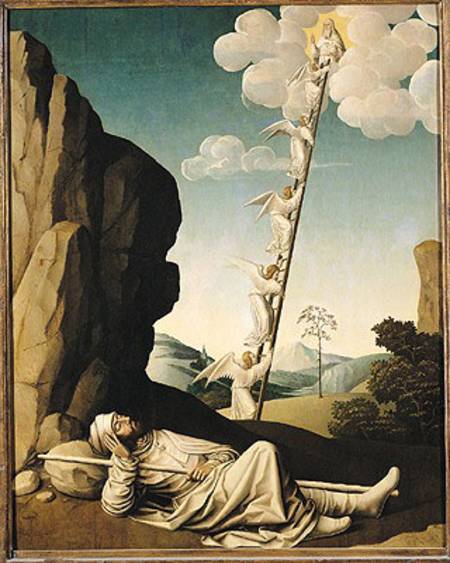
When life thrusts uncertainties at us, we often grasp for a sense of being connected to someone or something. We search for ways to recreate the sense of safety and certainty, either consciously or not. This idea of looking for refocusing on how faith and belief might be a place of safety is exemplified in one of the famous biblical stories, Jacob’s dream in which he envisions a “Stairway to Heaven.”
After running away from Isaac and Rebecca’s home as a means of self preservation because his twin brother Esau planned to take revenge over the stolen birthright, the Torah finds Jacob having stopped overnight to sleep. On this night, Jacob dreams of a ladder going from the land to heaven. The Torah states:
And the LORD was standing beside him and He said, “I am the LORD, the God of your father Abraham and the God of Isaac: the ground on which you are lying I will assign to you and to your offspring.
Your descendants shall be as the dust of the earth; you shall spread out to the west and to the east, to the north and to the south. All the families of the earth shall bless themselves by you and your descendants.
Remember, I am with you: I will protect you wherever you go and will bring you back to this land. I will not leave you until I have done what I have promised you.”
Genesis 28:12-16
Jacob dreams/receives a prophetic message that Gd will be with him and protect him throughout his journey until such time as he returns to the land of Canaan. For Jacob, this reassurance is key to his ability to withstand the trials and tribulations he will come to face during his sojourn. Yet, Jacob maintains uncertain, for a few verses later, as Jacob takes leave of this seemingly holy place, the Torah states:
Jacob then made a vow, saying, “If God remains with me, if He protects me on this journey that I am making, and gives me bread to eat and clothing to wear,
And this stone, which I have set up as a pillar, shall be God’s abode; and of all that You give me, I will set aside a tithe for You.”
Genesis 28:20-22
This latter scene suggests that Jacob was not one hundred percent convinced that Gd would fulfill his promise from the dream, so Jacobs offers the vow that he would provide a percentage of his hoped for accumulated wealth to Gd as a tribute for protection. Why would Jacob not believe wholeheartedly in Gd’s promise? I would suggest that Jacob’s uncertainty is not from a lack of faith but rather from an innate sense of abandonment that he feeling on this night. This is depicted in the first image of the dream, in which the “angels of Gd” ascend and then descend from the ladder. If we consider the image we would expect to see, the angels should have descending first and only then ascending. Yet, the verse flips the actions, leading to the following comment from Rashi:
עלים וירדים ASCENDING AND DESCENDING — It states first ascending and afterwards descending! Those angels who accompanied him in the land of Israel were not permitted to leave the Land: they ascended to Heaven and angels which were to minister outside the Land descended to accompany him (Genesis Rabbah 68:12).
As we know, dreams, even in the prophetic sense that is attributed to them throughout the Bible, contain many images that illustrate our unconscious or conscious concerns. For Jacob, the angels were his protectors, his internal sense of not being alone, which his subconscious highlighted in his vision. While Jacob does have a destination, his uncle’s home and a mission to marry his uncle’s daughter, he is presumably filled with feelings of abandonment and uncertainty about the future. As such, he dreams of angels first ascending, for deep down he knows he is never alone. Furthermore, the entire dream focuses on Gd being with him throughout his journey. The angels represent that Jacob can rest assured that he is not being abandoned at any point.
Regarding his vow after the dreams, the vow speaks to Jacob’s conscious sense of uncertainty. A dream is a dream and even one of a “prophetic” nature can leave someone with doubts. Jacob’s vow/covenant to Gd is a way for Jacob to accept that dream and change his mindset. No longer will he allow himself to be worried about the uncertainties that lie ahead. He knows he will be able to handle them because of Gd’s “promise” and his offer as a means of submission to this new perspective.
Jacob’s vision and response is a powerful example of the challenge we all face when starting on a new journey. Deep down we know there is risk any time we venture into something new. Doubts exist. Yet, if we allow the doubts to overtake us, we will never be able to take the first step. When we acknowledge the doubts and take control of them, recognizing the doubts are part of the journey, not the barrier, we will be able to move forward and find our new beginning.
May we find the ability to change our mindset as we work towards achieving our growth potential and our wishes.



 New beginnings: A blog about spirituality, chaplaincy and renewal