Humility is recognizing we don’t have to do it alone

It can be quite a challenge to be willing to work together with others. For many of us, it can seem less cumbersome and less stressful to just take on another task instead of seeking help from others. I believe this is particularly true when it comes to fostering our spiritual and emotional growth. Yet, if we allow ourselves to find the person or persons who can hold our hand and lift us up in the process, we will find greater success in all of what we venture out to do.

With the fall Jewish holidays over, the Torah reading cycle starts afresh with Bereishit, Genesis. Chapter one tells the story of creation, in which Gd, and Gd alone, for the most part, brings the world into existence. Yet, there is a single exception, for a mere 26 verses into the Torah, we come across a moment of collaboration in the midst of the story. Verse 1:26 states, in describing the creation of humanity:

וַיֹּ֣אמֶר אֱלֹהִ֔ים נַֽעֲשֶׂ֥ה אָדָ֛ם בְּצַלְמֵ֖נוּ כִּדְמוּתֵ֑נוּ וְיִרְדּוּ֩ בִדְגַ֨ת הַיָּ֜ם וּבְע֣וֹף הַשָּׁמַ֗יִם וּבַבְּהֵמָה֙ וּבְכׇל־הָאָ֔רֶץ וּבְכׇל־הָרֶ֖מֶשׂ הָֽרֹמֵ֥שׂ עַל־הָאָֽרֶץ׃

And God said, “Let us make humankind in our image, after our likeness. They shall rule the fish of the sea, the birds of the sky, the cattle, the whole earth, and all the creeping things that creep on earth.”

In a departure from the majority of the verses in chapter one, this verse states that Gd seemingly has consulted with other “beings” in the decision to create the human being. In response to this anomaly, Rashi, the great medieval Jewish biblical commentator, suggests a non-literal, ethical read of the text. He states:

נעשה אדם WE WILL MAKE MAN — Although they did not assist Him in forming him (the man) and although this use of the plural may give the heretics an occasion to rebel (i. e. to argue in favour of their own views), yet the verse does not refrain from teaching proper conduct and the virtue of humbleness, namely, that the greater should consult, and take permission from the smaller; for had it been written, “I shall make man”, we could not, then, have learned that He spoke to His judicial council but to Himself. And as a refutation of the heretics it is written immediately after this verse “And God created the man”, and it is not written “and they created” (Genesis Rabbah 8:9)

Quoting midrashic literature, Rashi suggests that the verse is written in plural form to teach that true humility includes not believing one has to do things by oneself. In looking at this comment, it is a reminder of the adage from Ethics of our Fathers,

יְהוֹשֻׁעַ בֶּן פְּרַחְיָה וְנִתַּאי הָאַרְבֵּלִי קִבְּלוּ מֵהֶם. יְהוֹשֻׁעַ בֶּן פְּרַחְיָה אוֹמֵר, עֲשֵׂה לְךָ רַב, וּקְנֵה לְךָ חָבֵר, וֶהֱוֵי דָן אֶת כָּל הָאָדָם לְכַף זְכוּת:

Joshua ben Perahiah and Nittai the Arbelite received [the oral tradition] from them. Joshua ben Perahiah used to say: appoint for yourself a teacher, and acquire for yourself a companion and judge all favorably.

Pirkei Avot 1:6

Life is about making connections and looking to one another for support and help. If Gd could be presumed to have asked for advice, then for sure each of us needs to find people in our lives who will help lift us up. In fact, like the above picture, one of the underlying premises of New Beginnings Spiritual Coaching and Consulting is to give someone a hand to help lift them up. Being willing to reach out a hand for another to help them up, an act of humility, an act of accepting one’s need for help, is the first step in spiritual growth.
I believe Rashi makes the choice of offering a non-literal read of the use of the plural instead of suggesting the more literal suggestion that the verse is merely using the “royal we” in this particular circumstance. Rashi is tasking the reader to see early on how the Torah can be a moral guide if we pay attention to the subtle nuances and gaps in the text. In this case, we learn this valuable lesson about humility. Of course, western religious literature is full of texts and commentaries that offer us multiple readings of the text to teach us lessons about life. If we pay attention, study the words carefully, and expand our reading to include different and varied approaches to these sacred texts, we are metaphorically putting out our hand to be lifted up spiritually.

As we begin the new Torah reading cycle, may each of us find a true sense of humility in realizing that there are always new opportunities to reach out our hands to be raised higher.

If you are ready to reach out your hand, I am here to help lift you along your journey of spiritual growth: Contact New Beginnings Spiritual Coaching and Consulting LLC at 732-314-6758 ext. 100 or via email at newbeginningsspiritualcoach@gmail.com.


The Gates are Closed/ The Gates are Open

Yom Kippur has come and gone. We have prayed, fasted and spent the day in the most spiritual way possible. The gates are closed. We emerge with the hope that this year will continue to be a year of good and of life.

And yet, with one gate closed, another is open:

Today begins a New Beginning. We have achieved our yearly moment of closure, the books of the past are sealed and now we have the chance to write the book of the present.

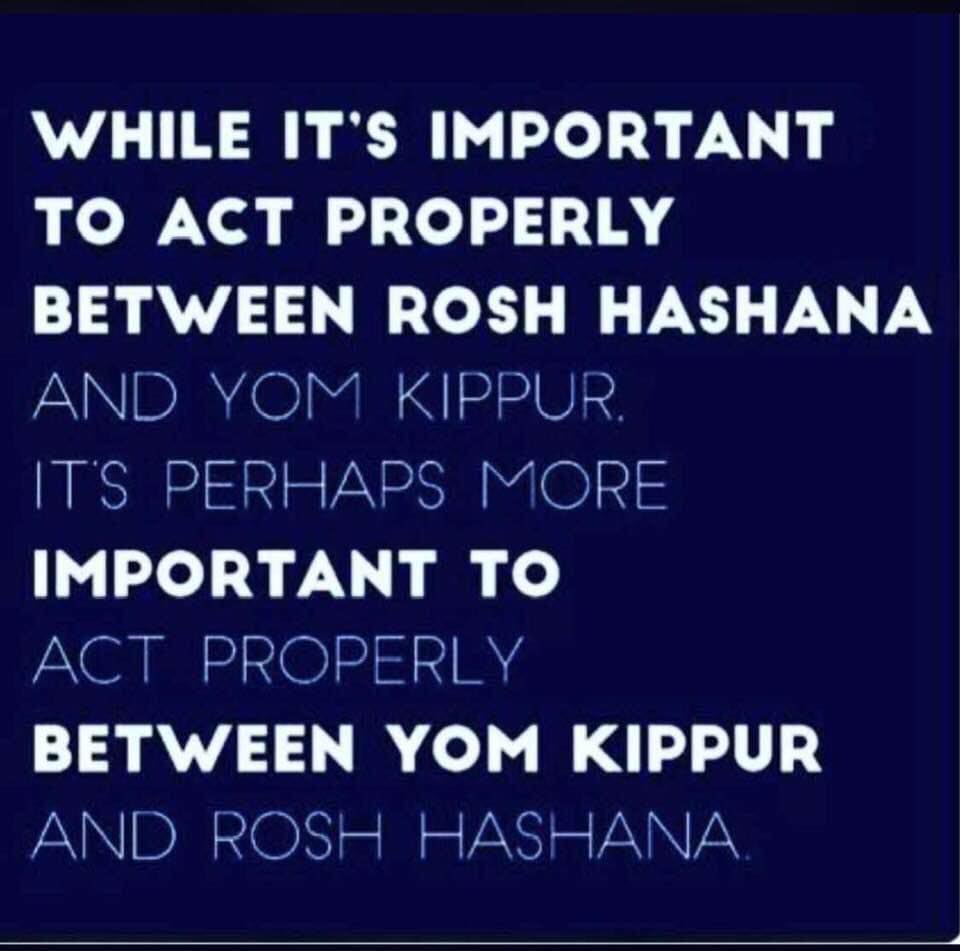
How do we take the spiritual high from yesterday forward? Perhaps the answer is best expressed in this popular meme:

As I have been reflecting on the prayers from the high holidays, specifically the viddui prayers we recited yesterday, it is clear that the confessionary nature of these words is a combination of raising for us a sense of what we have done wrong in the past and a road map of how to better ourselves. The areas of confession range from how we speak, how we interact with others and our need for mindfulness in all of our actions. If we have truly taken the day to heart, we will have hopefully walked away taking the first steps towards how we approach the next 12 months until the next Yom Kippur.

We are now in the 4 days leading up to Sukkot, Zman Simchateinu, the time of Joy. As we prepare for the celebratory days of Sukkot, may each of us take the power of Yom Kippur forward and celebrate the new opportunity placed before us.

Are you looking to take the next steps in the process of establishing your new journey: Contact New Beginnings Spiritual Coaching and Consulting LLC at 732-314-6758 ext. 100 or via email at newbeginningsspiritualcoach@gmail.com.
We can still Light the Candle

The hour is late. In mere hours we will be entering Yom Kippur. We have had ample opportunity for reflection and introspection. And while we might think it is too late, we would do well to remember it is never too late. We can still open our hearts to the desire to change and offer that deep desire as our first step to real, true teshuvah, true returning to the person we strive to be. I came across the following idea from Rav Moshe Weinberger that illustrates this concept (found here [p.19]):

One year on Yom Kippur, the Sar Shalom of Belz quoted the mishna in Shabbos (34a),


”ג’ דברים צריך אדם לומר בתוך ביתו ערב שבת עם חשכה עשרתם ערבתם הדליקו את הנר,““a person must say three things erev Shabbos as it gets dark, ‘Have you tithed?’, ‘Have you prepared the eruvim?’, and ‘Light the candle!’”

He explained that because Yom Kippur is called the ultimate Shabbos (Vayikra 16:31), this mishna also alludes to our feelings as we enter into Yom Kippur. “עשרתם “means “Have you tithed,” but because the root word is “עשר “,meaning ten, it alludes to the ten days of teshuva, as if to ask, “Have you used the ten days of teshuva properly?” Indeed, the ten days of teshuva have passed and what did we accomplish?! “ערבתם “ means “have you prepared the eruvim?”, like the eruv techumim and the eruv chatzeiros. But “ערב “also means “eve,” as if to ask “Have you used the eve of Yom Kippur properly to prepare? Erev Yom Kippur has passed and how did we use it?!

And the last question relates to kindling the Yom Kippur candles. The Sar Shalom continued “The candles are already lit and look what a state we are in!” He was quiet for a moment and then he concluded, “But ‘הדליקו את הנר ‘,does not mean ‘the candle
is already lit.’ It means ‘Light the candles!’ Therefore it is not too late! Each and everyone of us still has time to light the candle, which refers to (Mishlei 20:27) ‘ נר אדם נשמת’ ה’ ‘,the soul of man is G-d’s candle.’”

Much of my suggested work in coaching others begins by showing them that the first step is to take the first step. If we just light the candle, do this one small task, we are already along the way to change. Once we recognize that the hardest thing is such a simple thing, we will then be able to begin along a new path towards growth.

Yom Kippur is both a culmination and a beginning. If we have been working on how to change this whole time, Yom Kippur allows us to have a sense of the slate wiped clean so we can make the fresh start we desire. And if we haven’t used this time as well as we could, don’t despair. Yom Kippur is a roadmap towards areas we can and always should be working to better ourselves in.

May each of us find this Day of Atonement to be the guide forward we are in need of as we all continue to foster the desire for New Beginnings in our lives.

If you are exploring ways to deepen your ability to recognize within yourself areas of desired spiritual growth: Contact New Beginnings Spiritual Coaching and Consulting LLC at 732-314-6758 ext. 100 or via email at newbeginningsspiritualcoach@gmail.com.

Listening to the whole story

How many of us only pay superficial attention when someone talks to us? Are we only conscious of hearing just what is being said? Maybe we are among the fortunate who pay just enough attention to get the gist of the message? Or perhaps, when someone is commenting about a situation or offering constructive criticism, even with the best of intentions, all we hear is the criticism without listening to the underlying suggestions of ways to improve? Are we too stuck in who we are, too stubborn to receive feedback, to recognize how the criticism is hopefully coming from a good place? (And yes, I am and have been guilty of this way too many times to count).

Sometimes the rebuke is really a blessing in disguise!

I came across a thought from the end of last week’s Torah portion that I found to be spot on as a reflection of hearing/not hearing as it pertains to growth and change. Deuteronomy 31:30 states:

וַיְדַבֵּ֣ר מֹשֶׁ֗ה בְּאזְנֵי֙ כל־קְהַ֣ל יִשְׂרָאֵ֔ל אֶת־דִּבְרֵ֥י הַשִּׁירָ֖ה הַזֹּ֑את עַ֖ד תֻּמָּֽם׃ {פ}
Then Moses recited the words of this poem to the very end, in the hearing of the whole congregation of Israel:

When the Torah uses the word אזני (in the hearing (related to the word for ear)) or any of its derivative words, it implies a different kind of listening, perhaps as in emphasizing paying attention. The people were to be paying attention to some form of poetic rendering of Moses’ final speech. This is either a reference to Deuteronomy 32 or it is a reference to the series of verses that precede 31:30 starting from 31:22, which also uses the word שירה as a reference to the words of Moses. Regardless, the word שירה has a positive connotation, the words preceding or upcoming are more of a rebuke. As such, what did they hear?

The Israelites, while hearing the harsh words from Moses, also heard hope in his words. They didn’t just hear the rebuke and the consequences of their fall. They also heard that even when falling so far, there is a point of being able to rise back up, that the relationship promised would remain. They heard the song because they were listening with their ear, listening intently to the entire speech, not just sitting with the negativity of rebuke.

Every year, I am amazed at the extent of the formal confessionary forms of prayer we engage in throughout the period between Rosh Hashanah and Yom Kippur, culminating in the Viddui/confessions of our various “sins,” which are recited time and again on Yom Kippur. It is easy to get overwhelmed by the categories of our errors and how far we must come. Yet, I am also amazed that within this hard reality check, we can emerge with a renewed feeling of “success” and belief that we will be sealed for a good year. In many synagogues, it has become the practice to sing and dance immediately post Yom Kippur as a show of our seeing beyond the words. Through our confronting our humanity in a serious fashion, we come out the otherside having taken the heaviness and made it into something to celebrate, not dread.

May each of us “hear” the prayers of Yom Kippur as the road map forward for us to grow each day. May our “ears” be open to both the voice inside ourselves looking to improve and to the feedback we hear from others.

If you are exploring ways to deepen your ability to recognize within yourself areas of desired spiritual growth: Contact New Beginnings Spiritual Coaching and Consulting LLC at 732-314-6758 ext. 100 or via email at newbeginningsspiritualcoach@gmail.com.

Self compassion as a door to compassion for others

Rosh Hashanah, the Jewish New Year, is a meaningful holiday for me. It is one of a series of opportunities in the year to take stock and to start anew. Unlike other times, such as my birthday and my wedding anniversary, part of the power of Rosh Hashanah is how together, communally, we are all together in this process of establishing a New Beginning, a new hope for the upcoming year. Through the sound of the Shofar, we are called to wake up and listen to the sounds and to the silences around us so as to better figure out what it is we hope for in the coming year.

I had the fortune to do a lot of reading and reflecting on the past two days (the beauty of being shut off from the constant barrage that comes from our connected world). And yes, while Shabbat and the holidays are about so much more than unplugging, the unplugging is a powerful byproduct.

In my reading over the holiday, I came across a piece that relates back to a book I read through this summer, Self-Compassion: The Proven Power of Being Kind to Yourself, by Dr. Kristin Neff. In a piece from Rabbi Dr. Abraham Twerski’s Growing Each Day, he suggests the following spiritual approach to understanding judgment during this period between Rosh Hashanah and Yom Kippur which I would extend to how we should see self-reflection in our daily lives:

God knows that personal interest makes us oblivious to the significance of our own misdeeds, so He contrives to make us observes in others actions and behavior similar to our own. How we react to our own acts as we see them in others determines how God will judge us. If we are considerate and lenient in our judgment, and give others the benefit of the doubt, allowing them the broadest latitude of circumstances that might have caused them to behave improperly, then God will judge us with equal leniency. But if we are self-righteous and quick to condemn others, we will be judged with equal severity.

p. 3

When we consider the work of self-compassion, one of the premises is that we tend to be quicker to forgive others mistakes than our own when the same mistake is made. We tend to be our own harshest critic. And lest you think that our self-criticism doesn’t ultimately harm our compassion for others, the more we lack in self-compassion, the harder it will be to continue to be compassionate and forgiving of others for their foibles. If we consider the above quote, we can see how our sense of personal, self-acceptance and compassion for our imperfections will open us up to increase our ability to be compassionate to others. If we are reacting to what we are witnessing, we would do well to spend a moment or two reflecting on what we see and what is being mirrored to us so we can react better to them and to ourselves.

As we continue on this journey together exploring how to foster new beginnings for ourselves, may we find ways to bring more compassion into the world for ourselves and for all those around us.

If you are looking to deepen your ability to recognize within yourself areas of desired spiritual growth: Contact New Beginnings Spiritual Coaching and Consulting LLC at 732-314-6758 ext. 100 or via email at newbeginningsspiritualcoach@gmail.com.

Planting seeds for the New Year – Rosh Hashanah 5783

We are standing on the precipice of another year in the Jewish calendar. As always, it is a time of introspection (it’s never too late to think back over the year). What do we want different? What are our hopes for the upcoming year? Where do we even begin?

One of the customs many have on Rosh Hashanah is to eat certain foods that symbolize our prayers and hopes for the new year. The source for this custom is mentioned in a couple of places in the Babylonian Talmud:

Horayot 12a and Keritut 6a

אמר אביי השתא דאמרת סימנא מילתא היא [לעולם] יהא רגיל למיחזי בריש שתא קרא ורוביא כרתי וסילקא ותמרי

Abaye said: Now that you said that an omen is a significant matter, a person should always be accustomed to seeing these on Rosh HaShana: Squash, and fenugreek, leeks, and chard, and dates, as each of these grows quickly and serves as a positive omen for one’s actions during the coming year.

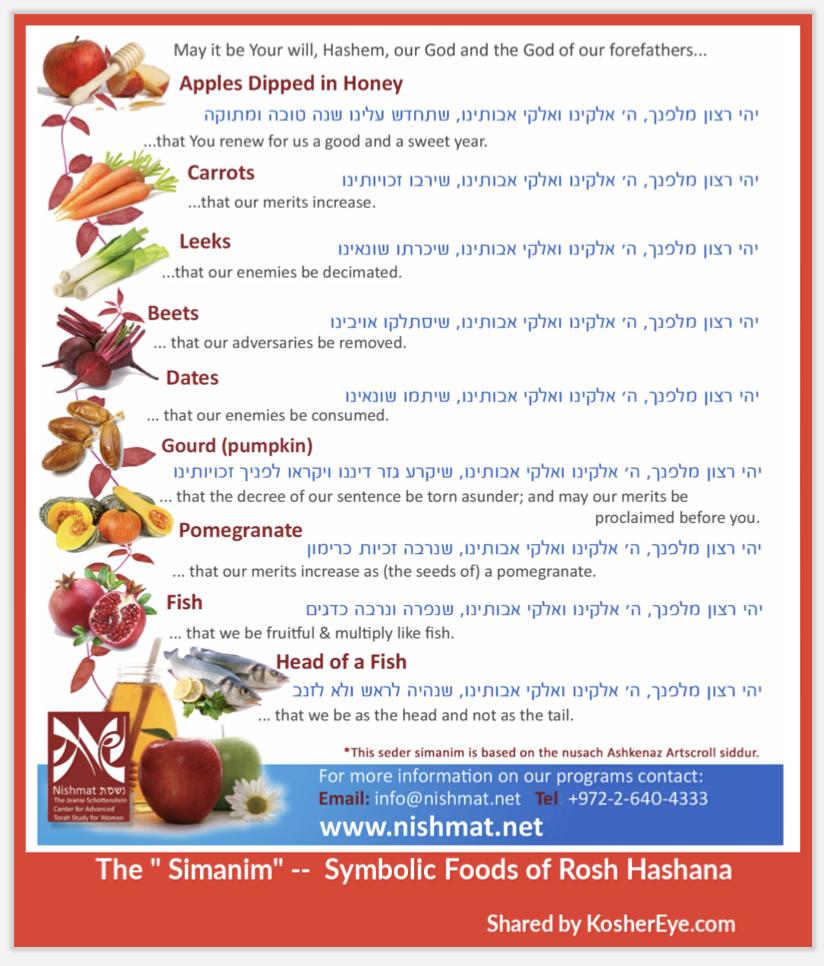
In addition to the above mentioned foods, see the chart below for what many do today, which adds to the Talmudic list.

In my pre-Rosh Hashanah reading yesterday, I came across a discussion of this custom. At first glance, many of us would think this is a bit like magic, that somehow my consumption of one food or another has the power to invoke change in our lives. How can it be that by eating an apple dipped in honey I should be able to ask Gd to grant us a sweet new year? Is it merely magical thinking? Is it really that simple?

In response, perhaps we are looking at the custom all wrong. According to the essay I was reading, we need to rethink the word siman(symbol). If we see the notion of symbol in the sense of planting a seed, as in a famous idea about how to read the stories of Genesis as “The actions of our forefathers are symbols for the children,” we can begin to appreciate the practice of these symbolic foods. If our actions become lessons for our children, then in a way, what we do is the equivalent of our planting the seeds for our children to learn from the good and bad in our lives. Hence, we can say symbols are seeds being planted.

On Rosh Hashanah, when we eat these symbolic foods, we are also planting seeds. We are praying, we want the upcoming year to be better, sweeter, with our successes at the forefront and our enemies vanquished. We want a year of positivity, a year in which the naysaying voice in our head is quieted down so we can see and feel the growth we are all experiencing, even when we don’t realize it. Through these foods, we aren’t performing magic tricks. We are taking the first step to real growth, naming what we want and hoping that this first step is a seed that germinates and sprouts for us along our journey of this upcoming year.

Many of my posts have been about the planting of seeds and taking first steps. This is the essential philosophy of New Beginnings. We are always presented an opportunity for a new beginning and while things might seem to be on a continuum, they are also a series of beginnings if we choose for them to be. I truly believe that each day we are doing is a day of growth and change even when we ourselves don’t see it as such. Each pitfall along the way, for there will be setbacks and challenges, are also growth points if and when we are ready to see them as such.

May this year, 5783, be a year in which we see the growth we are all doing, a year of peace in our lives and in the world, a year of less worry over the things we can’t control and most of all, a sweet, good and healthy year to all.

Want to take your hopes and wishes for a new year and really concretize them? Looking to solidify and continue your spiritual growth: Contact New Beginnings Spiritual Coaching and Consulting LLC at 732-314-6758 ext. 100 or via email at newbeginningsspiritualcoach@gmail.com.

99 and 1 – 100 posts and seeing time in increments of 1%

Today I celebrate the 100th posting on this blog/website. As I reflect on the number 100, I find myself going back to my piece last week about the number 99 and prefer to see this post as number 99 + 1. I am grateful to have been able to share and reflect on a variety of topics with all my readers and look forward to continuing along on this journey of exploration.

For this post, I found myself trying to determine what the 1 of 99 + 1 could symbolize for me or what we could learn from this equation instead of merely sitting with the number 100. Fortunately, a colleague of mine in our local BNI group pointed out an idea about 1 as it relates to 1% of one’s day.

1% of the day is the equivalent of 14 minutes and 40 seconds. Imagine if we were intentional for just 1% of the time. What can you get accomplished in 14 min. and 40 sec. a day? According to this piece, TRANSFORM YOUR LIFE BY CHANGING JUST 1% OF YOUR DAY, we underestimate how much we can grow in this short burst of intentionality. We underestimate how establishing this small routine might very well be the mere opening to use more time with intentionality.

Similarly, in any long term activity we desire to take on, if we just take one piece at a time, we can find the greater success. For me, the achievement of this blog is not the total posts so far, but it is in each piece I write. Whether exceptional, plain or even subpar, each piece is a unique undertaking. And while it adds up over time, my focus can only be on the 1. Time is the same. I might be setting aside X hours to do a task, yet if I then break that down further and further to manageable moments, I will more likely come away with a better outcome. Too much and we get overwhelmed.

What do you do with your 1% of the day?

Exploring how to create a 1% a day practice?: Contact New Beginnings Spiritual Coaching and Consulting LLC at 732-314-6758 ext. 100 or via email at newbeginningsspiritualcoach@gmail.com.
99 – imperfection and greatness

Today is my 99th post on this website. Usually, people celebrate the whole numbers, so I am one off from a celebratory moment of writing post 100. Yet, I find the number 99 to be highly significant for a story I will share a little later on. But first…

Last night, I was playing around on Twitter and came across this tweet from a friend:

Aaron Judge, probably the most recognizable #99 in today’s sports fandom, is having a season for the ages. And while I am a Mets fan, with his own #99 –

it is clear that Judge is the better #99. Granted, for me, #99 takes me back to the great one Wayne Gretzky (NHL) and to the eccentrics like Wild Thing Mitch Williams and the infamous Turk Wendell (MLB – if you know, you know), but right now, for Baseball fans, 99 is Aaron Judge, and all the others tend to be glossed over (for a full list of all those in MLB who wore 99, see here).

This got me thinking about the significance of 99, only to recall another 99, but not in terms of sports. I was reminded of a teachable moment from when I was in High School, which I go back to every so often. It was 11th grade Chumash. We had just gotten a test back from our teacher and I noticed that while I got every question correct, I only received a 99 (yes, I admit, I was one of those students, always looking for the extra point). This bothered me as clearly I had earned the 100, the arbitrary perfect score we generally place on tests. I went to the rabbi and asked him why I didn’t get 100 when I clearly got all of the questions correct. To this day, I recall his response:

“Even Moses didn’t know everything, so in my opinion it would be impossible for anyone to achieve a 100.”

I’ll admit, the answer didn’t fully satisfy me. Yet, the lessons are quite apparent and in truth ones I have come to appreciate.

  1. As I wrote about months ago, there is a notion of When 80 Percent is Perfect. We should always strive for the best we can do and recognize that the best will never be 100 percent because the 100 is a long term impossibility. There will always be something that is missed, even when it appears as if you got everything right.
  2. We need to appreciate the beauty and greatness of the 99 within the scale of 100. Truth is, we need to appreciate even more than just the number closest to 100. We need to learn to appreciate all we have gained and not focus on the missing point(s).

Which brings me back to sports. Aaron Judge is having an outstanding season, a season for the ages, since we learn that in sports we focus on the accomplishments when it comes to most statistics as opposed to the failures that are the opposite side of the coin. For example, he has been on base over 40% of the time this year, which means he not been on base a little less than 60% of the time. In other words, his great year includes more failures than successes. Yet, we see the success and ignore the failures. He is having a 99 season (which for sports video game people, is the highest rank a player can get for a season).

If you have made it this far, thank you for reading this 99th post. Writing is a series of failures, deletions and edits until something comes together that is hopefully coherent and interesting. Life is the same. We fail, change course, shift, all in the drive to forge a path for ourselves. We experience many endings and New Beginnings. May each of you find the success within the imperfection and remember the greatness that is a 99.

Reflecting on how to appreciate the steps along the way: Contact New Beginnings Spiritual Coaching and Consulting LLC at 732-314-6758 ext. 100 or via email at newbeginningsspiritualcoach@gmail.com.

Self-reflection/looking in the mirror

A couple of my more recent posts have explored the topic of identifying the various components of self identity. In this post, I am…, I included the beginnings of a list of different terms as to who I see myself as and as a paradigm for your personal growth. This practice, of listing the various “I ams” is a crucial component of growth. By looking in the mirror and engaging in the various elements of who we see, we can then explore the deeper characteristics that underlie each of those elements of our self-makeup.

Some of you reading this might question this method. After all, the work of claiming an “I” seemingly flies in the face of many spiritual practices. It is a common misconception that the goal of spiritual practice is an absolute self-nullification, a removal of all “I” elements of life. I would argue that this is a mistaken premise. Self-nullification, losing oneself in greater spiritual growth, is about the work of not allowing any of the identifying elements of the self to become sacred, to become the be all and end all.

Rather, what I am proposing is that the “I am” is a gateway to deep exploration and spiritual work as it relates to growth. This dawned on me in working with a couple of my clients, exploring the underlying meaning of the terms they were using to identify themselves. The exploration was to try to understand what were the drivers behind the particular term that the person used as a definition of self. When we are clear on who we are and what that means to us, we can then travel a road of who we wish to become within or without the term we are exploring.

For example, in my previous post, I identified myself as a “reader.” If I were to break this down further, I might begin by describing what I like to read or the types of books I find myself reading at the moment. I might explore what reading does for me. In fact, here is a rough outline of what saying I am a Reader is to me:

  1. explorer
  2. curious
  3. seeker of knowledge
  4. reading allows me times to escape from the challenges of life
  5. reading is a spiritual practice
  6. growth and change
  7. reading is a gateway to unexplored worlds
  8. reading is helpful in being a writer

I would then take this list and go deeper in this and related topics as it pertains to the goals the person I am working with would like to explore. For example, if I want to explore the notion of reading as a personal spiritual practice in relation to what it means when I define myself as a reader, I would work with the person to deepen their self-notion of what reading as a spiritual practice is. Is it the focus of reading? Is reading really about study and being absorbed in the depths of another’s words? Is it a form of connection to Gd (there is much in religious thought about connecting to the divine through the practice of study, of learning)? The goal of these explorations would be to help foster within the person the richness that comes from insights into the self so as to better foster the growth a person is looking for.

May each of us discover new aspects of ourselves as we consider the “I ams” we bring to the world.

Reflecting on your own path of self-discovery: Contact New Beginnings Spiritual Coaching and Consulting LLC at 732-314-6758 ext. 100 or via email at newbeginningsspiritualcoach@gmail.com.
How many drafts does it take

I have been finding a lot of self-reflective material when considering aspects of writing. In writing, like life, it is almost impossible to create the perfect piece in a single sitting. Just like it is important to remember that all goals are made up of a series of single steps, one foot after the other, so too writing is a process of putting one word on paper at a time, in which eventually the string of words becomes a cohesive unit. Along the way, there will be updates to the unit of writing, whether because of a misspelled word, a missing punctuation mark, or information that is lacking because we forget to convey to the reader precisely what we are thinking. Or, perhaps you think it is good, post it on a website, and then get a copy-editor’s eye to read it and circle in yellow the errors in the piece (which luckily is easily fixable in wordpress).

Serious writing is a series of rough drafts, when in a way even the final draft remains an incomplete, imperfect product. Yet, for those of us who persist in writing, the rough draft, the initial go, is often as valuable if not more valuable than the “final product.” The rough draft is the opportunity to try and fail in the craft of formulating an idea. The rough draft is the proof you need to know you have taken the hard first step of engaging in the writing process.

The rough draft is a great metaphor when we consider self-introspection and change. Most of us are searching for do-overs, the opportunity to change what was, whether by scrapping something and moving away from the past or from veering slightly to the right of left to a different turn that we believe will lead us in the direction we really want to go. Like with writing, when we cross out and change words, life gives us countless opportunities to adjust to the moment, to the times by changing, rearranging or erasing elements of our before so as to make the step forward towards a new start.

I came to this thought this afternoon as I was scrolling through a list of some of the blog posts which I have either not completed or have pretty much decided to leave in the draft folder because they don’t resonate for me at this point. Many of the drafts were like the dipping of a toe into a topic and realizing the water was not ready yet or perhaps might never be. The draft folder contains the tried and failed so as to then try again and succeed with any number of other posts.

Every Elul as well as every other demarcation point in one’s year, when we reflect and desire to explore unknown elements of the path going forward, we are reminding ourselves that we remain a “rough” draft in need to further polishing. The polishing can take multiple reads, multiples steps and missteps along the way. We can and do go through many drafts of our lives. The goal is fostering and maintaining the hope that each time we reread and edit, we are succeeding by seeing the incremental and/or monumental improvement over the previous version.

May this be a time of year when we can all look inside and make the necessary edits to improve on the rough drafts we have crafted up until now.

Need help scouring and editing the Rough Drafts of your life: Contact New Beginnings Spiritual Coaching and Consulting LLC at 732-314-6758 ext. 100 or via email at newbeginningsspiritualcoach@gmail.com.