
Who is The Real Me

Late yesterday, I updated my Facebook profile picture and cover photo to reflect who I am currently. Interesting that this change got a lot of reactions from my social media feed. This lesson in social media ties into something that I have been thinking about, “who is the real me?” This question relates to how we portray ourselves in public vs. how we see ourselves in private. We live in a very public, open world in our digital age. We live in a world where the majority of us are not just sharing public and private personas in our small communities. Living in a global community requires an increased consciousness of what we want others to see and that most likely moves us further away from our true, inner self that we often show in the privacy of our homes. And if I were to be honest, this is a challenging state to constantly have to navigate.

When we meet new people, are they showing us the glossy website version of themselves, the deep, troubled version or something in between? Sure, meeting a new person and expecting an instant trust is hard to ask of anyone. Yet, why is it that we hide behind an image. We are all guilty of this.

My Spiritual Life Coaching Practice, which is informed by my pastoral/spiritual care training, is also informed by the real, imperfect person that I am. No two people will ever have the same experiences. And, nobody is ever alone in experience, as we all have a well of emotional and spiritual ups and downs we can draw upon to be present with someone else struggling. I believe that if we are to help others discover hope, meaning, New Beginnings in a transitional period in life, we have to meet them from the place of our humanness and vulnerability. We must maintain boundaries with each other and we must find a way to build the trust needed to explore and effect the changes we are looking for when engaging a professional to help in our self discovery.

As I write these words, I realize how so much of this notion of showing the “real” me is predicated on trusting myself to be OK and compassionate to the real, imperfect self that I am. My belief is that each of us is masking our true, real selves behind a mask because we aren’t OK with who we are. Too many of us don’t like the person we see in the mirror, even though we wish we could. And yes, that last line is channeled from an interesting albeit strange self-help practice call the High Five Habit, in which we develop a notion of self-compassion and confidence through literally offering ourselves a high five each morning in the mirror.

May today be the day we begin to foster our self-compassion, trust and acceptance of the person we see in the mirror and may this person be the person we share with others.

Looking to discover your more authentic, spiritually focused self? Let me help you along this path! Contact New Beginnings Spiritual Coaching and Consulting LLC at 732-314-6758 ext. 100 or via email at newbeginningsspiritualcoach@gmail.com


Rebbe Nachman’s Advice # 12 – Finding Truth through removing the urge to win

Most of us have a competitive nature. This competitiveness can be positive in that pushes us to success. Yet, this same push can also have negative side effects. Often this competitiveness will lead people to push others aside, cut corners or do other things just for the sense of victory. In this piece by Rebbe Nachman, he suggests that this dark side of looking for the victory can blind us to what is sitting right in front of us:

לג. ×”Ö·× Ö·×¦Ö°×—Öø×Ÿ אֵינוֹ הוֹבֵל ×”Öø×Ö±×žÖ¶×Ŗ, וְאַף א֓ם יְבָרְרוּ ×œÖ°×¢Öµ×™× Öø×™×• דְּבַר ×Ö±×žÖ¶×Ŗ י֓דְחֶה אוֹתוֹ ×žÖµ×—Ö²×žÖ·×Ŗ × Ö“×¦ÖøÖ¼×—×•Ö¹×Ÿ. עַל־כֵּן מ֓י שֶׁרוֹצֶה לֵידַע ×”Öø×Ö±×žÖ¶×Ŗ ×œÖ·×Ö²×žÖ“×ŖÖ¼×•Ö¹, יְהַלֵּק מ֓קֹּדֶם ×žÖ“×“Ö·Ö¼×Ŗ ×”Ö·× Ö“Ö¼×¦ÖøÖ¼×—×•Ö¹×Ÿ מֵעַצְמוֹ, וְאָז ×™Öø×›×•Ö¹×œ ×œÖ“×ØÖ°××•Ö¹×Ŗ ×”Öø×Ö±×žÖ¶×Ŗ א֓ם י֓רְצֶה ×‘Ö¶Ö¼×Ö±×žÖ¶×Ŗ: (לק”א ×”×™’ קכ”ב)

One who always wants to be victorious is very intolerant of truth. The truth may be staring him in the face. But because he is determined to win at all costs he ignores it completely. If you want to find the real truth you must rid yourself of the urge to win. Then you will be able to see the truth if you wish (122).

This is a powerful spiritual growth principle. When we are looking to foster our drive to fulfill our goals, are we blinded by the end game? Do we constantly just look at the ends but not spend time where true growth really occurs, which is the process of striving towards a goal? Do we struggle to find that inner sense of the spiritual because we are always comparing ourselves to the images we think are the truths in front of us?

It is too easy to compare ourselves to others, to judge others based on how they appear and think that their lives are better. Too often the stumbling block to seeing the truth we know, the one in which we are making progress and succeeding in our own journey, is the urge to compete and compare lives. There are few who have fully shed this blindness to the reality right in front of us.

Yes, there are times we need to “fake it till we make it.” There are moments when the appearance is primary, dressing for the success we hope to have (attested to in the theme of this week’s Torah portion, Tetzaveh, which describes the clothing the priests and high priest must wear when in service to Gd in the Temple). We give off the positive impressions on the outside as part of the societal norms. Yet, our true path, true growth, comes from the internal, not from how I am in relation to another but how I am in relation to myself.

Today, may each of us work towards striving to see the truth that is already in front of us, inside of us. May we find the gratitude towards the self for all of our successes, seeing that Truth cannot be fostered when we are judging ourselves based on someone else.

Are you struggling with your spiritual growth? Faith? Feeling lost in the midst of the journey of life? Contact New Beginnings Spiritual Coaching and Consulting LLC at 732-314-6758 ext. 100 or via email at newbeginningsspiritualcoach@gmail.com

Who isn’t an imposter? The struggle of confidence

Let’s be real today. Who among us isn’t struggling to a certain extent with feeling like an imposter? According to this overview of imposter syndrome from Psychology Today, 70% of adults will have the feelings related to imposter syndrome at least once in life. In other words, most of us will have experienced this sense at some point in life.

I find myself reflecting on confidence and feeling like an imposter often. I find that part of the struggle is because we are inundated with the pristine images presented on social media. And just to be clear, we all do this. We get headshots to show our ideal selves, our smiling faces, our confidence. Most of us weed out the awkward picture for the perfect shot. We try not to post our foibles, only our successes.

Today, I want to say, I get the imposter feeling because many times I myself struggle with confidence. Recently I had an experience which reminded me of this struggle. The other day I was working along with a colleague and when he started speaking about me to a third person while I was present, sharing some of my “resume,” I found myself feeling both a sense of embarrassment to hear praise about myself (not in a humble sense, so don’t presume this comes from a sense of humility) and a sense of confidence being reminded that, yes, I am those things. For those who know me, that response is not surprising. Yes, I am aware of my resume and I do know what I have accomplished or attempted to accomplish. Yet, I struggle to believe it to be true. I struggle like we all struggle wondering whether we really have made an impact.

Why am I sharing this, being vulnerable with my readers?

I have a philosophy I bring to my work as a spiritual coach and I always tried to bring to my chaplaincy. It was something I learned early on in hospice work. Inevitably, during the course of a visit with the hospice patient and/or family, people would start asking me basic questions about my life, such as, was I married, did I have children, where do I live. At first, though I would respond, I was hesitant to answer, boundaries and all. Eventually, I realized that this was their way of testing the waters to see the humanness of the professional across the room. Sure, we could argue it is a form of avoidance in the midst of seriousness, but I truly believe it was a method for building trust. As such, I came to see this part of the conversation as a value unto itself. Sure, there are limits and professional boundaries and we aren’t there to unburden ourselves. Yet, if we don’t relate and connect on the basic human level, we will never fully engage the depth and sacredness of the space. In my coaching work, I have found the importance of bringing myself into the space, drawing from our common humanity to help further explore and build trust and relationship, which inevitably goes a long way to helping someone grow and discover.

Back to the imposter syndrome. We are all struggling in one way or another with who we really are and with how we perceive how others perceive us. It is part of being human. My hope is that each of has ways to remind ourselves that while it is a struggle, if we really think through all the naysaying, we might find how much we really are the person we claim to be, not an imposter pretending to be what we aren’t. May each of you find the confidence to overcome feeling like an imposter.

Are you struggling with your sense of self-confidence? Wondering if you really are the person people see you as? Are you working on your spiritual growth? Faith? Feeling lost in the midst of the journey of life? Contact New Beginnings Spiritual Coaching and Consulting LLC at 732-314-6758 ext. 100 or via email at newbeginningsspiritualcoach@gmail.com

Audio – Lessons in Tanya 37

Part one chapter 25. This recording reviews some of the concepts we have seen in the previous chapters about how to overcome the spirit of folly. If we presume our ability to love and fear Gd are always present, we have the tools needed to sustain our positive spiritual growth. This section reviews the importance of relationship with the divine as part of the ability to overcome our mistakes. I also add in a plug for spiritual growth as relational and my work as a spiritual coach. I also offer a special wish at the end of the show to my older son as he turns 13 today on the Gregorian calendar (Hebrew birthday upcoming in a week).

Episode 37

All episodes can also now be heard on Apple Podcasts – here

Do you want to work on taking the actions of your life and find meaning in all you do and who you are? Are you struggling with your spiritual growth. Contact New Beginnings Spiritual Coaching and Consulting LLC at 732-314-6758 ext. 100 or via email at newbeginningsspiritualcoach@gmail.com

The Day after – What happens after we decide on a goal?

Yesterday, as I was sitting and scrolling through Facebook and Twitter, I was seeing reminders of the big Daf Yomi Siyum HaShas (completion of the daily study of one page of Talmud a day which takes 7.5 yrs to complete) event that took place Jan. 1 2020 at MetLife stadium and other venues around the world. In seeing these posts, I began to reflect on the drive to maintain daily disciplines, whether study, prayer, spiritual practice, new hobby, etc. What does it take to maintain these self-driven desires for improvement, for growth? How do we start a daily routine and keep it going without becoming self-absorbed in it to the detriment of those around us?

Here is an outline of how to best work towards true goal setting and change:

  1. What do we want to change? Before getting into the muck of why and how we want to bring about change, we must first name the change, either in specific or in general terms. Name the thing we want to do different.
  2. Why do I want to change? What is motivating the change? For some, it is the humdrum nature of the lives we are currently living. For others, there is a deep yearning of the soul for growth and connection to something far greater than ourselves. Maybe we feel stuck, lost, drained. And maybe we need to make a better change to foster better, healthier habits and choices. Regardless, in order to set goals and maintain change, the motivation for why needs to be clear and needs to be constantly reviewed so as to remember why we started down this path.
  3. How do I bring about the change in behavior? Truth is, this might be the toughest category to reflect upon. Making a big change to establish a new routine and/or goal requires a multiplicity of smaller changes which can affect others. Do I need to change my sleep habits? Do I need to delete an app from my phone that I’m addicted to? How do I balance a new routine with the needs of my family? These questions and many others require time and discussion as we work on scheduling and establishing this new thing. As such, each of us needs to take a two prong approach. On the one hand, begin the journey. Don’t wait for everything to line up perfectly because it never will. On the other hand, make sure those around you support you as best they can. It can be hard for others to fit your change into their lives. For true spiritual growth, we need to be working toward finding a balance of our desires with the needs of those around us.
  4. Don’t overthink – With those other three suggestions, remember to not overanalyze and overthink the journey. It is easy to get paralyzed in all the details of how to make it work instead of just Do It. Sometimes, the doing makes the rest fall into place. Sometimes it will be imperfect. Sometime it might even be going through the motions. But as you do and you build step by step, seeing how far you have come will help motivate on those days it is more difficult to get going.
  5. Don’t get overwhelmed by the process. Going back to the Daf Yomi as an example, it is easy to feel like the task is too big. I know that studying a page a day can be very challenging, which is why I have failed at it more often than I remember (by fail I mean I fall off and stop). I am in the midst of trying again. This time, my motivations have changed and my focus is different. I hope to maintain the success and am proud of how I try each day, even when it is far from an ideal situation.

These 5 ideas are how I work on setting my goals and how I work with others to set and maintain their spiritual growth and work.

May each of us find the motivation and focus to succeed along the path we wish to set before us in our spiritual and emotional growth.

Set goals for this year and looking to uncover and solidify the why and how of making the goals stick? Contact New Beginnings Spiritual Coaching and Consulting LLC at 732-314-6758 ext. 100 or via email at newbeginningsspiritualcoach@gmail.com

I’m here – Hineni

“I am here.”

I have always been taken by this simple word/phrase. It is one of deepest and most powerful of all calls to action. Are we willing to truly acknowledge our presence in a crucial moment?

Below you will find an anecdote which I often turn back to about the power of being present.

It is told of one of my teachers, the late Milton H. Erickson, who was perhaps the greatest therapist of our era, that a patient, having heard of his healing prowess, traveled halfway around the world to see him. Entering Milton’s somewhat shabby office, he was shocked as he took in its well-worn furniture, overused chairs, and ramshackle bookshelves – rather humble surroundings for such a great man. Erickson noticed him looking around in disbelieve, fixed his intense gaze upon him, and said, “I know it’s not much, but I’M HERE!”

I’M HERE! We can have no better motto. Each of us is more than enough. Each of us is all we’ve got. Each of us and all of us are blessed. We need to know and be assured that our blessedness is not in the doing; it is in the being. We are blessed through no choice of our own. Our being blessed is God’s irrevocable gift. So when the going gets tough, and assuredly it will, each of us can do no better than to respond, “Hineni, I’m Here,” words that have reverberated down the ages. Each of us is more than enough. Each of us is a blessing.

Jewish Relational Care A-Z: We are Our Brother’s Keeper – P.219

I believe this message is one that resonates for all of us. Can we be comfortable in the uncomfortable situations knowing that our showing up is more than enough? Can we accept that sometimes the best thing to do is sit in silence when another is in pain, not worrying about fixing, but just being available to the person? Can we do this for ourselves as well, being compassionate and non-judgmental when we ourselves are struggling?

Part of what drives me in my work as a chaplain and now a spiritual life coach is this presence, this being. How many of us are just looking for someone who can sit and reflect with us during times of transition, times of difficulty, times of grief. I find it powerful in the moments of sitting with someone, just sitting. Yes, to coach and to chaplain requires more than sitting. Yet it requires the ability to know when sitting and being is the best approach.

I’m Here. If you or someone you know is in journeying along the waves of life, allow me to join you along the road to discovery. Contact New Beginnings Spiritual Coaching and Consulting LLC at 732-314-6758 ext. 100 or via email at newbeginningsspiritualcoach@gmail.com
The world is renewed for us

I previously described the Jewish practice that upon awakening, we start our day with words of gratitude for being alive another day, Modeh Ani.

With these words we offer words of recognition for the renewed opportunities we have as we start the day. Each day allows us to press refresh, and as I highlighted in my previous post, if we can overcome the fear of pressing refresh, we can truly take a first step. Today, I want to suggest that are acknowledgment of gratitude each day is part of taking this first step.

I came across a deeper, more mystical approach to this declaration of gratitude. Maharal, Rabbi Judah Loew of Prague, who lived in the 16th and early 17th centuries, suggested that the gratitude we are expressing is more than just about the return of our soul, our life, for another day. It also represents our expressing gratitude for the world being renewed again for another day. In other words, when we go to sleep, from a natural perspective the world continues to exist. Yet, if we take the perspective of ourselves asleep, the world ceases to be. When we wake up, the world comes back into focus, coming back into existence like we do.

I found this deeper level of renewal inspirational. If it is not just us, but the world starting over in our eyes when we start the day, when we wake up from sleep, it means we do not need to live our lives enslaved to what was. Of course, we don’t find ourselves waking up in a different bed, in a different place, but we do have the chance to make the world what we want to each day. By deliberately acknowledging and expressing this gratitude for the opportunity for the new, we always have the chance to take that first step to something new.

May we find each day as an opportunity to reinvest in the opportunities for renewal we have in front of us.

You have the opportunity to start again. If you are struggling to begin the process of starting your next journey in life. Contact New Beginnings Spiritual Coaching and Consulting LLC at 732-314-6758 ext. 100 or via email at newbeginningsspiritualcoach@gmail.com

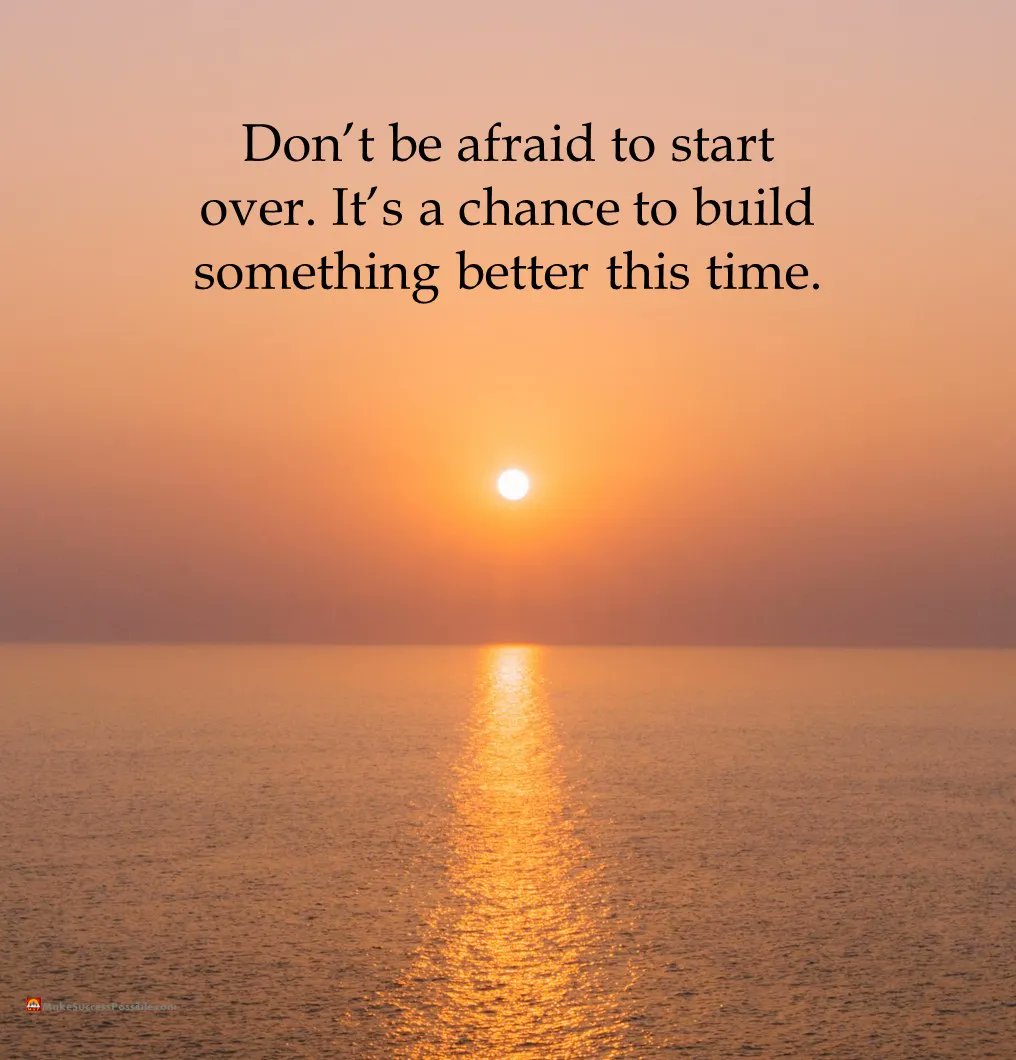
Don’t be afraid to Start Over

Yesterday, I came across this motivational quote on LinkedIn (here). It was a beautiful reminder of the opportunity we have each day to have a “do-over.”

Today, I find myself focused on these words again as I consider the notion of mistakes. We all make them (except for certain people who shall remain unnamed šŸ˜‰) and if you are like me, you have a multiplicity of negative feelings that can overwhelm you. How many of us relate to this vicious cycle. We mess something up, feel guilty about it and then start to avoid or justify our errors instead of confronting them. Often this avoidance, guilt, etc. comes from feeling shame (for a perspective on the challenges of shame, see here). Deep down, we wish for it to magically disappear, like being able to have a do-over in a video game. And while it can never just disappear, the mistake, the lost opportunity, doesn’t need to remain what defines us.

In order to find this do-over, we need to overcome different fears including:

  1. fear of embarrasment.
  2. fear of being uncomfortable
  3. fear of the unknown
  4. fear of failure in starting over (see here for another post on fear of success)

This is no easy task. Yet, I believe we innately do this all the time. Each day brings a series of unknowns, even in the familiar. We could either shrink away from what the day’s schedule could bring, because plans always change, or we could embrace the myriad possibilities potentially before us. If we embrace the unknown, if we accept that we are imperfect and can practice self-forgiveness, we will then others embrace forgiveness as well, recognizing mistakes happen and we can try again. And if we are ready to start over, we will find new opportunities even in the seemingly monotonous, routine.

As it relates to spiritual practice, for example, how often do we find ourselves recognizing how distracted we become in moments of hoped for focus. As a personal example, which I’m sure I’m not alone in, is how often my mind wanders during prayer. All of a sudden, I find myself saying certain words, wondering how I got to that part of the service. I could just give up and say, oh well, I missed out so why bother refocusing. Or, as I try to do, I restart my efforts to find focus, often with some momentary success. The point is, we have opportunity to shift midstream and continue forward in an improved manner, even if we missed out up until this point.

If you are searching for that new opportunity, new beginning, I hope you find ways to overcome your fears to find the opening to a road ahead full of possibilities.

If you are looking to overcome the fear of setting out on a new journey in life. Contact New Beginnings Spiritual Coaching and Consulting LLC at 732-314-6758 ext. 100 or via email at newbeginningsspiritualcoach@gmail.com

A balanced life perspective

Sometimes we are reminded of a message that is deep and meaningful at the most important of times. Over the past few days, I keep coming across these two phrases, “I am but dust and ashes” and its contrast, “For my sake was the world created.” According to Rabbi Dr. Abraham Twerski, in Growing Each Day, it is said that:

Rabbi Bunim of Psis’cha said that everyone should have two pockets; one to contain, “I am but dust and ashes,” and the other to contain, “The world was created for my sake.” At certain times, we must reach into one pocket; at other times, into the other. The secret of correct living comes from knowing when to reach into which.

p. 62

I realized that this advice/message was crucial to how we all should strive to live. There are times when we feel down, feel lost, feel like we are just going through the motions of life. In those moments we could use the pick me up of recognizing that we each play a role in the role, perhaps even the most fundamental of roles. We should strive in those moments to reflect on how much our actions are of value to existence.

On the other hand, we can all get caught up in taking ourselves too seriously. It is very easy to fall into the trap of seeing ourselves as better than someone else, as the one to judge others, to point a finger and make ourselves out to be the best while others are not. In those moments we are best served remembering that we too are just human, we are imperfect and have our own flaws and challenges that we wouldn’t want others to judge us over.

I believe this is an important lesson when engaging in self-reflection and when working with a coach or a therapist. As we go through self-discovery, we can find ourselves oscillating between our great self and our lowly self, swinging along a pendulum trying to find the balance, static point. It behooves us to take steps to find ways and methods for approaching the highs and lows of life.

May we each find our balance, recognizing our importance and our humility at the same time.

If you are looking to explore and discover new approaches to the difficulties in your life, trying to find the middle path: Contact New Beginnings Spiritual Coaching and Consulting LLC at 732-314-6758 ext. 100 or via email at newbeginningsspiritualcoach@gmail.com.