Standing in someone else’s shoes

If you could be someone else for a day, who would you be, and why?

I was playing around with the Jetpack app (newer app to serve for wordpress.com) and came across prompt questions to write about. Interestingly, this was today’s question. I think this question is a great exercise in self reflection. At first glance, the question presumes we want to be someone we are not and that we have an image of who that person is. The answer we give could be a combination of our current personal struggles, our dreams and our perception of what life is like for the other person. Yet, we also know that this wish is perhaps a bit like how we see the grass is greener on the other side, thinking it better to be anywhere but here.
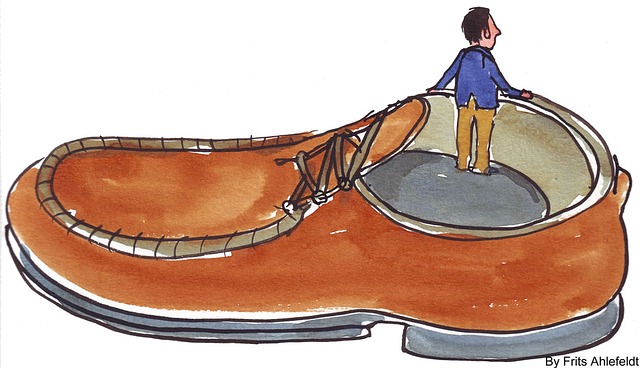
Nevertheless, let’s play this question out a little bit using a deeper dive. What are we looking for/at when we imagine life as someone else? Is it about looks, riches, the joy we perceive? Is it a momentary isolated picture on Facebook which makes us dream of that life? Do we see an immaculate house while living in clutter? Whatever the picture is of life in another’s shoes, when we have those moments, perhaps it is the opportune moment to take steps that lead us to a New Beginning.

The change we are seeking when dreaming of that other life might not even be about the facts we are imagining. They might be about a desire for someone different than what we are currently doing. Maybe it’s how we schedule the day. Maybe it is re-prioritizing the important and the unimportant. Or maybe it really is a desire to be different and that we should foster bigger change through small, goal oriented steps. Any which way we look at it, trying to imagine being another person can actually be beneficial if it comes from a cautious growth oriented mindset and not from a place of jealousy.

After all that, I am sorry to disappoint everyone but truth is, I don’t really have a desire to be someone else for a day. I am truly blessed to be who I am and have worked to recognize that the desires to be someone else where really all about how to be better in my own life.

Are you imaging your life would be different that it is? Wondering if you really are the person people see you as? Are you working on your spiritual growth? Faith? Feeling lost in the midst of the journey of life? Contact New Beginnings Spiritual Coaching and Consulting LLC at 732-314-6758 ext. 100 or via email at newbeginningsspiritualcoach@gmail.com

Listening to the whole story

How many of us only pay superficial attention when someone talks to us? Are we only conscious of hearing just what is being said? Maybe we are among the fortunate who pay just enough attention to get the gist of the message? Or perhaps, when someone is commenting about a situation or offering constructive criticism, even with the best of intentions, all we hear is the criticism without listening to the underlying suggestions of ways to improve? Are we too stuck in who we are, too stubborn to receive feedback, to recognize how the criticism is hopefully coming from a good place? (And yes, I am and have been guilty of this way too many times to count).

Sometimes the rebuke is really a blessing in disguise!

I came across a thought from the end of last week’s Torah portion that I found to be spot on as a reflection of hearing/not hearing as it pertains to growth and change. Deuteronomy 31:30 states:

וַיְדַבֵּ֣ר מֹשֶׁ֗ה בְּאזְנֵי֙ כל־קְהַ֣ל יִשְׂרָאֵ֔ל אֶת־דִּבְרֵ֥י הַשִּׁירָ֖ה הַזֹּ֑את עַ֖ד תֻּמָּֽם׃ {פ}
Then Moses recited the words of this poem to the very end, in the hearing of the whole congregation of Israel:

When the Torah uses the word אזני (in the hearing (related to the word for ear)) or any of its derivative words, it implies a different kind of listening, perhaps as in emphasizing paying attention. The people were to be paying attention to some form of poetic rendering of Moses’ final speech. This is either a reference to Deuteronomy 32 or it is a reference to the series of verses that precede 31:30 starting from 31:22, which also uses the word שירה as a reference to the words of Moses. Regardless, the word שירה has a positive connotation, the words preceding or upcoming are more of a rebuke. As such, what did they hear?

The Israelites, while hearing the harsh words from Moses, also heard hope in his words. They didn’t just hear the rebuke and the consequences of their fall. They also heard that even when falling so far, there is a point of being able to rise back up, that the relationship promised would remain. They heard the song because they were listening with their ear, listening intently to the entire speech, not just sitting with the negativity of rebuke.

Every year, I am amazed at the extent of the formal confessionary forms of prayer we engage in throughout the period between Rosh Hashanah and Yom Kippur, culminating in the Viddui/confessions of our various “sins,” which are recited time and again on Yom Kippur. It is easy to get overwhelmed by the categories of our errors and how far we must come. Yet, I am also amazed that within this hard reality check, we can emerge with a renewed feeling of “success” and belief that we will be sealed for a good year. In many synagogues, it has become the practice to sing and dance immediately post Yom Kippur as a show of our seeing beyond the words. Through our confronting our humanity in a serious fashion, we come out the otherside having taken the heaviness and made it into something to celebrate, not dread.

May each of us “hear” the prayers of Yom Kippur as the road map forward for us to grow each day. May our “ears” be open to both the voice inside ourselves looking to improve and to the feedback we hear from others.

If you are exploring ways to deepen your ability to recognize within yourself areas of desired spiritual growth: Contact New Beginnings Spiritual Coaching and Consulting LLC at 732-314-6758 ext. 100 or via email at newbeginningsspiritualcoach@gmail.com.

Being the person you want to be takes hard work

With Rosh Hashanah 27 days away, it is an important time to reflect on the work of change. Realistically, one should not treat growth and change like most of us treat tests, a time to cram and get it over with. Rather, one should regularly be in a place of self-improvement so as to have times in which to ramp up the process a bit, such as during this auspicious time leading to a new demarcation, a new year, a New Beginning.

As most of you who have been reading this blog have noticed, much of what I emphasize is incremental growth, small steps, the importance of acknowledging the gains along the path, and other modalities of fostering long term success. I recognize that these ideas can and are difficult. First, we have to begin the journey, which, as which I described in my previous post, is the hardest step. Once we do that, we then have the difficulty of maintaining and taking more steps. This isn’t easy, though if we recognize the accomplishment of the initial step, perhaps we can find the strength to continue along.

I myself continue to consciously work on these approaches in my own growth work, and struggle with the ups and downs that inevitably do come into play when travelling along the waves of life. Yet, if we try to just leap from the bottom to the top, most likely we will just fall right back down. If we put one foot in front of the other, walking or climbing one step at a time, we can always stop on the landing along the way to catch our breath, take stock and reflect on the step we have arrived at before continued “upward.”

Recently, a client sent me an article that struck me as highlighting this point about perspective when things seem challenging. The author, Binyomin Yudin, describes two situations, one logistics, one self-care focused in which to do “right” he had to the hard thing. At the end of his piece, he reflected on the following:

It was during one of these four-mile walks that Rav Steinman’s words came to mind. Walking up a grueling hill near my office, I was getting fairly aggravated, thinking about all of my friends who don’t have to do this, who can eat what they want without worrying about the impact of their choices on their lifespans. As I crested this hill, however, I realized that this was the quintessential example of Rav Steinman’s lesson. I had sweat running down my face; the exercise was clearly tirchah. Just as clearly, though, it was the right thing to do.

“We can do hard things.” Living the life you want to live and being the person you want to be demands hard work, I reminded myself, with Rav Steinman’s words echoing in my ears: “I’ve found that doing the right thing often takes tirchah.”

In this month of Elul, 5782, as we desire to work towards striving to be the person we wish we could be, we should remember, that with growth comes regular work, daily ritual and routine, challenges and moments of needing to foster our drive for continued successes along the way.

Need support as you work on the difficult task of self improvement and growth: Contact New Beginnings Spiritual Coaching and Consulting LLC at 732-314-6758 ext. 100 or via email at newbeginningsspiritualcoach@gmail.com.