Audacity in Prayer During the High Holidays

Imagine, or maybe just remember, what it was like to turn to a parent and say, “it’s really your fault I am the way I am.” While we all might feel this way at one point or another, it is one thing to think it and another to voice this feeling aloud. If this is the case with one’s parents, how much more so would this be the case as it relates to our relationship with Gd. And yet, we find countless examples in the Jewish tradition that suggest we can verbally express the blame for our imperfections and troubles back at Gd.

One recent thought I came across expresses this concept from a statement in the work Hayyei Moharan, which describes anecdotes about the life of Rebbe Nachman of Breslov. The idea is a creative reinterpretation of how we understand the use of the plural in Viddui.

It is written in Chayei Moharan (601) in regards to viduy – the confession prayer, that Rebbe Nachman once said to Reb Yudel of Dashiv (a chossid of Rebbe Nachman, who was first, a chossid of Reb Pinchas Koritzer), “tell me something from your Rebbe, the Tzaddik, Reb Pinchos Koritzer.  Reb Yudel responded, “Reb Pinchos once said that we say ashamnu, bagadnu, gazalnu in a plural tense, when really we should be saying it in a singular tense.  However, (the reason [ed.]) we say it plurally is because we are really saying, so to speak, in a way of claim and argument towards Hashem, ashamnu, we have been guilty, that if not for you, Hashem, giving us the energy and ability to sin, we wouldn’t be able to sin.”  

Sea of Wisdom Parshas Nitzavim/VaYeilech 5783 – R. Itche Meir Morgenstern

How do we have the audacity to turn around our imperfections and place some of the blame back on Gd? Well, this idea of Rebbe Nachman’s is not unique to him, but has precedent throughout the Jewish tradition. I found myself reminded of something I shared over a decade ago, which remains highly relevant as we enter Rosh Hashanah, 5784. At the time, I prepared a sermon describing multiple examples of spiritual audacity. See here for the full piece.

As part of this piece, I drafted the following prayer:

Dear G-d.  We are here again standing in your shadow.  We are in your presence.  We are unworthy, because we are full of sin.  But you know what G-d, it’s your fault we sinned.  You are the master of the world.  You created us with good and evil.  You created the evil inclination, the yetzer hara.  Therefore, we are blameless because without that stumbling block, we wouldn’t be in need of judgment each year.

Looking back, I am not sure I was correct in the usage of the phrase, “we are blameless.” If we believe we have the choice to make before each decision, then we are responsible for what we do. Yet, most of us often in life really feel so much about ourselves is not in our control. It wasn’t our fault, it’s someone or something else outside of our control that we can blame. True and… if we are to then find a path for growth and change, we need to be willing to accept responsibility as well.

For this Rosh Hashanah, when we sit down and reflect on the life we have led through 5783 and the life we wish to lead starting 5784, can we both be comfortable to verbalize our feelings that so much of who we are might not be our “faults” and also hold personal responsibility to acknowledge how much we can do to take the steps to forge a new path forward? When we confess to our shortcomings, we are taking the first step. So, speak your real thoughts, pray with abandon just like our ancestors, and simultaneously, examine the barriers holding us back from spiritual growth and plan strategies so we can see a better year in this upcoming year.

May this year be the start of a New Beginning and filled with opportunities for reaching closer to your goals and dreams.

Looking to gain further, broader insight in becoming your more authentic, spiritually focused self? Let me help you along this path! Contact New Beginnings Spiritual Coaching and Consulting LLC at 732-314-6758 ext. 100 or via email at newbeginningsspiritualcoach@gmail.com

Elul Thoughts: Finding Renewed Ways to Connect

As I continue to reflect on my recent trip to Israel, one of the things that always strikes me when I am there is how comfortable I feel in Israel. This has many layers, from religiously and spiritually as well as I get a sense in certain parts of the country that it is like I am home. This makes travelling less fraught with worries and anxieties. And, this does also have a shadow side.

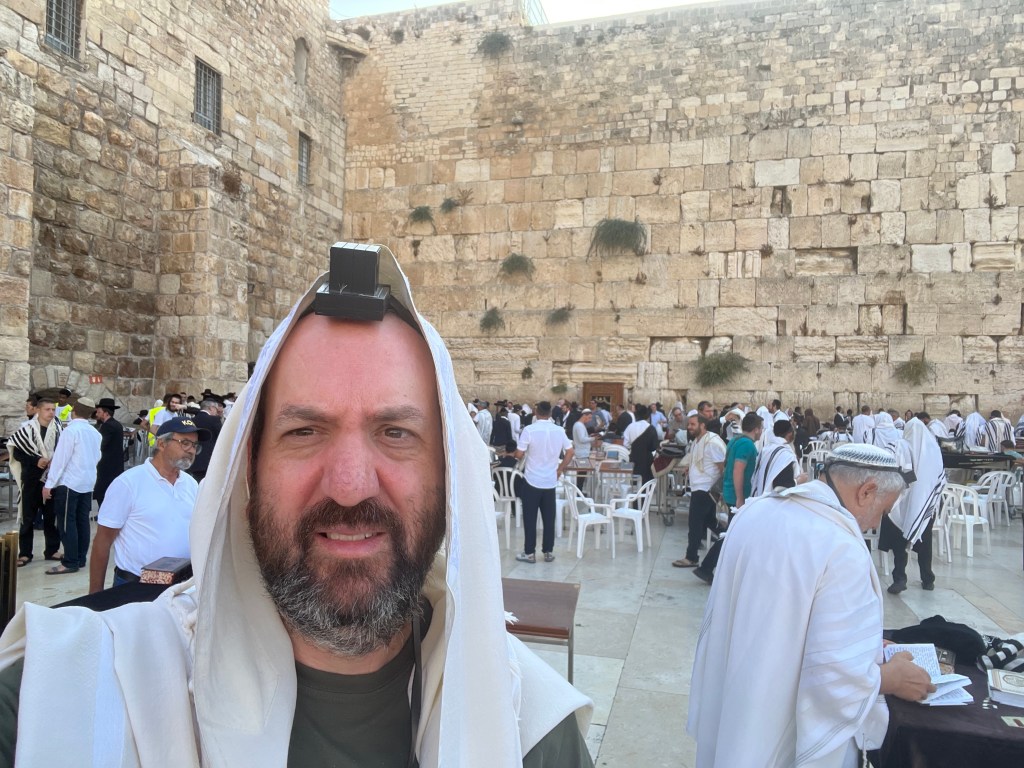
During this trip, as with most of my trips, I find myself drawn to spend time by the Kotel, the Western Wall. It is a place of prayer and pilgrimage. It is a sacred space. And while historically the physical wall itself was merely one of the four sides of the retaining wall for the Temple Mount, the area has become a spiritual focal point and symbol for so much. And yet, sometimes, the mystique seems to disappear.

During this trip, I had two types of experiences. Some of my sojourns to the wall, I was left with something lacking. I couldn’t find my spiritual comfort zone, struggled to pray with much focus, almost finding myself asking what was even the point of making the trek from the apartment I was staying at. It can be difficult to feel inspired when the sacred space seems commercialized and is overflowing with people. Other times, I found that inspiration. This occurred in two ways. When I went on Shabbat afternoon and found the area pretty empty and quiet, I was able to hear my thoughts better. Other times, even in the midst of massive crowds, context can be key. Being there for a Bar Mitzvah and public Selichot, both times when the place is packed, also inspired me because it was the opportunity to experiences new things in a place I know so well.

I am sharing these thoughts because I came across and was reminded of a beautiful concept drawn from a question about Psalm 27. During the month of Elul, it is customary to recite this chapter twice a day. Reading the Psalm, we can see many themes that tie into the High Holidays. One, which I want to explore, emerges from Verse 4.

אַחַ֤ת ׀ שָׁאַ֣לְתִּי מֵֽאֵת־יְהֹוָה֮ אוֹתָ֢הּ אֲבַ֫קֵּ֥שׁ שִׁבְתִּ֣י בְּבֵית־יְ֭הֹוָה כׇּל־יְמֵ֣י חַיַּ֑י לַחֲז֥וֹת בְּנֹעַם־יְ֝הֹוָ֗ה וּלְבַקֵּ֥ר בְּהֵֽיכָלֽוֹ׃

One thing I ask of the LORD, only that do I seek:
that I may dwell in the House of Hashem all the days of my life, to behold the sweetness of Hashem and to contemplate in His Sanctuary.

There is a fundamental question that arises from this passage. How can we ask Gd to both live in Gd’s house forever and also be visitors “contemplating” his temple? Doesn’t this seem contradictory.

Over Shabbat I was reminded of this question from a Parasha printout called Alei Deshe, which shares the Torah thoughts of R. Shaul Alter, Rosh Yeshiva of Gur. He shared:

The answer given to this seeming contradiction is that our request is to reside permanently in Hashem’s house, and yet maintain the freshness and excitement of one who comes only as a visitor. But how is this possible? After all, a person naturally loses enthusiasm for activities that continue for a lengthy period of time.

In order to understand this, we must look at the words preceding the request for visitor-like excitement: לַחֲז֥וֹת בְּנֹעַם־יְ֝הֹוָ֗ה, to behold the sweetness of Hashem. When one feels the pleasure and beauty of sitting in Hashem’s house and serving Him, he will naturally maintain his enthusiasm for it, and will return day after day feeling as if it were his first day there.

Too often in life, finding ourselves in moments that used to drive us, inspire us, excite us, and suddenly it has little to no meaning. The shiny new toy feels like it loses its shine. When this happens, we get frustrated, we try to find something new. For most of us, it is easier to discard and move on to something new. Yet, perhaps the issue isn’t the lost luster but it starts with us. Did we go in with the wrong expectations? Did we presume to find the same inspiration and joy without playing our part in being present and focusing?

In this preparation season for Rosh Hashanah, are we truly listening to the daily shofar sound, to the added prayers, to our stirring souls which are looking to make meaningful changes to our lives. Have we slowed down to see? Or are we merely heading to the place we always head to because that’s just what we do?

Going back to my personal experiences, I found that if once I could remember inspiration comes just as much from what we put in as from what the moment gives me, I was able to feel that sense of enthusiasm of “visiting” instead of the routine feeling of always being present. It required a refocus, a renewed effort and, at least with the late night trek for Selichot, doing something new and different to help refind that spiritual connection I was seeking all along.

May each us, during these last two weeks leading to Rosh Hashanah, find our things that inspire us and find new ways to put in and take out those drops of inspiration so that we may see in ourselves growth and renewal during this upcoming new year.

Looking to gain further, broader insight in becoming your more authentic, spiritually focused self? Let me help you along this path! Contact New Beginnings Spiritual Coaching and Consulting LLC at 732-314-6758 ext. 100 or via email at newbeginningsspiritualcoach@gmail.com

Self compassion as a door to compassion for others

Rosh Hashanah, the Jewish New Year, is a meaningful holiday for me. It is one of a series of opportunities in the year to take stock and to start anew. Unlike other times, such as my birthday and my wedding anniversary, part of the power of Rosh Hashanah is how together, communally, we are all together in this process of establishing a New Beginning, a new hope for the upcoming year. Through the sound of the Shofar, we are called to wake up and listen to the sounds and to the silences around us so as to better figure out what it is we hope for in the coming year.

I had the fortune to do a lot of reading and reflecting on the past two days (the beauty of being shut off from the constant barrage that comes from our connected world). And yes, while Shabbat and the holidays are about so much more than unplugging, the unplugging is a powerful byproduct.

In my reading over the holiday, I came across a piece that relates back to a book I read through this summer, Self-Compassion: The Proven Power of Being Kind to Yourself, by Dr. Kristin Neff. In a piece from Rabbi Dr. Abraham Twerski’s Growing Each Day, he suggests the following spiritual approach to understanding judgment during this period between Rosh Hashanah and Yom Kippur which I would extend to how we should see self-reflection in our daily lives:

God knows that personal interest makes us oblivious to the significance of our own misdeeds, so He contrives to make us observes in others actions and behavior similar to our own. How we react to our own acts as we see them in others determines how God will judge us. If we are considerate and lenient in our judgment, and give others the benefit of the doubt, allowing them the broadest latitude of circumstances that might have caused them to behave improperly, then God will judge us with equal leniency. But if we are self-righteous and quick to condemn others, we will be judged with equal severity.

p. 3

When we consider the work of self-compassion, one of the premises is that we tend to be quicker to forgive others mistakes than our own when the same mistake is made. We tend to be our own harshest critic. And lest you think that our self-criticism doesn’t ultimately harm our compassion for others, the more we lack in self-compassion, the harder it will be to continue to be compassionate and forgiving of others for their foibles. If we consider the above quote, we can see how our sense of personal, self-acceptance and compassion for our imperfections will open us up to increase our ability to be compassionate to others. If we are reacting to what we are witnessing, we would do well to spend a moment or two reflecting on what we see and what is being mirrored to us so we can react better to them and to ourselves.

As we continue on this journey together exploring how to foster new beginnings for ourselves, may we find ways to bring more compassion into the world for ourselves and for all those around us.

If you are looking to deepen your ability to recognize within yourself areas of desired spiritual growth: Contact New Beginnings Spiritual Coaching and Consulting LLC at 732-314-6758 ext. 100 or via email at newbeginningsspiritualcoach@gmail.com.

Planting seeds for the New Year – Rosh Hashanah 5783

We are standing on the precipice of another year in the Jewish calendar. As always, it is a time of introspection (it’s never too late to think back over the year). What do we want different? What are our hopes for the upcoming year? Where do we even begin?

One of the customs many have on Rosh Hashanah is to eat certain foods that symbolize our prayers and hopes for the new year. The source for this custom is mentioned in a couple of places in the Babylonian Talmud:

Horayot 12a and Keritut 6a

אמר אביי השתא דאמרת סימנא מילתא היא [לעולם] יהא רגיל למיחזי בריש שתא קרא ורוביא כרתי וסילקא ותמרי

Abaye said: Now that you said that an omen is a significant matter, a person should always be accustomed to seeing these on Rosh HaShana: Squash, and fenugreek, leeks, and chard, and dates, as each of these grows quickly and serves as a positive omen for one’s actions during the coming year.

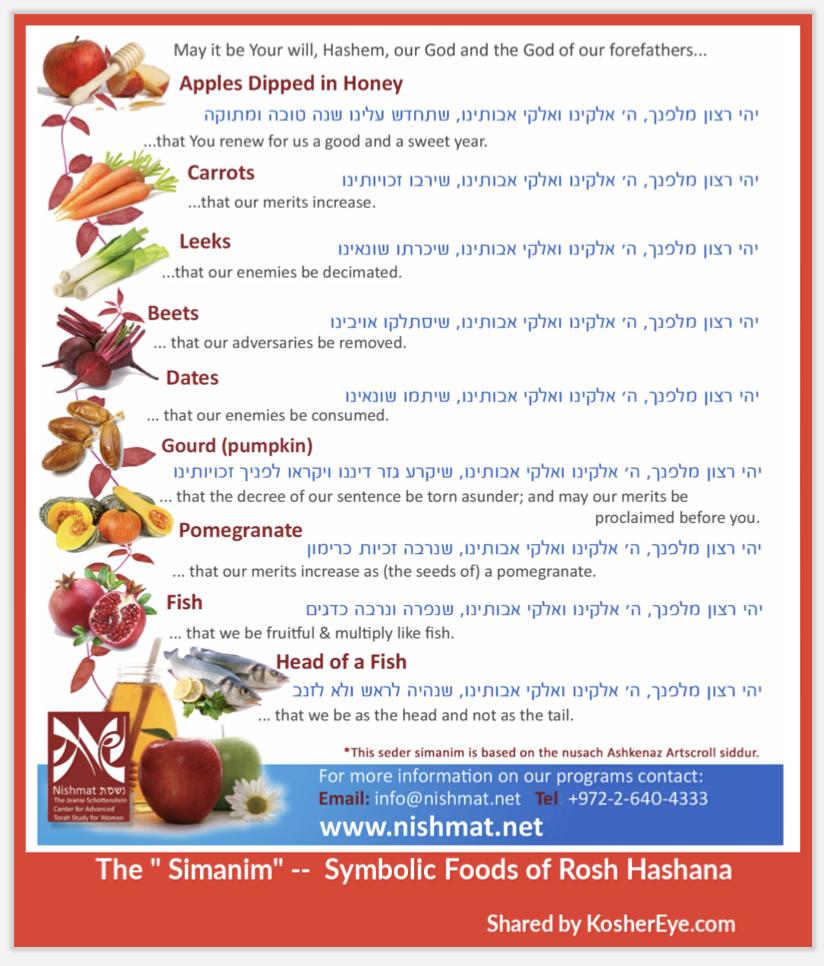
In addition to the above mentioned foods, see the chart below for what many do today, which adds to the Talmudic list.

In my pre-Rosh Hashanah reading yesterday, I came across a discussion of this custom. At first glance, many of us would think this is a bit like magic, that somehow my consumption of one food or another has the power to invoke change in our lives. How can it be that by eating an apple dipped in honey I should be able to ask Gd to grant us a sweet new year? Is it merely magical thinking? Is it really that simple?

In response, perhaps we are looking at the custom all wrong. According to the essay I was reading, we need to rethink the word siman(symbol). If we see the notion of symbol in the sense of planting a seed, as in a famous idea about how to read the stories of Genesis as “The actions of our forefathers are symbols for the children,” we can begin to appreciate the practice of these symbolic foods. If our actions become lessons for our children, then in a way, what we do is the equivalent of our planting the seeds for our children to learn from the good and bad in our lives. Hence, we can say symbols are seeds being planted.

On Rosh Hashanah, when we eat these symbolic foods, we are also planting seeds. We are praying, we want the upcoming year to be better, sweeter, with our successes at the forefront and our enemies vanquished. We want a year of positivity, a year in which the naysaying voice in our head is quieted down so we can see and feel the growth we are all experiencing, even when we don’t realize it. Through these foods, we aren’t performing magic tricks. We are taking the first step to real growth, naming what we want and hoping that this first step is a seed that germinates and sprouts for us along our journey of this upcoming year.

Many of my posts have been about the planting of seeds and taking first steps. This is the essential philosophy of New Beginnings. We are always presented an opportunity for a new beginning and while things might seem to be on a continuum, they are also a series of beginnings if we choose for them to be. I truly believe that each day we are doing is a day of growth and change even when we ourselves don’t see it as such. Each pitfall along the way, for there will be setbacks and challenges, are also growth points if and when we are ready to see them as such.

May this year, 5783, be a year in which we see the growth we are all doing, a year of peace in our lives and in the world, a year of less worry over the things we can’t control and most of all, a sweet, good and healthy year to all.

Want to take your hopes and wishes for a new year and really concretize them? Looking to solidify and continue your spiritual growth: Contact New Beginnings Spiritual Coaching and Consulting LLC at 732-314-6758 ext. 100 or via email at newbeginningsspiritualcoach@gmail.com.

First Day of…

Today is the start of the school year for my two boys, as they enter 7th and 6th grade. It’s a very exciting day, full of hope and anticipation for a good year. It’s also a day full of nerves and worries about what will come during the year.

The notion of firsts has been a primary focus of mine lately, as you can tell from a few of my most recent posts. I have been trying to grapple with how we begin something and how we prepare to begin something new. Yet, another element of firsts is the calendrical milestone moments we encounter throughout the year. As I continue to reflect on and prepare for Rosh Hashanah (now only 25 days away), I find myself focused on how we mark the new start, the first day, the first step along a new aspect of our journeys.

Isn’t it interesting, that for new beginnings, we often take the smiling, before picture, highlighting the hope and excitement that comes from the starting new. And we all know that underlying the smiles is fear and nerves, yet we show our brave, happy faces to hide away the muck that is most often found inside us during these moments of the unknown. The before picture is like the on-ramp to this next journey. We are standing, carrying the tools we will need for this part of the path, trying to figure out how much of who we were and who we wish to be will help guide in this new section of our story.

And of course, if we are talking about the beginning, we cannot forget that there will be an end as well. What fascinates me is that we often forget to also take the “after” picture, either because the ending doesn’t happen or we merely don’t get as excited by the ending as the beginning. Or perhaps because we could say all “before” pictures are really the “after” pictures from the previous period of time, we never truly do miss out because in a grander sense each new leg of the journey is another beginning from a previous ending.

How do you capture your firsts? It doesn’t just have to be firsts like a new school year that we ritualize. Each of us should take the time to celebrate a new start, a new job, a new research project, taking the initial step into the new time frame we are about to enter. If we think about Rosh Hashanah, the anticipation and hope for a sweet new year, symbolized by dipping apple into honey and offering a wish for this action to manifest itself in our lives, is a beautiful example of setting a positive tone to whatever we hope to accomplish in the upcoming year.

Starting new things is difficult. Celebrate and embrace that you began something. By starting, you have already accomplished tremendous amounts.

Are you working on starting something new and finding ways to take that first step: Contact New Beginnings Spiritual Coaching and Consulting LLC at 732-314-6758 ext. 100 or via email at newbeginningsspiritualcoach@gmail.com.

Focus on the Process

As we continue to travel along this seven week path towards Rosh Hashanah, I found the following quote to be a good point of reflection for daily growth:

No matter what the tangible outcome is, you cannot help but become a better person when you follow a creative call. If you focus on the product, you get fleeting satisfaction from an end result. If you focus on the process you get a life because life is a process.

The Muse Is In: An Owner’s Manual to Your Creativity p. 20

We establish a goal or multiple goals. We desire reach our intended goal/s. Yet, to get their requires not the the goal but the steps along the way towards the goal. By being able to focus on the steps along the path, we gain the ability to see progress, celebrate progress and pivot from the main path much easier if the approach to the goal is not leading us there. By recognizing this last point, we don’t get stuck in frustration presuming that there is only a single path that can lead us to where we want to be.

As we continue on towards Rosh Hashanah, may we find inspiration from the day to day process towards the goal of establishing new opportunities all along the path.

Looking for help along your journey as you go onward and upward? Contact New Beginnings Spiritual Coaching and Consulting LLC at 732-314-6758 ext. 100 or via email at newbeginningsspiritualcoach@gmail.com.

Onward and Upward

The title of this post was inspired by my wife’s comment to yesterday’s piece, From Despair to Hope: Seven Weeks until Rosh Hashanah. Each day, we have the opportunity to do something that helps foster a feeling of onward and upward. Too often we remain in the despair, the stagnant place of not doing. There could be many reasons for the paralysis. We are afraid, we hate making a mistake or mistakes, we don’t want to fail. Or perhaps we are really in a place where progress is almost impossible to foster (and we need the support of professionals to help and support us in these darker moments.)

How do we foster the ability to go onward and upward?

Forward momentum begins from a place of taking stock. If we spend the time in introspection, in reflecting on our journeys, we will begin to see how far we have come. We have taken the step/s forward we intended on the way to attaining our goals. Yet, too often, as I have been writing about lately, we don’t recognize how we got this moment, but will only look at how far we still want or need to go. My personal growth and journey continuously includes the work of seeing what I have accomplished along the way, not as a means of resting on my past but as a way of drawing strength from what was to continue to take one step at a time. Every step is an achievement unto itself. By celebrating the results, regardless of “success” or “failure,” we can learn to find real success, which is the striving forward we all look for in our lives.

A primary element of the period leading into Rosh Hashanah is the preparation for the aspect of Rosh Hashanah that is Gd judging the world for the upcoming year. This preparation is usually described as Teshuva, normally translated as repentance but better translated as a type of returning. In the words of Rabbi Menachem Mendel Schneerson o.b.m. as presented by Rabbi Lord Jonathan Sacks o.b.m:

2. Teshuvah and Repentance

“Repentance” in Hebrew is not teshuvah, but charatah. Not only are these two terms not synonymous, they are opposites.

Charatah implies remorse, or a feeling of guilt about the past and an intention to behave in a completely new way in the future. The person decides to become “a new man.” But teshuvah means “returning” to the old, to one’s original nature. Underlying the concept of teshuvah is the fact that the Jew is, in essence, good. Desires or temptations may deflect him temporarily from being himself, being true to his essence. But the bad that he does is not part of, nor does it affect, his real nature. Teshuvah is a return to the self. While “repentance” involves dismissing the past and starting anew, teshuvah means going back to one’s roots in G‑d and exposing them as one’s true character.

For this reason, while the righteous have no need to repent, and the wicked may be unable to, both may do teshuvah. The righteous, though they have never sinned, have to constantly strive to return to their innermost. And the wicked, however distant they are from G‑d, can always return, for teshuvah does not involve creating anything new, only rediscovering the good that was always within them.

Torah Studies: The Ten Days of Teshuvah

What resonates most for me is that by seeing Teshuva as a focus on the idea of returning to one’s spiritual roots instead of seeing the time as one we spend reflecting on all we haven’t accomplished, we can find the strength to truly go onward and upward.

Today is the second day along the seven week path towards Rosh Hashanah. What will your “return to self” look like? How will you work on taking the steps you are taking in your lives and further fostering growth and change to better oneself in this life?

Looking for help along your journey as you go onward and upward? Contact New Beginnings Spiritual Coaching and Consulting LLC at 732-314-6758 ext. 100 or via email at newbeginningsspiritualcoach@gmail.com.

From Despair to Hope: Seven Weeks until Rosh Hashanah

What can we do to change our mindset from feeling the sense of divine distance to divine nearness? What is the path to be ready to “greet the King in the field” which is a theme of the month of Elul, the month preceding Rosh Hashanah?

Yesterday was the commemoration known as Tisha B’Av (usually falling out on the 9th day of the Hebrew calendar month Av but due to the 9th being Shabbat, the fast day was pushed off until Sunday, the 10th of Av). Tisha B’Av is a day of collective mourning in the Jewish community, focused first and foremost on the destruction of the First and Second Temples in Jerusalem (586 BCE and 70 CE respectively) and then tying in all other tragedies that we have experienced throughout Jewish History. It is a day we lament and try to grapple with “why” and with “how.” After expressing many prayers and reflections that focus on these pain questions, we begin to search and look for some form of collective hope.

Coming out of Tisha B’Av, while having touched on this sense of hope, there remains the sense of Gd being distant, far away. It is hard to find how the tiny amount of hope will help lead us forward from feeling Gd is hiding to the sense of Gd’s presence we look to feel in seven weeks, when we change our tune and acknowledge Gd as the ruler of all humanity, coronating Gd as we do yearly on Rosh Hashanah.

What can we do to change our mindset from feeling the sense of divine distance to divine nearness? What is the path to be ready to “greet the King in the field” which is a theme of the month of Elul, the month preceding Rosh Hashanah?

It isn’t a coincidence that just like how the time period of Passover to Shavuot seven weeks period which is supposed to be a time of getting ready to receive the Torah anew, this 7 week period between Tisha B’Av and Rosh Hashanah is also a preparation period. The preparation begins by rising up from the depths of pain by taking one single step at a time. By taking the first step, we begin the journey and process.

Breaking it down further, there are two main periods we have in front of us as we get ready for Rosh Hashanah. The first three weeks from today until the beginning of Elul are about opening up our hearts and souls to the notion of reconnecting. We do this through study, through readings that offer comfort (nechama) and that awaken us to the notion we are never abandoned.

We then enter Elul. Starting from the first day of the month, we sound the shofar daily as a wake up call to work on ourselves (teshuva). The work we do is to take steps in our desire for self-improvement and growth, with the specific purpose of preparing for the new beginning Rosh Hashanah sets before us. We cannot just enter this period, waiting for the alarm call. We have the opportunity over the next three weeks to set the alarm so that when it goes off, one’s heart and soul is ready to hear the sounds emanating from the shofar. We shouldn’t just wait for the alarm but need to set it and prepare for it in the first three weeks leading up to Elul.

May these next 7 weeks be a time of growth and introspection and a time of finding hope out of the depths of despair.

Looking for help along your journey from despair to hope? Contact New Beginnings Spiritual Coaching and Consulting LLC at 732-314-6758 ext. 100 or via email at newbeginningsspiritualcoach@gmail.com.

“For Your Sake Living God”

In the midst of the period between Rosh Hashanah and Yom Kippur, there are liturgical additions that help frame the focus of these 10 days. One of the phrases is:

“זָכְרֵֽנוּ לְחַיִּים מֶֽלֶךְ חָפֵץ בַּחַיִּים וְכָתְבֵֽנוּ בְּסֵֽפֶר הַחַיִּים לְמַעַנְךָ אֱלֹהִים חַיִּים:

Remember us for life, King, Who desires life, and inscribe us in the Book of Life, for Your sake Living God.”

The other day, as I was reciting these words, I found myself shuddering when I came to the last phrase “for Your sake, Living God.” I began experiencing a sense that it is so difficult to live up to an ideal that if all else fails, we hope we can rely upon, “for Your sake…” inscribe us for good. As I was lost in this awesome moment, I was reminded of a short piece I recently read in Growing Each Day, a daily reader written by Rabbi Dr. Abraham Twerski o.b.m.. After asking what the phrase “for Your sake” means, Rabbi Twerski suggests a creative read of the prayer:

We might read the verse a bit differently. “Inscribe us in the book of a life that is lived for Your sake.” In other words, we pray not only for life, but for a quality of life that is meaningful and purposeful, one that will be lived for the greater glory of God (p. 5)…

Of course, we wish to be inscribed in the book of life, but it should be a life that we wish to be in rather than one that we seek to escape from (ibid.)

We recite these words during the 10 days of repentance as a focus on our striving for an ideal life of meaning, or spirit, of Godliness. I shuddered because it is an awesome and lofty goal that recognizes how hard it would be to reach. During this period, we look to formulate our ideal self, turning in prayer to God recognizing our imperfections and expressing a deep sense of hope to start clean.

Years ago, in a similar way, standing in prayer on Yom Kippur, reciting the words of confessions, the Viddui, I found myself suddenly laughing at the seeming absurdity of striving for forgiveness for all the myriad mistakes we make and will find ourselves making year in and year out. The laughter came from a place of fear, as if I didn’t laugh, I would have felt crushed by how truly difficult change is. I realized in that moment the goal of Viddui, the goal of this entire period is a striving, a framing of who we hope our ideal selves will be. And when we emerge from Yom Kippur, the question will be: do we have the opportunity afforded to us by being in the book of life to work on living towards our ideal self throughout the coming period between Yom Kippur and the next Rosh Hashanah? Will we carry forward the image of who we want to be during the doldrums of the remainder of the year?

May this new year of 5782 and this period be one of deep introspection in finding the ideal you so that we can take the opportunity to hit pause and beginning anew with a new goal, a new purpose and a new mission in our lives.

Meditation for Rosh Hashanah

Rosh Hashanah is a new beginning, a new opportunity to reconnect with our most basic self. There are no barriers. The shofar blowing represents this barrierless experience, as the sounds come from our breath and breath alone. We listen to the depths of the soul and if we are attentive, will truly experience the cries and pains that emerge.

For those looking for a focus for this upcoming Rosh Hashanah, the following piece is very meaningful. Rav Yoel Glick shared the following reflection and practice for concentration during Shofar Blowing.

The shofar (ram’s horn) that we sound on Rosh Hashanah is intimately linked with this process. The shofar blast is a column of energy in the form of sound that aligns us with our soul and prepares us to receive the incoming new consciousness and energies. It creates the “birth canal” for the spiritual awakening that is to take place at this time. The stronger the alignment is with the column of energy, the greater will be the spiritual birth that takes place.

Rebbe Natan of Nemirov teaches that on Rosh Hashanah we bring the New Year from koach el hapoel, from potential into action, from the plane of the mind into the plane of physicality — from celestial energies into concrete activities in the world. The physical act of blowing the shofar is a symbolic representation of this movement. We take air from our lungs and send it through a physical vessel, the shofar, which then takes the breath and turns it into sound...

When we listen to the sound of the Shofar, we are hearing the depths of the shofar blower. Are we paying attention to the sound, the breath, the energy put out into the world? Here is Rav Yoel’s practice for being mindful and focused during and after the shofar blowing:

Begin by first emptying your mind of all thoughts. Search inward and find the center of your being. Now turn your mind towards the God of Israel and the Soul of Israel, and look in their direction with love and awe.

When the shofar is blown, use the sound to focus your mind and ascend upward on the energy. Keep reaching higher and higher as the shofar blasts continue. When the shofar stops — sit in the silence — still and ready to receive the Lord’s response.

This response may come as a feeling of God’s presence, or as a thought, word or image that drops into your mind; or it may simply come as the “livingness” within the silence. Whatever form God’s response takes, if you are open and sincere, then you will receive.

May this year be a year where we all find a new beginning, something that invigorates our hearts and minds. May we be open to receive blessing and goodness. May this year see us continue to emerge from the traumas of the past year and a half and may each of you find a sweetness and hope.