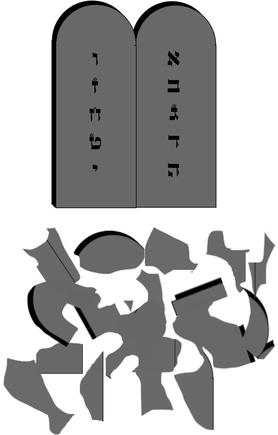
During Shavuot, I came across an idea which I have been reflecting on these past couple of days. During the prayers we recite on Shavuot, we refer to the holiday as Zeman Matan Torateinu, the day of the giving of the Torah, not the day of receiving the Torah. What is the difference between a day on which we were given something vs. a day we received something? Aren’t those just two sides of the same coin?
R. Menachem Genack, in his introduction to a book of R. Dr. Norman Lamm’s collected sermons, Torah Beloved, offers a simple, yet important answer to this question. He writes:
The reason we do not refer to Shavuot as the day on which we received the Torah is that Shavuot is not the day on which we received the Torah. Before I am accused of heresy, let me clarify. The Luhot which Moshe received on Shavuot were shattered at the base of the mountain, forty days later. We never received them. It was only after two more forty-day periods of prayer and fasting, on Yom Kippur, that God gave Moshe the second set of Luhot which the Jewish people were able to receive, unshattered. Thus, the day on which we received the Torah is actually Yom Kippur, not Shavuot, and that is why Shavuot is not identified in our liturgy as the day we received the Torah.
pg. XV
Shavuot is a culmination of sorts. It is a holiday that concludes a seven week countdown for the early harvest period. In our modern take, it is the completion of a seven week period of preparation to receive the Torah. Either way, Shavuot is an ending. Yet, when we reflect on R. Genack’s words, we realize that Shavuot is an end that remains incomplete. In a way, Shavuot is just the beginning. Shavuot was the first moment of what became a 120 day process of being able to truly receive the Torah.
To answer the question of giving vs. receiving, it makes sense that Shavuot is referred to as the Giving Torah day, not the receiving Torah day. When we are given something, it doesn’t automatically mean we have received it. Yes, it is now something in our “possession,” but there is a difference between something just dropped into one’s lap vs. being ready to receive it. I think reception in the context of the Torah needed to be an active process of grabbing hold of the precious item being given. And clearly, this is not something that is so easily done. For R. Genack, recalling the entire story of receiving the whole tablets, from Shavuot to Yom Kippur, we can learn a lesson about recognizing the different demarcation points in our lives.
All milestones, important moments in life contain two sides of the same coin. The milestone is a moment of accomplishment, of arriving at this junction of life. And yet, a milestone is also a stop along the way, from which we move to the next stop along our journey. It is a New Beginning. And we have an opportunity to always be ready to go for the next milestone while also celebrating the place we have arrived.
So my charge for today: Each morning, when we wake up, we have a chance to start fresh. We have completed and arrived at this new point. We have built up to be ready for today’s newness. Take a moment today reflecting on how we got to this moment, this day and then take a moment to recognize how we can take whatever brokenness came along with getting here and build and mend the brokenness while starting on this next step of our journeys today and every day.
Looking to discover your more authentic, spiritually focused self? Let me help you along this path! Contact New Beginnings Spiritual Coaching and Consulting LLC at 732-314-6758 ext. 100 or via email at newbeginningsspiritualcoach@gmail.com
 New beginnings: A blog about spirituality, chaplaincy and renewal