Vulnerability

Part of spiritual growth is being able to confront one’s imperfections. This confrontation allows us to hone in on those areas of weakness that we wish to work on. While most often we work towards cultivating our strengths and reinvigorating the tools we have to overcome weakness, we don’t always allow the discomfort of admitting to the weakness to be a tool as well.

In a recent article exploring The Role of Vulnerability in Jewish Life, the author, Akiva Garner, shed light on a few points which stuck for me as it relates to a spiritual/religious approach to the concept of being vulnerable.

Here are few highlights (I recommend reading the whole piece as it provides a thorough approach to this important topic).

In defining vulnerability, Akiva suggests the following thesis:

Vulnerability is not tantamount to one oversharing all their difficulties to the world; rather, it is more directly a person’s willingness to present themselves to others as someone aware of, and comfortable with, the fact that attempts to succeed are often inseparable from failures to get there.

Vulnerability is the ability to be honest about being human and being imperfect. From this premise, we can confront many aspects of religious/spiritual life. As an example, he offers the following reflection on prayer:

Prayer is a meditation on humanity’s dependence on God, an admission of the petitioner’s weakness. It is, in some sense, about realizing that what we have comes from God and that what we hope to obtain is possible with the help of God. Expressions of this approach span the wide sea of Jewish thought, from the Kabbalists[2] to Rambam’s Moreh Nevukhim.[3] By the same token, many modern figures have emphasized the importance of this notion in one’s encounter with God. Rabbi Aharon Lichtenstein was fond of quoting Friedrich Schleiermacher, who understood the essence of piety as identifying “the consciousness of our absolute dependence… of our relation to God.”[4]

A third passage, one better known in the Orthodox Jewish community, as it relates to our imperfections, is a famous letter from R. Yitzchak Hutner to a student struggling against the weight of the great sages of our tradition:

Rabbi Isaac Hutner understood the importance of this very tension, and he depicted his attitude toward it strongly in a celebrated letter to one of his students:

It is a terrible problem that when we discuss the greatness of our Torah giants (gedolim), we actually deal only with the end of their stories. We tell about their perfection, but we omit any mention of the inner battles which raged in their souls. The impression one gets is that they were created with their full stature. For example, everyone is impressed by the purity of Hofetz Hayyim’s speech. However, who knows about all the wars, the battles, the impediments, the downfalls, and the retreats that Hofetz Hayyim experienced in his fight with the evil inclination?! As a result, when a young man who is imbued with a [holy] spirit and with ambition experiences impediments and downfalls, he believes that he is not planted in the house of Hashem.[8]

In responding to a student distressed by his spiritual shortcomings, Rabbi Hutner does not guarantee that if the student simply works harder things will turn out well, nor does he merely encourage the student to keep trying. Rather, R. Hutner instills within him the comfort that his trial and error will be worthwhile. He ensures the student that his struggles are normal and that authentic achievement does not come without failure along the way. In such an instance, vulnerability is thus not only the modality of being a struggling person but also the courage to expose oneself to others as being as such, allowing oneself to be seen as imperfect in an effort to affirm the normalcy of life’s difficulties and comfort those around us.

This passage always gave me a sense of resolve that we must remember that to be great means to try and try again and always keep trying. It also means when we presume others have achieved perfection, it might be that we are seeing the perfection from the standpoint of hindsight and veneration, not the reality in front of us.

Of course, being vulnerable can also be fraught with certain challenges that we must recognize. Akiva suggests the following in his conclusion:

Firstly, one might be vulnerable simply with the hope that others should resolve his problems on his behalf―with the assumption that the pity he receives from others might exempt him from contributing to his own efforts to overcome his difficulty. This must be avoided for vulnerability to remain a healthy trait…

Furthermore, the argument that has been made here is not that we should be vulnerable in order that we become complacent with our difficulties and collectively give up on them. There lies a tremendous distinction between being comfortable failing and being satisfied with failure;…

Lastly, embracing vulnerability should be done with the value of tzniut in mind. Sharing personal, emotional experiences must be done in a context which is comfortable for all parties; artificially attempting to accelerate a relationship by leaping immediately to sensitive information can wind up doing more harm than good…

Much of my work with others is in confrontation our humanity, imperfections and all, exploring the possibilities for the road ahead, building off the successes and failures of our lives before the moment of wanting a new beginning. We would do well to work on bringing our vulnerable, imperfect selves into all we do, from a place of strength, for it is within the recognizing our humanity is a strength, not a weakness that we can grow and support others in growing spiritually and emotionally.

Don’t confront your vulnerability alone? Contact New Beginnings Spiritual Coaching and Consulting LLC at 732-314-6758 ext. 100 or via email at newbeginningsspiritualcoach@gmail.com
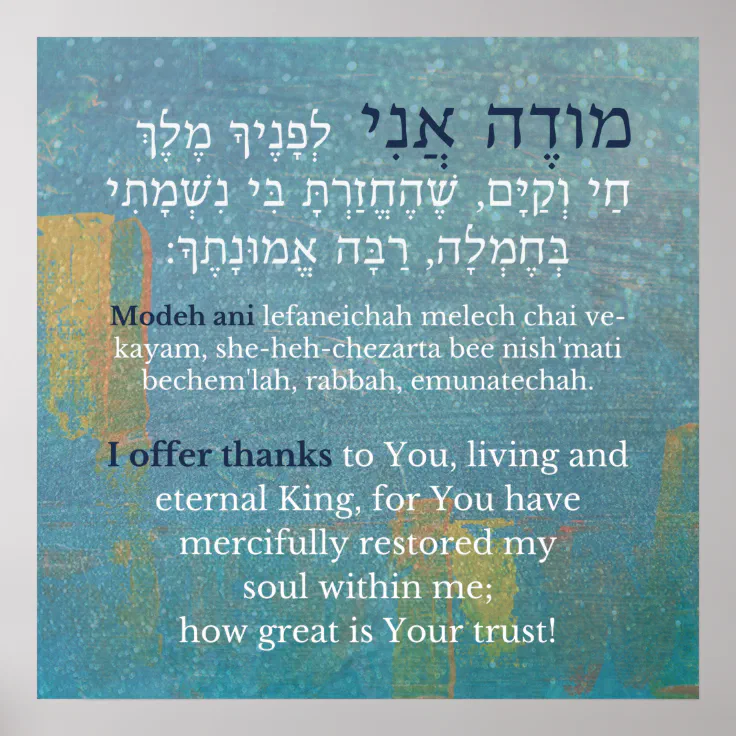
The world is renewed for us

I previously described the Jewish practice that upon awakening, we start our day with words of gratitude for being alive another day, Modeh Ani.

With these words we offer words of recognition for the renewed opportunities we have as we start the day. Each day allows us to press refresh, and as I highlighted in my previous post, if we can overcome the fear of pressing refresh, we can truly take a first step. Today, I want to suggest that are acknowledgment of gratitude each day is part of taking this first step.

I came across a deeper, more mystical approach to this declaration of gratitude. Maharal, Rabbi Judah Loew of Prague, who lived in the 16th and early 17th centuries, suggested that the gratitude we are expressing is more than just about the return of our soul, our life, for another day. It also represents our expressing gratitude for the world being renewed again for another day. In other words, when we go to sleep, from a natural perspective the world continues to exist. Yet, if we take the perspective of ourselves asleep, the world ceases to be. When we wake up, the world comes back into focus, coming back into existence like we do.

I found this deeper level of renewal inspirational. If it is not just us, but the world starting over in our eyes when we start the day, when we wake up from sleep, it means we do not need to live our lives enslaved to what was. Of course, we don’t find ourselves waking up in a different bed, in a different place, but we do have the chance to make the world what we want to each day. By deliberately acknowledging and expressing this gratitude for the opportunity for the new, we always have the chance to take that first step to something new.

May we find each day as an opportunity to reinvest in the opportunities for renewal we have in front of us.

You have the opportunity to start again. If you are struggling to begin the process of starting your next journey in life. Contact New Beginnings Spiritual Coaching and Consulting LLC at 732-314-6758 ext. 100 or via email at newbeginningsspiritualcoach@gmail.com

Pray for minimum sin

While we are always striving for perfection, reality is that we will always be faced with making mistakes and errors. It in how we learn from these imperfections that can help us truly improve and grow.

In Living Each Day, Rabbi Dr. Abraham Twerski suggests the following interpretation of a little know prayer to be recited before Kiddush on Friday night.

Grant us that we may welcome many Sabbaths amidst much joy, with abundance and honor, and with a minimum of sins

Why pray for a minimum of sins? Why not pray to be completely free of sin?

Sins are mistakes in life, and no person goes through life without making any mistakes.

Mistakes can be valuable experiences and can teach us a great deal, but only if we are open minded and willing to learn, willing to accept both reprimand and guidance.

We can learn just as well from minor mistakes as from very serious mistakes. If we do learn from minor mistakes, we may well be able to prevent major ones. If we dismiss minor mistakes as trivia, as insignificant, then we learn nothing from them, and we render ourselves vulnerable to more serious mistakes.

So we pray for ‘minimal’ mistakes. But we must be wise to know how to benefit from them.

P. 127

If you are someone in the process of creating your own new beginning, trying to negotiate the hazard along your journey, New Beginnings Spiritual Coaching and Consulting LLC is here to help. For more information, please check out: https://achaplainsnewjourney.wordpress.com/about/

Strength to the Weary

Among the morning blessings is one that blesses Gd for giving strength to the weary.

בָּרוּךְ אַתָּה יְהֹוָה אֱלֹהֵֽינוּ מֶֽלֶךְ הָעוֹלָם הַנּוֹתֵן לַיָּעֵף כֹּֽחַ:

Blessed are You, Adonoy our God, King of the Universe, Who gives strength to the weary.

Many of us recite this in the midst of feeling tired, either physically or emotionally, yet within this blessing is a moment of the inspiration to feel energized for the day ahead. I read a short piece that I believe helps frame the deeper sense of this blessing.

Consider: two persons, one young and the other old, walking the same road, or climbing the same mountain, with the goal far out of sight; who will reach it: the young one, starting out with full strength, but with little hope, or the old one, lacking in strength, but full of hope? The youth will soon get out of breath, and, despairing of ever attaining the goal, will give it up in frustration. But the old man will steadily forge ahead constantly renewing his strength by hope and confidence. This is what the prophet tells us: Physical strength will be of no avail, where there is no hope, but “they that hope in Gd will renew their strength (Isaiah 40:31).”

And so, when we start a new day, which may be a difficult one, it is good to bear in mind that it is Gd “who gives strength to the weary.” With hope and trust in Gd, no road is too long or too hard, and no obstacles are too difficult.

My Prayer Volume 1 by Rabbi Nissan Mindel pg. 34-35

So often we burn bright and burn out too fast because we get caught up in the moment and lose sight of the goal and the steadiness goal setting can provide us. If we take a moment to trust that the process is going at the pace it needs to and that we are along the right path, we can maintain the strength needed to forge ahead. The strength comes from the hope in the correctness of the path. This doesn’t mean the path is always the right one, but the path, right or wrong, will lead to the next crossroads and to the next new beginning. In one sense, every day is this opportunity. And so we recognize that when we are weary there is a strength we can draw on each day to strive forward.

For more information about New Beginnings Spiritual Coaching and Consulting LLC, and how we can support you on the journey through the waves of life, please check out: https://achaplainsnewjourney.wordpress.com/about/

Swaying like a flame – Hanukkah Day 3

There is a relationship between the flame of the candle and prayer. According to Rabbi Nissan Mindel in his introduction to My Prayer:

Our soul has, in fact, been called the “candle of G‑d.” The flame of a candle is restless, striving upwards, to break away, as it were, from the wick and body of the candle; for such is the nature of fire—to strive upwards. Our soul, too, strives upwards, like the flame of the candle. Such is its nature, whether we are conscious of it, or not. This is also one of the reasons why a Jew naturally sways while praying. For prayer is the means whereby we attach ourselves to G‑d, with a soulful attachment of “spirit to spirit,” and in doing so our soul, as it were, flutters and soars upward, to be united with G‑d.

https://www.chabad.org/library/article_cdo/aid/682090/jewish/The-Meaning-of-Prayer.htm

The ideal of prayer is the revelation of what is already living deep within ourselves. By reflecting, saying words and through a bit of movement, we are investing our whole selves into the process. Through this, we can bring light into our day.

Tonight, as you are watching the flames of the Chanukkah lights swaying, reflect on the candle as a symbol of the yearning of your soul, your spirit, to bring light into the world through the words and actions of prayer.

For more information about New Beginnings Spiritual Coaching and Consulting LLC, and how we can support you on the journey through the waves of life, please check out: https://achaplainsnewjourney.wordpress.com/about/

Joyfulness and Prayer

How do we approach prayer? This is a daily question that I grapple with. One answer which resonates is from a verse that is recited most days from Psalm 100:

עִבְד֣וּ אֶת־יְהֹוָ֣ה בְּשִׂמְחָ֑ה בֹּ֥אוּ לְ֝פָנָ֗יו בִּרְנָנָֽה׃

worship the LORD in joy;
come into His presence with shouts of gladness.

Psalm 100:2

It is a goal to worship from a place of gladness, joy, happiness. As we know, this is not an easy task. It is quite a challenge to sustain a sense of gladness in prayer, especially given the difficulty most face in of remaining focused in prayer for a significant period of time. As it is something we should strive towards, we remain questioning how to create within ourselves these two states of gladness and joy.

One approach I want to share is based on a reading of this verse from the Zohar (the following is based on Leviticus 3:8B, found in Vol. 7 of the Pritzker Edition pgs. 37-39). The word joy is associated with the heart, with our emotional/mental state, while gladness is associated with our mouth, with the words we speak and chant. When we approach worship, prayer, we are to strive to approach prayer with a unity between what we say and what we think/feel. Joyfulness in prayer is seemingly when we approach prayer as a whole person, not as a house divided.

This is not a simple task as our lives are full of complications that can take us away from our sense of wholeness. How often do we pay lip service by saying or putting on an external persona that looks one way but in our hearts we are feeling the exact opposite? So often we are in conflict with the person we feel we are and the person others perceive us to be. If this is so, how can we approach prayer as a whole?

Perhaps by approaching prayer as a divided self, it is praying as a whole self. By being our conflicted self, we can pray from the place of division by embracing the internal conflict as that which makes us who we are. If we can find the place to not fight who we are but embrace ourselves, we can come to prayer with joy and contentment.

May each day bring a new opportunity to strive to find the joy and beauty of prayer.

Blessings are reminders – “Who provided me all I need”

During these past few months, I have been working on a personal goal of slowing down and paying attention, specifically during the three times a day in which I pray. This process has afforded me the opportunity to more deeply connect to the words I recite on a daily basis. At times, I come across something that I have been saying over and over and find myself stuck on the word or phrase, trying to incorporate its message into my remaining prayers and beyond.

The other day, in the midst of reciting the daily blessings in the Siddur (prayerbook), I found myself “stuck” on one blessing

בָּרוּךְ אַתָּה יְהֹוָה אֱלֹהֵֽינוּ מֶֽלֶךְ הָעוֹלָם שֶׁעָשָׂה לִי כָּל־צָרְכִּי:

Blessed are You, Adonoy our God, King of the Universe, Who provided me with all my needs.

While I have said this blessing thousands of times, on this day the words resonated more acutely. What does it mean to bless Gd “Who provided me with all my needs?” Am I being true to this blessing when I, like most, spend an inordinate amount of time trying to accumulate, to gain, to “guarantee” I have? Am I truly grateful for what I do have? Perhaps I need to allow this blessing to be a guide to help me cultivate gratitude for all I have.

I decided to further investigate this concept and came across a comment in the Koren Ani Tefilla Weekday Siddur.

Almost of the blessings are in the present tense yet this one is expressed in the past tense. Why not say “who gives me all I need?” Oftentimes sadness, hardship, and misfortune may appear to be filling up our lives but it truly is only later, further on down the road, that we can see that it all happened for a reason. Only then can we thank Hashem for what previously seemed to have been bad. A man could have found what seemed to be the perfect job: great pay, great location, and great facilities. He goes in for an interview, thinks he got the job, gets excited, and then finds out that he did not get this position. He is distraught, upset and quite puzzled. Why would he want to thank God for all He does? Only after he gets his new job with better pay, a better location, and better facilities can he thank God for not granting him his originally desired position. Only then can he distinguish the forest for the trees. The Siddur helps give perspective to our lives. (Based on R. A. Twersky).

Koren Ani Tefilla Siddur – Weekday Edition – P. 31

When reciting this blessing, I find it important to take a moment and reflect on how we have arrived at this moment, on this day, to this place in life. By finding that ability to bless, to praise, to be grateful for where we have arrived from, we can find ways to enhance the day ahead, imbuing the day with a renewed sense of purpose. By taking the moment to the see the forest and not just the trees, we can gain an increased sense of gratitude at the more complete, yet always evolving, picture.

May today and everyday be one in which we recognize what was and find ways to enhance the was to further along our new beginnings.

Facing Yom Kippur alone?

Yom Kippur, the Day of Atonement, is a very terrifying day. While it is an opportunity to start again through confession and regret, there is a sense of urgency that highlights the day. Whether one has spent this time preparing or not, how can a person wipe the entire slate clean in one 25 hour period? Sure, change is ultimately instantaneous, yet in examining the liturgy of the day, the task of repentance and finding forgiveness seems insurmountable.

Throughout Yom Kippur, the liturgy revolves around a formal confession, viddui, which lists a litany of areas we encounter and inevitably fall short of during the year. I find myself overwhelmed by the vastness of our perceived imperfections and our forced listing of them again and again. It can be lonely when confronting one’s shame, one’s failures. How can we even open our mouths to recite these words? It can be too much!

Yet, there is a short phrase in the introduction of the viddui which brings me solace. Before reciting the confession, it says:

אֱלֹהֵֽינוּ וֵאלֹהֵי אֲבוֹתֵֽינוּ תָּבֹא לְפָנֶֽיךָ תְּפִלָּתֵֽנוּ, וְאַל תִּתְעַלַּם מִתְּחִנָּתֵֽנוּ שֶׁאֵין אֲנַֽחְנוּ עַזֵּי פָנִים וּקְשֵׁי עֹֽרֶף לוֹמַר לְפָנֶֽיךָ יְהֹוָה אֱלֹהֵֽינוּ וֵאלֹהֵי אֲבוֹתֵֽינוּ צַדִּיקִים אֲנַֽחְנוּ וְלֹא חָטָֽאנוּ אֲבָל אֲנַֽחְנוּ וַאֲבוֹתֵֽינוּ חָטָֽאנוּ:

Our God and God of our fathers, let our prayer come before you and do not ignore our supplication. For we are not so brazen-faced and stiff-necked to say to you, Adonoy, our God, and God of our fathers, “We are righteous and have not sinned.” But, indeed, we and our fathers have sinned.

When we are confronting our inner self, working to overcome aspects of our lives we wish to change for the better, confessing our imperfections, there is a sense of being alone. And yet, in this phrase, “But, indeed, we and our fathers have sinned” the prayer is offering us strength, in that we are not alone in this process. We enter the auspicious day as part of a chain of tradition. We are here because it is part of our tradition, our legacy, to pause and take stock of what we have fallen short of and what we hope to rise to in the coming year. We are here because our parents, grandparents, etc. also needed a day a year to reframe life’s challenges and struggles. We are not doing this because everyone else is perfect and we are not. Rather, Yom Kippur is a day for all of us to embrace the imperfections for it is through this embrace that we can grow.

One of the struggles with growth and change in life is thinking that those around us don’t understand the struggles we are dealing with. When people are honest about their fears, worries and doubts, many barriers to change are removed. (As an example of a book that speaks about how shame is a barrier to change, see The Gifts of Imperfection: Let Go of Who You Think You’re Supposed to Be and Embrace Who You Are by Brene Brown.)

As we prepare in these final hours for Yom Kippur, may we find the resolve of knowing that we are all striving to be our ideal selves and find ways of reaching for those ideals. And if we fall short, if we err, let us remember that its OK, its part of our being human. It is merely a lonely struggle but it is a struggle we all face. May this Yom Kippur be a day of meaning, a day of introspection and a day of finding something to strive to reach for in the coming year.

“For Your Sake Living God”

In the midst of the period between Rosh Hashanah and Yom Kippur, there are liturgical additions that help frame the focus of these 10 days. One of the phrases is:

“זָכְרֵֽנוּ לְחַיִּים מֶֽלֶךְ חָפֵץ בַּחַיִּים וְכָתְבֵֽנוּ בְּסֵֽפֶר הַחַיִּים לְמַעַנְךָ אֱלֹהִים חַיִּים:

Remember us for life, King, Who desires life, and inscribe us in the Book of Life, for Your sake Living God.”

The other day, as I was reciting these words, I found myself shuddering when I came to the last phrase “for Your sake, Living God.” I began experiencing a sense that it is so difficult to live up to an ideal that if all else fails, we hope we can rely upon, “for Your sake…” inscribe us for good. As I was lost in this awesome moment, I was reminded of a short piece I recently read in Growing Each Day, a daily reader written by Rabbi Dr. Abraham Twerski o.b.m.. After asking what the phrase “for Your sake” means, Rabbi Twerski suggests a creative read of the prayer:

We might read the verse a bit differently. “Inscribe us in the book of a life that is lived for Your sake.” In other words, we pray not only for life, but for a quality of life that is meaningful and purposeful, one that will be lived for the greater glory of God (p. 5)…

Of course, we wish to be inscribed in the book of life, but it should be a life that we wish to be in rather than one that we seek to escape from (ibid.)

We recite these words during the 10 days of repentance as a focus on our striving for an ideal life of meaning, or spirit, of Godliness. I shuddered because it is an awesome and lofty goal that recognizes how hard it would be to reach. During this period, we look to formulate our ideal self, turning in prayer to God recognizing our imperfections and expressing a deep sense of hope to start clean.

Years ago, in a similar way, standing in prayer on Yom Kippur, reciting the words of confessions, the Viddui, I found myself suddenly laughing at the seeming absurdity of striving for forgiveness for all the myriad mistakes we make and will find ourselves making year in and year out. The laughter came from a place of fear, as if I didn’t laugh, I would have felt crushed by how truly difficult change is. I realized in that moment the goal of Viddui, the goal of this entire period is a striving, a framing of who we hope our ideal selves will be. And when we emerge from Yom Kippur, the question will be: do we have the opportunity afforded to us by being in the book of life to work on living towards our ideal self throughout the coming period between Yom Kippur and the next Rosh Hashanah? Will we carry forward the image of who we want to be during the doldrums of the remainder of the year?

May this new year of 5782 and this period be one of deep introspection in finding the ideal you so that we can take the opportunity to hit pause and beginning anew with a new goal, a new purpose and a new mission in our lives.

Ritual for coming into the present moment

Prayer is a verbal encounter with G-d, with the divine in our lives. Prayer is also a series of actions and rituals which help the body engage with the mind and soul in this spiritual, mystical encounter. In the Jewish tradition, the central prayer of the thrice daily services is referred to as Shemoneh Esrai, the 18, referring to the 18 (now 19) prayers/blessings. These prayers connect one to a deep, personal and communal relation with Gd, requesting for the restoration of what Jews would consider an ideal society and lifestyle. Before the beginning of this part of the service, the tradition is to take three steps back from the position one is standing in and then take three steps forward back into the initial position. I recently came across a sweet and deep explanation offered as to what is behind this ritual of movement.

And so, before beginning the Amidah, the quintessence of prayer, we take three steps back as if to clear ourselves of thoughts of the future, and then we take three steps forward, as if to clear our consciousness of the past. Then we can stand with ha’kol, “everything,” all of ourselves, in the simplicity of the present moment, to attune to and engage the Ribbono Shel Olam – the Source of Everything – and to address our immediate reality and our current needs. The rivers of past and future mingle, converge and fan out across the ground of the present moment. In the Amidah we stand firmly on stable ground with Hashem, opening ourselves and our hearts in prayer, touching eternity. Contact with the Infinite is only possible here, now. (Rabbi Judah Mischel, BaDerech, PG. 66.)

As Rabbi Mischel explains, we can take this movement as an opportunity to center ourselves in the present, leaving behind the past and future during this few minutes of intimate, one on one time with G-d. I find myself drawn to this idea of physically bringing ourselves into the present moment while we are also mindfully doing so in the form of the opening words of the prayer:

אֲדֹנָי שְׂפָתַי תִּפְתָּח וּפִי יַגִּיד תְּהִלָּתֶֽךָ:

My Master, open my lips, and my mouth will declare Your praise.

When we are in search of mindfulness, we must bring our body and soul together. We must strive for this harmony within who we are.