Believing in Oneself is a form of Humility

Most of us are familiar with some version of the following story (found here):

So there is a joke you probably know on the topic of humility. The chief rabbi of the synagogue at Yom Kippur is beating his breast and crying, tears running down his cheeks “I’m nothing, Lord! I’m nothing! I’m absolutely nothing!” Next to him the chief donor to the synagogue, a wealthy banker kneels down and hits himself on the chest and yells “I’m nothing! God forgive me for thinking I’m something. I’m not. I’m nothing!” Whereupon Shlomo a poor man who sweeps the synagogue out after services and hauls trash gets down on his knees and yells “I’m nothing! I’m nothing.” The rabbi observes this, elbows the banker and whispers “Look who thinks he’s nothing.”

We tend to confuse humility, the idea that we lack pride and the idea of having an attitude that even if we are skilled and knowledgeable, it doesn’t make us inherently better than anyone else, with feelings of low self-worth and self esteem. In most spiritual practices this distinction is crucial because it can help frame a fundamental spiritual practice of self-nullification. Self-nullification is about recognizing that within the greater universe, we are practically nil. In many religions, this is described in relation to the divine, that from a divine perspective, the only real existence is the divine (see here for one example of a Jewish perspective of the definition and purpose of self-nullification).

Yet, in conjunction with this important practice, our spiritual growth can only truly become manifest if we balance this self-nullification with knowing that our lives have purpose and meaning. I have been thinking about this in relation to a piece I read last weekend from R. Elimelech Biderman in Torah Wellsprings (Parashat Beshalach – see the full piece here pgs.4-5).

To quote a few excerpts from the piece:

Reb Tzadok HaKohen (Tzidkas HaTzaddik 154) writes: “Just as one must believe in Hashem (Gd), one must also believe in himself. This means to believe that Hashem is interested in him. He must believe that his soul comes from Above, and Hashem has pleasure from him and has enjoyment when he does Hashem’s will. This is the meaning of the pasuk (verse) (Shmos ויאמינו בה’ ובמשה עבדו (14:31, ‘And they believed in Hashem and in Moshe…’ Moshe represents the six-hundred-thousand Yidden (Jews) of that generation. They believed that Hashem desires them and derives pleasure from them and from the good that’s in them.”

It is hard for people to believe that Hashem wants them because they know their faults. However, faults and errors are part of the creation of the world. This shouldn’t prevent us from believing that Hashem wants us…

From the very essence of creation, a pattern of imperfection emerged.

Yet after all of that, it states (Bereishis 1:31) וירא אלקים את כל אשר עשה והנה טוב מאוד, ”And Hashem saw all that He had made, and behold it was very good.”

This is what Hashem calls good. It is because of imperfections that Hashem created the world. Hashem has pleasure when we overcome the struggles, downfalls, blockades, and hardships and do His will. So, you can believe in yourself, even if you are imperfect. In fact, your imperfections are the purpose of the entire creation. This trait enables you to bring a nachas ruach (inner sense of wellbeing) to Hashem more than all the malachim (angels) in heaven…

Our approach in life is two fold. We must be humble in recognizing our finite nature, our inherent imperfections and our existence in relation to Gd. At the same time, we cannot see ourselves as so low and unworthy that we never strive for anything, we never strive to grow and improve and lessen the imperfections we have in life. When we have a healthy sense of self-compassion and self-worth, we are able to do the things that help us move along our paths to fulfill our goals, our purpose for being.

This is a challenging practice to work on. It can feel extremely difficult to maintain the balance between humility and self-worth. Yet, we must always be working to find the balance, the right mix, so that we are moving forward step by step, moment by moment. We have the opportunity each day to practice through prayer, through our relationships with others and through our work towards attaining our personal goals.

May we each work to foster our own balance between believing in ourselves and the humility to recognize each of us is another part of our interdependent existence.

If you or someone you know is looking to forge ahead and set new goals for the journey of life or trying to find a sense of meaning in life, we are here to help foster spiritual and emotional growth and change. Schedule your appointment today here. For more information, please contact New Beginnings Spiritual Coaching and Consulting LLC at 732-314-6758 ext. 100 or via email at newbeginningsspiritualcoach@gmail.com

99 – imperfection and greatness

Today is my 99th post on this website. Usually, people celebrate the whole numbers, so I am one off from a celebratory moment of writing post 100. Yet, I find the number 99 to be highly significant for a story I will share a little later on. But first…

Last night, I was playing around on Twitter and came across this tweet from a friend:

Aaron Judge, probably the most recognizable #99 in today’s sports fandom, is having a season for the ages. And while I am a Mets fan, with his own #99 –

it is clear that Judge is the better #99. Granted, for me, #99 takes me back to the great one Wayne Gretzky (NHL) and to the eccentrics like Wild Thing Mitch Williams and the infamous Turk Wendell (MLB – if you know, you know), but right now, for Baseball fans, 99 is Aaron Judge, and all the others tend to be glossed over (for a full list of all those in MLB who wore 99, see here).

This got me thinking about the significance of 99, only to recall another 99, but not in terms of sports. I was reminded of a teachable moment from when I was in High School, which I go back to every so often. It was 11th grade Chumash. We had just gotten a test back from our teacher and I noticed that while I got every question correct, I only received a 99 (yes, I admit, I was one of those students, always looking for the extra point). This bothered me as clearly I had earned the 100, the arbitrary perfect score we generally place on tests. I went to the rabbi and asked him why I didn’t get 100 when I clearly got all of the questions correct. To this day, I recall his response:

“Even Moses didn’t know everything, so in my opinion it would be impossible for anyone to achieve a 100.”

I’ll admit, the answer didn’t fully satisfy me. Yet, the lessons are quite apparent and in truth ones I have come to appreciate.

  1. As I wrote about months ago, there is a notion of When 80 Percent is Perfect. We should always strive for the best we can do and recognize that the best will never be 100 percent because the 100 is a long term impossibility. There will always be something that is missed, even when it appears as if you got everything right.
  2. We need to appreciate the beauty and greatness of the 99 within the scale of 100. Truth is, we need to appreciate even more than just the number closest to 100. We need to learn to appreciate all we have gained and not focus on the missing point(s).

Which brings me back to sports. Aaron Judge is having an outstanding season, a season for the ages, since we learn that in sports we focus on the accomplishments when it comes to most statistics as opposed to the failures that are the opposite side of the coin. For example, he has been on base over 40% of the time this year, which means he not been on base a little less than 60% of the time. In other words, his great year includes more failures than successes. Yet, we see the success and ignore the failures. He is having a 99 season (which for sports video game people, is the highest rank a player can get for a season).

If you have made it this far, thank you for reading this 99th post. Writing is a series of failures, deletions and edits until something comes together that is hopefully coherent and interesting. Life is the same. We fail, change course, shift, all in the drive to forge a path for ourselves. We experience many endings and New Beginnings. May each of you find the success within the imperfection and remember the greatness that is a 99.

Reflecting on how to appreciate the steps along the way: Contact New Beginnings Spiritual Coaching and Consulting LLC at 732-314-6758 ext. 100 or via email at newbeginningsspiritualcoach@gmail.com.

When 80 percent is perfect

When we embark on any new beginning, we often get lost in our ideal selves wanting everything to be perfect. While we must always strive to do the best we can, with hard work, dedication and resolve, it is important to be grateful for the imperfections that will be inevitable. Often, if something isn’t perfect, we immediately give up.

As we are arriving at the end of 2021, heading into another new calendrical year, when so many of us consider what we want to do new or different, let us not lose momentum when things are imperfect. Instead, recognize how far you have come and find the inspiration to keep going through seeing how much you have accomplished so far.

If you are someone in the process of creating your own new beginning, New Beginnings Spiritual Coaching and Consulting LLC is here to help. For more information, please check out: https://achaplainsnewjourney.wordpress.com/about/

Overcoming Analysis Paralysis, or remembering that good can be perfect.

How to Push Past Your Analysis Paralysis – Scott Young

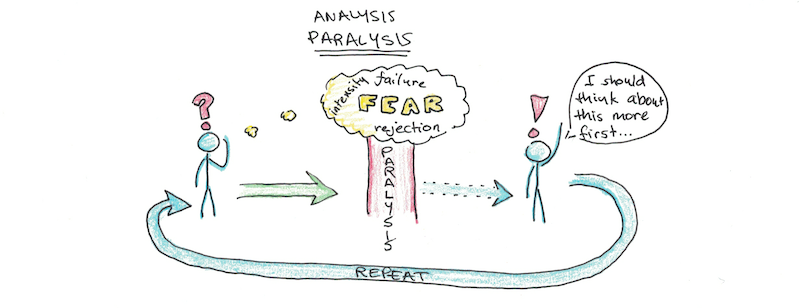
I recently came across the phrase “analysis paralysis,” a term used to describe the process of when we spend so much time thinking and deliberating that we cannot come to a decision. This phrase struck a chord with me. I find I miss out more often than not because of overthinking or outthinking my initial instinctual reaction. It stems from a fear of not having trust in my initial reaction. While it is good to have some measure of caution in life and not respond with one’s first thought, decisions do need to be made or we will never have the chance to experience so much of what life has to offer.

In the same vein, an area that I find myself exploring lately is learning to not allow “the perfect to be the enemy of the good,” the famous quote attributed to Voltaire. (See the previous post Perfection is about process not perfection for another take on this theme.) Each of us can find places in our lives in which we experience this struggle, where we give up on something because it isn’t perfect, even if it is good enough. Of course, there are areas in which anything less than “perfect” is dangerous, but even within those areas, since we know there is always improvement, then perfect is not really perfect after all. When we get caught up in making the perfect, most right decision, we often get caught in the analysis paralysis loop.

When it comes to spirituality and growth, I think the ability to overcome analysis paralysis is the difference between feeling stagnant and true growth. We allow the process to be the guide, steering us towards the goals we wish to attain, even when there are detours along the way.

For more on analysis paralysis and methods for how to break this cycle, see, for example, “Do You Have Analysis Paralysis?: Overthinking everything can make everyday life a challenge.” by Robert Taibbi L.C.S.W. and How to Push Past Your Analysis Paralysis by Scott Young.

Perfection is about process not perfection

In my continued quest for growth, one area that is constantly standing in the way is perfection. It is a nurtured habit of so many of us to “accept” nothing less than perfection. While we all know that there is no such thing as perfection or perfect people, we still struggle to accept our imperfections. I came across an interesting take on this strive towards perfection in the following analysis of Rabbi Dr. Abraham Twerski o.b.m. in his work Growing Each Day.

It states in Genesis 17:1:

וַיְהִ֣י אַבְרָ֔ם בֶּן־תִּשְׁעִ֥ים שָׁנָ֖ה וְתֵ֣שַׁע שָׁנִ֑ים וַיֵּרָ֨א יְהֹוָ֜ה אֶל־אַבְרָ֗ם וַיֹּ֤אמֶר אֵלָיו֙ אֲנִי־אֵ֣ל שַׁדַּ֔י הִתְהַלֵּ֥ךְ לְפָנַ֖י וֶהְיֵ֥ה תָמִֽים׃

When Abram was ninety-nine years old, the LORD appeared to Abram and said to him, “I am El Shaddai. Walk in My ways and be perfect.”

Rabbi Twerski notes:

If a human being cannot be perfect, why did God demand perfection of Abraham?

The entire context of the verse indicates both the definition of this perfection and the way in which it can be achieved. It is obvious that no human being can aspire to equal God’s degree of perfection. What man can achieve is to live according to God’s teachings and thereby live up to his own human potential; more than man’s personal maximum is not possible of expected. Thus, God did not say simply ‘Be perfect;’ He said, ‘Walk before me – and thereby you will be perfect.’ When a person tries to live according to the Divine teachings, that constitutes human perfection, although one is technically never perfect.

Growing Each Day P. 37

Perfection is a process. Perfection is something we strive towards by living a spiritual, divinely inspired life. Perfection is the ability to walk forward even while remaining imperfect. When we strive to improve, our next action is a first action, a new opportunity and new beginning to get it better. In a way, each opportunity we take in life to live up to our potential is another perfection on a continuum of perfection.

May we strive towards the reframing of perfection as not about the end result but about the process of getting to the end.