Last night we began the eight day celebration of Hanukkah. The traditional story of Hanukkah describes how the Hasmoneans, upon recapturing the Temple Mount from the Seleucid Greeks, where left without the ability to light the menorah in the Temple. Fortunately, after much searching, they came across a single jug of oil, which would have been sufficient to last for one day. Miraculously, the oil burned for eight days until they could get more pure olive oil to light the menorah on a daily basis as part of the Temple ritual.
One of the famous questions about this miraculous event is why do we light for eight nights when the miracle was that while they had enough for one night, the oil lasted an additional seven nights? One answer to this question is presented in Growing Each Day by Rabbi Dr. Abraham Twerski. He states:
…They did light the Menorah anyway, reasoning that it was best to do what was within their ability to do and to postpone worrying about the next day until such worry was appropriate. This decision elicited a Divine response and the Menorah stayed lit for that day and for seven more.
This miracle was thus initiated by the Jews themselves, and the incident was set down as a teaching for all future generations: concentrate your efforts on what you can do and do it! Leave the rest to God.
While even our best and most sincere efforts do not necessarily bring about miracles, the teaching is nevertheless valid. Even the likelihood of failure in the future should not discourage us from any constructive action that we can take now.
pg. 86
Whenever we are faced with “not enough,” many of us will freeze and give up instead of forging ahead and having the confidence that our efforts will be of value. While there are no guarantees, this is an example of better to have tried and failed than to have failed to try at all. As one strives for new beginnings, it is important to always remember the journey begins with one step, one flame, one light.
Happy Hanukkah!
For more information about New Beginnings Spiritual Coaching and Consulting LLC, and how we can support you on the journey through the waves of life, please check out: https://achaplainsnewjourney.wordpress.com/about/
In today’s piece in Growing Each Day, Rabbi Dr. Abraham Twerski suggests the value in taking ownership of one’s feelings and thoughts. He states:
We tend to disown those thoughts, feelings and actions that we dislike. Something we saw, read, or heard upset us, we like to think, and caused us to think, feel or act in certain way. We forget that we have considerable say in what we choose to see or to hear.
Psychiatry and psychology have contributed to this abdication of responsibility. Their emphasis on the impact of early-life events on our emotions has been taken to mean that these factors determine our psyche, and that we are but helpless victims of the past…
p.74
There is much value in getting a deeper understanding of how our journeys have led us to be the person we have become. Rabbi Twerski is reminding us that while we might have grown and changed, part of growth is being able to own who we have become and and then keep working to better ourselves as a result of knowing who we are.
He goes on to offer the following vignette
A man once complained to his rabbi that alien thoughts were interfering with his prayer and meditation. The rabbi shrugged his shoulders. “I don’t know why you refer to them as alien,” he said. “They are your own.”
If we stop disavowing our feelings and actions, we may be able to do something about them.
p. 74
From first hand experience, I can speak to the value of examining how past events in my life which have come back to the forefront of thought can help open up new vistas for new growth opportunities. As we strive for a new beginning in our day to day life, may we find how who we are has helped guide us to this moment and this opportunity for new growth goals and new opportunities.
When life thrusts uncertainties at us, we often grasp for a sense of being connected to someone or something. We search for ways to recreate the sense of safety and certainty, either consciously or not. This idea of looking for refocusing on how faith and belief might be a place of safety is exemplified in one of the famous biblical stories, Jacob’s dream in which he envisions a “Stairway to Heaven.”
After running away from Isaac and Rebecca’s home as a means of self preservation because his twin brother Esau planned to take revenge over the stolen birthright, the Torah finds Jacob having stopped overnight to sleep. On this night, Jacob dreams of a ladder going from the land to heaven. The Torah states:
And the LORD was standing beside him and He said, “I am the LORD, the God of your father Abraham and the God of Isaac: the ground on which you are lying I will assign to you and to your offspring.
Your descendants shall be as the dust of the earth; you shall spread out to the west and to the east, to the north and to the south. All the families of the earth shall bless themselves by you and your descendants.
Remember, I am with you: I will protect you wherever you go and will bring you back to this land. I will not leave you until I have done what I have promised you.”
Genesis 28:12-16
Jacob dreams/receives a prophetic message that Gd will be with him and protect him throughout his journey until such time as he returns to the land of Canaan. For Jacob, this reassurance is key to his ability to withstand the trials and tribulations he will come to face during his sojourn. Yet, Jacob maintains uncertain, for a few verses later, as Jacob takes leave of this seemingly holy place, the Torah states:
Jacob then made a vow, saying, “If God remains with me, if He protects me on this journey that I am making, and gives me bread to eat and clothing to wear,
And this stone, which I have set up as a pillar, shall be God’s abode; and of all that You give me, I will set aside a tithe for You.”
Genesis 28:20-22
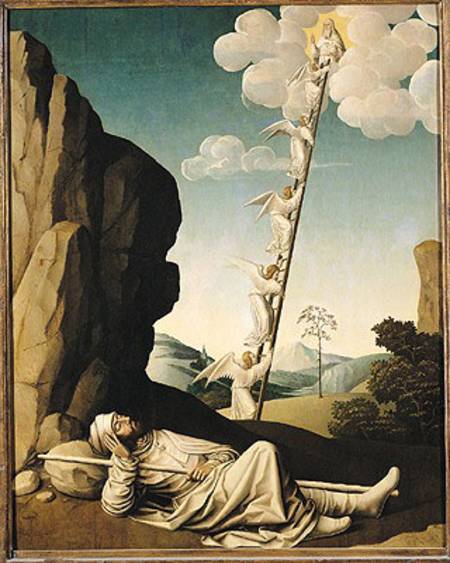
This latter scene suggests that Jacob was not one hundred percent convinced that Gd would fulfill his promise from the dream, so Jacobs offers the vow that he would provide a percentage of his hoped for accumulated wealth to Gd as a tribute for protection. Why would Jacob not believe wholeheartedly in Gd’s promise? I would suggest that Jacob’s uncertainty is not from a lack of faith but rather from an innate sense of abandonment that he feeling on this night. This is depicted in the first image of the dream, in which the “angels of Gd” ascend and then descend from the ladder. If we consider the image we would expect to see, the angels should have descending first and only then ascending. Yet, the verse flips the actions, leading to the following comment from Rashi:
עלים וירדים ASCENDING AND DESCENDING — It states first ascending and afterwards descending! Those angels who accompanied him in the land of Israel were not permitted to leave the Land: they ascended to Heaven and angels which were to minister outside the Land descended to accompany him (Genesis Rabbah 68:12).
As we know, dreams, even in the prophetic sense that is attributed to them throughout the Bible, contain many images that illustrate our unconscious or conscious concerns. For Jacob, the angels were his protectors, his internal sense of not being alone, which his subconscious highlighted in his vision. While Jacob does have a destination, his uncle’s home and a mission to marry his uncle’s daughter, he is presumably filled with feelings of abandonment and uncertainty about the future. As such, he dreams of angels first ascending, for deep down he knows he is never alone. Furthermore, the entire dream focuses on Gd being with him throughout his journey. The angels represent that Jacob can rest assured that he is not being abandoned at any point.
Regarding his vow after the dreams, the vow speaks to Jacob’s conscious sense of uncertainty. A dream is a dream and even one of a “prophetic” nature can leave someone with doubts. Jacob’s vow/covenant to Gd is a way for Jacob to accept that dream and change his mindset. No longer will he allow himself to be worried about the uncertainties that lie ahead. He knows he will be able to handle them because of Gd’s “promise” and his offer as a means of submission to this new perspective.
Jacob’s vision and response is a powerful example of the challenge we all face when starting on a new journey. Deep down we know there is risk any time we venture into something new. Doubts exist. Yet, if we allow the doubts to overtake us, we will never be able to take the first step. When we acknowledge the doubts and take control of them, recognizing the doubts are part of the journey, not the barrier, we will be able to move forward and find our new beginning.
May we find the ability to change our mindset as we work towards achieving our growth potential and our wishes.
Over the summer, standing at the beach, watching the waves rise and fall, push and pull, I had a moment of realization. The idea that life is like a wave (I know, cliche) became readily apparent. We all have ups and downs, rising and falling constantly. We surf on these waves of life, sometimes consciously and sometimes not.
After my many years of working with the senior population and within the world of hospice care, I have decided to embark on a new wave in my journey, and am launching New Beginnings Spiritual Coaching and Consulting LLC. My goal is to provide a spiritually focused coaching service for those struggling with the waves of life, the ups and downs of change, challenge, grief and loss, and engaging and growing in one’s spirituality. I am available to work with individuals and groups as well as provide lectures/webinars on a variety of topics related to transitions and spirituality.
For more information, please check out my About page.
Over Shabbat I read the following analogy that I believe speaks to the idea of a New Beginning:
When a person is traveling away from his town, his path becomes darker and darker, because the lights of the town are further and further away. But the closer he gets to ending his journey, the closer he is to finding the next town, he begins to see the lights of the town even before he gets there. The lights of the coming town begin to light up his path, even though he is not yet there yet.
When we head out on a new road, we leave behind what we knew. The knowledge of the past fades like the lights of the town as we keep traveling on the road. The road in front of us is scary as we can’t see what is ahead. Yet, as we move along the path, we are also coming closer to a new destination. As we come closer, the “end,” which is the new start, becomes clearer and clearer.
Each day, as we journey forward, we are confronted with this constant going from known to unknown to known again. If we can be mindful that the journey will lead us to a new knowledge, a new “light” we can travel forward with confidence, facing any obstacles along the way because we know the way will be illuminated for us.
May each of you travel your road to a new beginning with the knowledge that it might look dark along the way but really it is a clear path when you reach the next stop along your journey.
Bible scholars throughout the generations recognized that the story of Isaac, (Genesis 25:19 – 28:9), is parallel in many ways to his father Abraham’s story (Genesis 12-25:18). There are some who suggest Isaac faces similar challenges as a means of rectifying and improving on the decisions of his father. Sometimes he succeeds and sometimes he fails. For an example of a lengthier, story by story analysis of this, see The Differences Between Avraham and Yitzchak by Rav Amnon Bazak.
In reflecting on the overall message of these parallel stories, I found myself reflecting on one of the challenges of change. In a previous post, Facing Yom Kippur Alone?, I reflected on how change is such a challenging undertaking that we incorporate all who have come before us to help guide and motivate our desire to change. This comes about by recognizing our imperfections.
As I have been reviewing the story of Isaac, I came to realize another element of change, the idea that many of our “desired” changes are driven by belief that we need to better the true and perceived mistakes of our parents/ancestors. While this is a noble effort, it can also be full of many pitfalls. When our only goal is to avoid making the same mistake, we are more likely to make that or a different mistake. For example, in the story of Isaac and family fleeing to the Philistine land due to a famine, Isaac, like his father, begins his sojourn in this land by claiming that his wife, Rebecca is his sister, not his wife. Abraham did this twice with Sarah, both in Egypt and in the land of the Philistines. Both times Abraham’s ruse was found out. Particularly striking is the reason Abraham gives to Avimelekh, king of the Philistines upon being found out:
“I thought,” said Abraham, “surely there is no fear of God in this place, and they will kill me because of my wife.
Genesis 20:11
Abraham expresses fear for his life. When Isaac finds himself in a similar situation a generation later, the Torah indicates Isaac’s reasoning and then shows how things worked out until Isaac was “caught:”
When the men of the place asked him about his wife, he said, “She is my sister,” for he was afraid to say “my wife,” thinking, “The men of the place might kill me on account of Rebekah, for she is beautiful.”
When some time had passed, Abimelech king of the Philistines, looking out of the window, saw Isaac fondling his wife Rebekah.
Genesis 26:7-8
One can imagine the following scenario: Isaac heard about the times his parents fled due to famine and perhaps even the stories about Abraham trying to pass Sarah off as his sister, and why. As such, when Isaac is faced with a similar situation, he figures he needs to be careful as well, but also calculates that since he knows what happened before, he can put extra precautions in place to avoid anything going wrong. And it worked. It worked so well that time passed and he let his guard down, leading to the revelation of Isaac and Rebecca’s true relationship. Change can be the avoidance of the errors of the past but often as time passes, we too let our guard down and the change we have been striving to maintain falls away because we get complacent or frustrated. This can be a sign that the change was not due to a deep yearning to begin anew but a more surface level need for change for some outside reason.
When embarking on a new beginning, the examination of one’s motivations can be crucial to the process and the extent that the change will have a long lasting effect. We strive to learn the lessons of the past, the lessons of our own mistakes and the mistakes of parents, etc. We strive to correct and improve our lives by implementing the lessons learned in our actions. From the parallel stories of Abraham and Isaac, we can see how sometimes we will succeed in changing the narrative and sometimes we will also fall short. It is our mission to uncover the motivations behind our choices, to work to embed our desire for change in our heart to help increase the likelihood of continued successful steps forward. Change is a constant and each incremental step is a victory unto itself. Through the work of uncovering motivation, it is my hope that each of us will find the growth and change we truly wish for, building on the past and paving the road for the future.
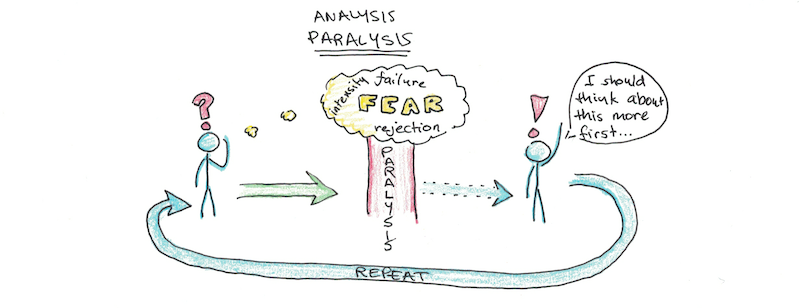
I recently came across the phrase “analysis paralysis,” a term used to describe the process of when we spend so much time thinking and deliberating that we cannot come to a decision. This phrase struck a chord with me. I find I miss out more often than not because of overthinking or outthinking my initial instinctual reaction. It stems from a fear of not having trust in my initial reaction. While it is good to have some measure of caution in life and not respond with one’s first thought, decisions do need to be made or we will never have the chance to experience so much of what life has to offer.
In the same vein, an area that I find myself exploring lately is learning to not allow “the perfect to be the enemy of the good,” the famous quote attributed to Voltaire. (See the previous post Perfection is about process not perfection for another take on this theme.) Each of us can find places in our lives in which we experience this struggle, where we give up on something because it isn’t perfect, even if it is good enough. Of course, there are areas in which anything less than “perfect” is dangerous, but even within those areas, since we know there is always improvement, then perfect is not really perfect after all. When we get caught up in making the perfect, most right decision, we often get caught in the analysis paralysis loop.
When it comes to spirituality and growth, I think the ability to overcome analysis paralysis is the difference between feeling stagnant and true growth. We allow the process to be the guide, steering us towards the goals we wish to attain, even when there are detours along the way.
for whom a contemptible man is abhorrent, but who honors those who fear the LORD; who stands by his oath even to his hurt;
Rabbi Twerski suggests the following psycho-spiritual reading for this section of verses.
People often fail to grow because they are reluctant to face the painful truth that they have done wrong. We have an innate tendency to avoid pain, and therefore we are apt to conjure up rationalizations that justify our behavior. These rationalizations are nothing but lies – sometimes clever and convincing, but lies nonetheless. Facing the truth and accepting the pain that comes with it requires courage.
People who “speak truth in their heart” says the Psalmist, do not retract their word even if it is to their own hurt. On the other hand, those who constantly seek to change everything to conform to their maximum comfort are only lying to themselves.
Growing Each Day P. 44
As I was reading this piece this morning, I found myself reflecting on the challenge of combating our innate attempts at self-deception and justification. The first example that came to mind was in the area of goal setting, a fundamental element in working on personal growth. How often do we have a goal in mind and yet find reasons to push it off, to change it for convenience or to just give it up because we missed a deadline along the way? How often do we then find justifications for our actions? Life is never a straight line and plans do often get waylaid for a variety of reasons (“Man plans and God laughs”). Yet, do we allow these curveballs to dictate our lives or do we find ways to incorporate the curveballs into how we choose to live?
Everyday we have affords us a new opportunity, a new beginning. A lost opportunity does not have to be the end of an opportunity. Rather, if we realize it is a bump in the road, we can pick up and continue along the path. If we are true to our perceived mission, our perceived goals in life, the bumps along the way can also guide us forward.
As we work daily on our growth, may we not allow unforeseen to completely derail us from our personal hopes and dreams.
In my continued quest for growth, one area that is constantly standing in the way is perfection. It is a nurtured habit of so many of us to “accept” nothing less than perfection. While we all know that there is no such thing as perfection or perfect people, we still struggle to accept our imperfections. I came across an interesting take on this strive towards perfection in the following analysis of Rabbi Dr. Abraham Twerski o.b.m. in his work Growing Each Day.
When Abram was ninety-nine years old, the LORD appeared to Abram and said to him, “I am El Shaddai. Walk in My ways and be perfect.”
Rabbi Twerski notes:
If a human being cannot be perfect, why did God demand perfection of Abraham?
The entire context of the verse indicates both the definition of this perfection and the way in which it can be achieved. It is obvious that no human being can aspire to equal God’s degree of perfection. What man can achieve is to live according to God’s teachings and thereby live up to his own human potential; more than man’s personal maximum is not possible of expected. Thus, God did not say simply ‘Be perfect;’ He said, ‘Walk before me – and thereby you will be perfect.’ When a person tries to live according to the Divine teachings, that constitutes human perfection, although one is technically never perfect.
Growing Each Day P. 37
Perfection is a process. Perfection is something we strive towards by living a spiritual, divinely inspired life. Perfection is the ability to walk forward even while remaining imperfect. When we strive to improve, our next action is a first action, a new opportunity and new beginning to get it better. In a way, each opportunity we take in life to live up to our potential is another perfection on a continuum of perfection.
May we strive towards the reframing of perfection as not about the end result but about the process of getting to the end.
I will bless those who bless you And curse him that curses you; And all the families of the earth Shall bless themselves by you.”
At first glance, it appears that God’s call to Abraham is to leave everything behind and travel forth to start fresh. Yet, in 12:5 we read that Abraham doesn’t travel alone or empty handed:
Abram took his wife Sarai and his brother’s son Lot, and all the wealth that they had amassed, and the persons that they had acquired in Haran; and they set out for the land of Canaan. When they arrived in the land of Canaan,
Abraham travels on this pilgrimage with family, an entourage from his homeland and his property. This would seem to contradict the nature of what we imagine as Abraham’s sacred pilgrimage. How do we resolve this potential contradiction between the divine request and the actual fulfillment of the request?
When we consider the overall nature of Abraham’s appointed mission, I believe that this is not in fact a contradiction but a key to the Abraham story and a lesson to learn. Abraham’s journey needed to be a new start, yet one which built off of his past. Abraham needed to leave behind the elements of his past that would have hindered him, that would have weighed him down. At the same time, in order to fulfill the promise of God, that he would be the founder of a great nation and a blessing to all those whom he encounters, the promise had to emerge from that which already existed. His was a journey that was more than just a physical pilgrimage. It was a journey of internal growth and change.
Abraham’s journey is a symbol for how we start anew. For most of us, the desire to change often leads down a road where we wish to leave everything behind and start completely fresh. Yet, for most of us, this is not a realistic way to approach change, growth and establishing a new beginning. Growth and change need us to leave the past in the past, move forward from what was, and yet not neglect all that got us to the moment of change. True growth and change emerges from the discovery of our core and enhancing those things we have cultivated throughout our lives. If we allow our past to be there as a guidepost and only a guidepost, not a chain to keep us trapped, we can experience the blessings of the new and better path we find ourselves on.



 New beginnings: A blog about spirituality, chaplaincy and renewal