The Gates are Closed/ The Gates are Open

Yom Kippur has come and gone. We have prayed, fasted and spent the day in the most spiritual way possible. The gates are closed. We emerge with the hope that this year will continue to be a year of good and of life.

And yet, with one gate closed, another is open:

Today begins a New Beginning. We have achieved our yearly moment of closure, the books of the past are sealed and now we have the chance to write the book of the present.

How do we take the spiritual high from yesterday forward? Perhaps the answer is best expressed in this popular meme:
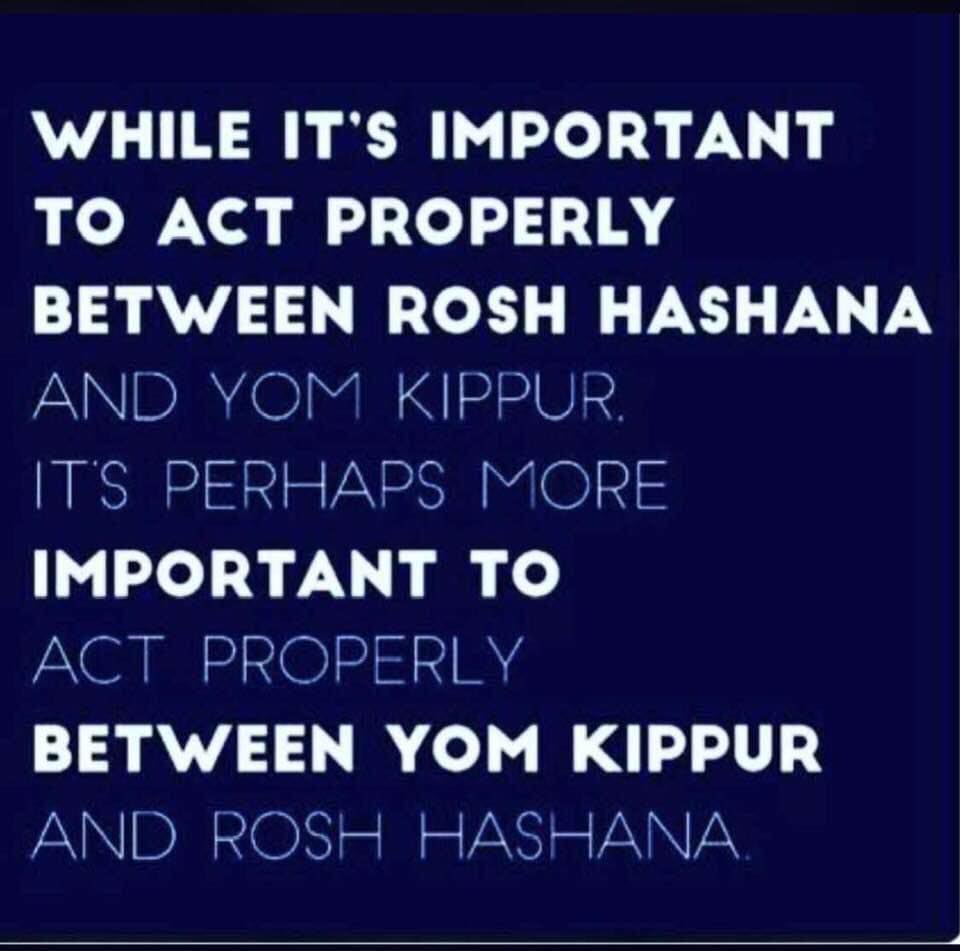
As I have been reflecting on the prayers from the high holidays, specifically the viddui prayers we recited yesterday, it is clear that the confessionary nature of these words is a combination of raising for us a sense of what we have done wrong in the past and a road map of how to better ourselves. The areas of confession range from how we speak, how we interact with others and our need for mindfulness in all of our actions. If we have truly taken the day to heart, we will have hopefully walked away taking the first steps towards how we approach the next 12 months until the next Yom Kippur.

We are now in the 4 days leading up to Sukkot, Zman Simchateinu, the time of Joy. As we prepare for the celebratory days of Sukkot, may each of us take the power of Yom Kippur forward and celebrate the new opportunity placed before us.

Are you looking to take the next steps in the process of establishing your new journey: Contact New Beginnings Spiritual Coaching and Consulting LLC at 732-314-6758 ext. 100 or via email at newbeginningsspiritualcoach@gmail.com.

We can still Light the Candle

The hour is late. In mere hours we will be entering Yom Kippur. We have had ample opportunity for reflection and introspection. And while we might think it is too late, we would do well to remember it is never too late. We can still open our hearts to the desire to change and offer that deep desire as our first step to real, true teshuvah, true returning to the person we strive to be. I came across the following idea from Rav Moshe Weinberger that illustrates this concept (found here [p.19]):

One year on Yom Kippur, the Sar Shalom of Belz quoted the mishna in Shabbos (34a),


”ג’ דברים צריך אדם לומר בתוך ביתו ערב שבת עם חשכה עשרתם ערבתם הדליקו את הנר,““a person must say three things erev Shabbos as it gets dark, ‘Have you tithed?’, ‘Have you prepared the eruvim?’, and ‘Light the candle!’”

He explained that because Yom Kippur is called the ultimate Shabbos (Vayikra 16:31), this mishna also alludes to our feelings as we enter into Yom Kippur. “עשרתם “means “Have you tithed,” but because the root word is “עשר “,meaning ten, it alludes to the ten days of teshuva, as if to ask, “Have you used the ten days of teshuva properly?” Indeed, the ten days of teshuva have passed and what did we accomplish?! “ערבתם “ means “have you prepared the eruvim?”, like the eruv techumim and the eruv chatzeiros. But “ערב “also means “eve,” as if to ask “Have you used the eve of Yom Kippur properly to prepare? Erev Yom Kippur has passed and how did we use it?!

And the last question relates to kindling the Yom Kippur candles. The Sar Shalom continued “The candles are already lit and look what a state we are in!” He was quiet for a moment and then he concluded, “But ‘הדליקו את הנר ‘,does not mean ‘the candle
is already lit.’ It means ‘Light the candles!’ Therefore it is not too late! Each and everyone of us still has time to light the candle, which refers to (Mishlei 20:27) ‘ נר אדם נשמת’ ה’ ‘,the soul of man is G-d’s candle.’”

Much of my suggested work in coaching others begins by showing them that the first step is to take the first step. If we just light the candle, do this one small task, we are already along the way to change. Once we recognize that the hardest thing is such a simple thing, we will then be able to begin along a new path towards growth.

Yom Kippur is both a culmination and a beginning. If we have been working on how to change this whole time, Yom Kippur allows us to have a sense of the slate wiped clean so we can make the fresh start we desire. And if we haven’t used this time as well as we could, don’t despair. Yom Kippur is a roadmap towards areas we can and always should be working to better ourselves in.

May each of us find this Day of Atonement to be the guide forward we are in need of as we all continue to foster the desire for New Beginnings in our lives.

If you are exploring ways to deepen your ability to recognize within yourself areas of desired spiritual growth: Contact New Beginnings Spiritual Coaching and Consulting LLC at 732-314-6758 ext. 100 or via email at newbeginningsspiritualcoach@gmail.com.

Listening to the whole story

How many of us only pay superficial attention when someone talks to us? Are we only conscious of hearing just what is being said? Maybe we are among the fortunate who pay just enough attention to get the gist of the message? Or perhaps, when someone is commenting about a situation or offering constructive criticism, even with the best of intentions, all we hear is the criticism without listening to the underlying suggestions of ways to improve? Are we too stuck in who we are, too stubborn to receive feedback, to recognize how the criticism is hopefully coming from a good place? (And yes, I am and have been guilty of this way too many times to count).

Sometimes the rebuke is really a blessing in disguise!

I came across a thought from the end of last week’s Torah portion that I found to be spot on as a reflection of hearing/not hearing as it pertains to growth and change. Deuteronomy 31:30 states:

וַיְדַבֵּ֣ר מֹשֶׁ֗ה בְּאזְנֵי֙ כל־קְהַ֣ל יִשְׂרָאֵ֔ל אֶת־דִּבְרֵ֥י הַשִּׁירָ֖ה הַזֹּ֑את עַ֖ד תֻּמָּֽם׃ {פ}
Then Moses recited the words of this poem to the very end, in the hearing of the whole congregation of Israel:

When the Torah uses the word אזני (in the hearing (related to the word for ear)) or any of its derivative words, it implies a different kind of listening, perhaps as in emphasizing paying attention. The people were to be paying attention to some form of poetic rendering of Moses’ final speech. This is either a reference to Deuteronomy 32 or it is a reference to the series of verses that precede 31:30 starting from 31:22, which also uses the word שירה as a reference to the words of Moses. Regardless, the word שירה has a positive connotation, the words preceding or upcoming are more of a rebuke. As such, what did they hear?

The Israelites, while hearing the harsh words from Moses, also heard hope in his words. They didn’t just hear the rebuke and the consequences of their fall. They also heard that even when falling so far, there is a point of being able to rise back up, that the relationship promised would remain. They heard the song because they were listening with their ear, listening intently to the entire speech, not just sitting with the negativity of rebuke.

Every year, I am amazed at the extent of the formal confessionary forms of prayer we engage in throughout the period between Rosh Hashanah and Yom Kippur, culminating in the Viddui/confessions of our various “sins,” which are recited time and again on Yom Kippur. It is easy to get overwhelmed by the categories of our errors and how far we must come. Yet, I am also amazed that within this hard reality check, we can emerge with a renewed feeling of “success” and belief that we will be sealed for a good year. In many synagogues, it has become the practice to sing and dance immediately post Yom Kippur as a show of our seeing beyond the words. Through our confronting our humanity in a serious fashion, we come out the otherside having taken the heaviness and made it into something to celebrate, not dread.

May each of us “hear” the prayers of Yom Kippur as the road map forward for us to grow each day. May our “ears” be open to both the voice inside ourselves looking to improve and to the feedback we hear from others.

If you are exploring ways to deepen your ability to recognize within yourself areas of desired spiritual growth: Contact New Beginnings Spiritual Coaching and Consulting LLC at 732-314-6758 ext. 100 or via email at newbeginningsspiritualcoach@gmail.com.

Self-reflection/looking in the mirror

A couple of my more recent posts have explored the topic of identifying the various components of self identity. In this post, I am…, I included the beginnings of a list of different terms as to who I see myself as and as a paradigm for your personal growth. This practice, of listing the various “I ams” is a crucial component of growth. By looking in the mirror and engaging in the various elements of who we see, we can then explore the deeper characteristics that underlie each of those elements of our self-makeup.

Some of you reading this might question this method. After all, the work of claiming an “I” seemingly flies in the face of many spiritual practices. It is a common misconception that the goal of spiritual practice is an absolute self-nullification, a removal of all “I” elements of life. I would argue that this is a mistaken premise. Self-nullification, losing oneself in greater spiritual growth, is about the work of not allowing any of the identifying elements of the self to become sacred, to become the be all and end all.

Rather, what I am proposing is that the “I am” is a gateway to deep exploration and spiritual work as it relates to growth. This dawned on me in working with a couple of my clients, exploring the underlying meaning of the terms they were using to identify themselves. The exploration was to try to understand what were the drivers behind the particular term that the person used as a definition of self. When we are clear on who we are and what that means to us, we can then travel a road of who we wish to become within or without the term we are exploring.

For example, in my previous post, I identified myself as a “reader.” If I were to break this down further, I might begin by describing what I like to read or the types of books I find myself reading at the moment. I might explore what reading does for me. In fact, here is a rough outline of what saying I am a Reader is to me:

  1. explorer
  2. curious
  3. seeker of knowledge
  4. reading allows me times to escape from the challenges of life
  5. reading is a spiritual practice
  6. growth and change
  7. reading is a gateway to unexplored worlds
  8. reading is helpful in being a writer

I would then take this list and go deeper in this and related topics as it pertains to the goals the person I am working with would like to explore. For example, if I want to explore the notion of reading as a personal spiritual practice in relation to what it means when I define myself as a reader, I would work with the person to deepen their self-notion of what reading as a spiritual practice is. Is it the focus of reading? Is reading really about study and being absorbed in the depths of another’s words? Is it a form of connection to Gd (there is much in religious thought about connecting to the divine through the practice of study, of learning)? The goal of these explorations would be to help foster within the person the richness that comes from insights into the self so as to better foster the growth a person is looking for.

May each of us discover new aspects of ourselves as we consider the “I ams” we bring to the world.

Reflecting on your own path of self-discovery: Contact New Beginnings Spiritual Coaching and Consulting LLC at 732-314-6758 ext. 100 or via email at newbeginningsspiritualcoach@gmail.com.

How many drafts does it take

I have been finding a lot of self-reflective material when considering aspects of writing. In writing, like life, it is almost impossible to create the perfect piece in a single sitting. Just like it is important to remember that all goals are made up of a series of single steps, one foot after the other, so too writing is a process of putting one word on paper at a time, in which eventually the string of words becomes a cohesive unit. Along the way, there will be updates to the unit of writing, whether because of a misspelled word, a missing punctuation mark, or information that is lacking because we forget to convey to the reader precisely what we are thinking. Or, perhaps you think it is good, post it on a website, and then get a copy-editor’s eye to read it and circle in yellow the errors in the piece (which luckily is easily fixable in wordpress).

Serious writing is a series of rough drafts, when in a way even the final draft remains an incomplete, imperfect product. Yet, for those of us who persist in writing, the rough draft, the initial go, is often as valuable if not more valuable than the “final product.” The rough draft is the opportunity to try and fail in the craft of formulating an idea. The rough draft is the proof you need to know you have taken the hard first step of engaging in the writing process.

The rough draft is a great metaphor when we consider self-introspection and change. Most of us are searching for do-overs, the opportunity to change what was, whether by scrapping something and moving away from the past or from veering slightly to the right of left to a different turn that we believe will lead us in the direction we really want to go. Like with writing, when we cross out and change words, life gives us countless opportunities to adjust to the moment, to the times by changing, rearranging or erasing elements of our before so as to make the step forward towards a new start.

I came to this thought this afternoon as I was scrolling through a list of some of the blog posts which I have either not completed or have pretty much decided to leave in the draft folder because they don’t resonate for me at this point. Many of the drafts were like the dipping of a toe into a topic and realizing the water was not ready yet or perhaps might never be. The draft folder contains the tried and failed so as to then try again and succeed with any number of other posts.

Every Elul as well as every other demarcation point in one’s year, when we reflect and desire to explore unknown elements of the path going forward, we are reminding ourselves that we remain a “rough” draft in need to further polishing. The polishing can take multiple reads, multiples steps and missteps along the way. We can and do go through many drafts of our lives. The goal is fostering and maintaining the hope that each time we reread and edit, we are succeeding by seeing the incremental and/or monumental improvement over the previous version.

May this be a time of year when we can all look inside and make the necessary edits to improve on the rough drafts we have crafted up until now.

Need help scouring and editing the Rough Drafts of your life: Contact New Beginnings Spiritual Coaching and Consulting LLC at 732-314-6758 ext. 100 or via email at newbeginningsspiritualcoach@gmail.com.
Being the person you want to be takes hard work

With Rosh Hashanah 27 days away, it is an important time to reflect on the work of change. Realistically, one should not treat growth and change like most of us treat tests, a time to cram and get it over with. Rather, one should regularly be in a place of self-improvement so as to have times in which to ramp up the process a bit, such as during this auspicious time leading to a new demarcation, a new year, a New Beginning.

As most of you who have been reading this blog have noticed, much of what I emphasize is incremental growth, small steps, the importance of acknowledging the gains along the path, and other modalities of fostering long term success. I recognize that these ideas can and are difficult. First, we have to begin the journey, which, as which I described in my previous post, is the hardest step. Once we do that, we then have the difficulty of maintaining and taking more steps. This isn’t easy, though if we recognize the accomplishment of the initial step, perhaps we can find the strength to continue along.

I myself continue to consciously work on these approaches in my own growth work, and struggle with the ups and downs that inevitably do come into play when travelling along the waves of life. Yet, if we try to just leap from the bottom to the top, most likely we will just fall right back down. If we put one foot in front of the other, walking or climbing one step at a time, we can always stop on the landing along the way to catch our breath, take stock and reflect on the step we have arrived at before continued “upward.”

Recently, a client sent me an article that struck me as highlighting this point about perspective when things seem challenging. The author, Binyomin Yudin, describes two situations, one logistics, one self-care focused in which to do “right” he had to the hard thing. At the end of his piece, he reflected on the following:

It was during one of these four-mile walks that Rav Steinman’s words came to mind. Walking up a grueling hill near my office, I was getting fairly aggravated, thinking about all of my friends who don’t have to do this, who can eat what they want without worrying about the impact of their choices on their lifespans. As I crested this hill, however, I realized that this was the quintessential example of Rav Steinman’s lesson. I had sweat running down my face; the exercise was clearly tirchah. Just as clearly, though, it was the right thing to do.

“We can do hard things.” Living the life you want to live and being the person you want to be demands hard work, I reminded myself, with Rav Steinman’s words echoing in my ears: “I’ve found that doing the right thing often takes tirchah.”

In this month of Elul, 5782, as we desire to work towards striving to be the person we wish we could be, we should remember, that with growth comes regular work, daily ritual and routine, challenges and moments of needing to foster our drive for continued successes along the way.

Need support as you work on the difficult task of self improvement and growth: Contact New Beginnings Spiritual Coaching and Consulting LLC at 732-314-6758 ext. 100 or via email at newbeginningsspiritualcoach@gmail.com.

The hardest step is the first step

I think most of us feel this way. We have a goal, a dream. We want to make a change in our lives. And yet, we don’t follow through because the first step seems like such a leap to make. Too often we get lost because, like the picture, it seems like the first step is impossible to reach.

Yet, I bet that once you take the first step along a journey of steps, in hindsight you realize the first step was the same as every other step in that it wasn’t really a leap but it was a manageable step.

These words sum up the point. Do it now, get started. Don’t allow the paralysis, the fear leave you seeing an insurmountable step, when in reality it is not insurmountable. I know this because in many areas of my life I struggled and continue to struggle with taking first steps. We are all afraid of taking the first step and not landing on solid ground, of falling, of failure, of defeat. There can seem to be too many stumbling blocks along the way. And if any of those obstacles really do stand in the way, we can also work to pick ourselves up and take another step, go another way around. Or, if you go back to image above, maybe the way to get up the first step is bring a ladder and use a tool you already have to climb up.

Regardless of outcome, what is most important is the initial moment of striving towards the dream, the wish, the change. May each of us find the way to take a first step today along a new path that we want to open up in front of us.

Are you looking for a ladder to help you climb up to the first step: Contact New Beginnings Spiritual Coaching and Consulting LLC at 732-314-6758 ext. 100 or via email at newbeginningsspiritualcoach@gmail.com.

I am…

Last week I wrote a personal reflection I Am A Writer, expressing how I see myself as the writer I am and want to be. It was a post about self-definition and about claiming one’s dreams as one’s current reality.

Today, I want to continue in the same vain, with a discussion of the more general statement “I am…” I was inspired by two things. First, while at a local business networking meeting, BNI, giving my 45 second ask, I realized that I was struggling to specify my ideal client. In the course of this challenge, I came to the recognition that understanding the ideal client would also require me to further understand who I am, who do I bring to a session when I am meeting with someone. Second, I had the fortune of connecting with a fellow rabbi/Spiritual coach to discuss how we serve others and how we can continue to grow our respective clientele. During this meeting, he reminded me about the importance of claiming who I am as part of growth for both myself and my business.

Before I answer this question, I want to explore this phrase “I am…” There is a classic situation in which someone asks us to tell them who you are and the initial answer we often give begins with our profession. And while this is one aspect of “I am…,” it is not the core of who we are. Yet, we are that professional as much as we are a parent, child, spouse, individual, a member of a community, faith tradition, etc. At different times we are one or many of these “I am…” descriptions. Further, the definition of “I am…” will inevitably change depending on our life circumstances.

To answer the question of who “I am…” is a moving target, yet it is a composite of all of the various definitions we experience of ourselves in life as it relates to both ourselves and to others. And finally, I think “I am…” can and should also include some of our in process goals and dreams as it can be a means of claiming elements of ourselves that might be incomplete/works in progress. As such, let me share some of my “I am…” statements and invite you to consider the same exercise for yourselves.

I am…

A husband, father, son, grandson, brother (and brother in law), uncle, nephew, cousin.

A Rabbi, chaplain, spiritual coach, teacher, writer, reader, learner.

A friend, colleague, mentor, disciple, student.

And this is just the tip of the iceberg of parts of who I am and helps me recognize how best to work and to serve others. All of these elements both enter a space with me and remain outside the sacred encounter with a client. When we have a deeper sense of self, the good, bad and ugly, we can better sit in the space of the uncomfortable with another.

As such, the answer to my ideal client is… You! You who are searching or engaging the same work of “I am…” You who are trying to foster a New Beginning. You who have experienced loss, death, new challenges and are trying to redefine the “I am…” that is who you are.

Reflecting on your own path of self-discovery: Contact New Beginnings Spiritual Coaching and Consulting LLC at 732-314-6758 ext. 100 or via email at newbeginningsspiritualcoach@gmail.com.

Perspective: Working to see the good

Let’s be real. It is much easier to see the negative, the difficult, the “bad” in life. And if you read most self help books, one of the themes that jumps out is the importance of working on seeing the positive, which should help us be more positive. For example, how often do we hear about the importance of smiling even when not happy because it has the physiological effect of eventually helping one to feel more positive (see The Health Benefits of Smiling as an example).

In relating this topic, I am reminded of the opening of this week’s Torah portion, Parashat Re’eh, presents the following choice:

רְאֵ֗ה אָנֹכִ֛י נֹתֵ֥ן לִפְנֵיכֶ֖ם הַיּ֑וֹם בְּרָכָ֖ה וּקְלָלָֽה׃

See, this day I set before you blessing and curse:

אֶֽת־הַבְּרָכָ֑ה אֲשֶׁ֣ר תִּשְׁמְע֗וּ אֶל־מִצְוֹת֙ יְהֹוָ֣ה אֱלֹֽהֵיכֶ֔ם אֲשֶׁ֧ר אָנֹכִ֛י מְצַוֶּ֥ה אֶתְכֶ֖ם הַיּֽוֹם׃

blessing, if you obey the commandments of your God יהוה that I enjoin upon you this day;

וְהַקְּלָלָ֗ה אִם־לֹ֤א תִשְׁמְעוּ֙ אֶל־מִצְוֹת֙ יְהֹוָ֣ה אֱלֹֽהֵיכֶ֔ם וְסַרְתֶּ֣ם מִן־הַדֶּ֔רֶךְ אֲשֶׁ֧ר אָנֹכִ֛י מְצַוֶּ֥ה אֶתְכֶ֖ם הַיּ֑וֹם לָלֶ֗כֶת אַחֲרֵ֛י אֱלֹהִ֥ים אֲחֵרִ֖ים אֲשֶׁ֥ר לֹֽא־יְדַעְתֶּֽם׃ {ס}        

and curse, if you do not obey the commandments of your God יהוה, but turn away from the path that I enjoin upon you this day and follow other gods, whom you have not experienced.

Deuteronomy 11:26-28

Notice that the language of choosing between blessing and curse is the language of sight, “See.” Moses’ exhortation is not just choose but see that the choice is placed before you. And with that choice, via the actions we take, following the commandments or not, will be the driver towards seeing the blessings or the curses of life.

In relation to this verse is an idea I came across from Kedushat Levi, R. Levi of Berditchev, one of the great early Chasidic thinkers. He presents in a variety of locations the following argument. There is an outlier belief quoted in the Babylonian Talmud (Kiddushin 39b) – רַבִּי יַעֲקֹב הִיא דְּאָמַר שְׂכַר מִצְוָה בְּהַאי עָלְמָא לֵיכָּא – It is in accordance with the opinion of Rabbi Ya’akov, who says: There is no reward for performance of a mitzva in this world, as one is rewarded for mitzvot only World-to-Come (often the Talmud quotes singular opinions in relation to the more presumed normative view as a means of recording an opinion that might be a polemical response to other beliefs of the time). R. Levi raised the following question. Does this view work in relation to another adage from Ethics of the Fathers (Pirkei Avot) – שֶׁשְּׂכַר מִצְוָה, מִצְוָה, the reward for performing a commandment is another commandment (4:2)? He suggests that reconciling this contradiction is that more opportunities to do mitzvot is the reward for doing mitzvot.

As I have been ruminating on this particular idea in relation to perspective making, I realize that this message about the reward for mitzvah is another mitzvah is similar to the idea of “smile and it will make you feel happy.” Every incremental action, positive or negative, has a corresponding positive or negative effect. To create blessing, it comes from positive incremental opportunities to do good, to perpetuate the positive.

This is not an easy or simple task. It is a task we have to constantly be working at, to constantly be seeing in front of us. Every opportunity is a choice, the choice to move forward, to take the next step building on the previous step. And if we do fall into a time of curse, a time of negativity, we have to guard ourselves from allowing that path to become the new road. The safeguard is to work to remind ourselves that we can always SEE the choice before us, the choice of turning back to the place of positivity, the place of blessing. Or, as I recently read in the book Now Is the Way: An Unconventional Approach to Modern Mindfulness by Cory Allen:

When we are dedicated to choosing the good, our view of the world changes. It grows into the shape of peace. And so do our lives.

P. 71

May you find the sight to see the positive, and may that sight be the first step along a more blessed path.

Reflecting on how to foster incremental positive change: Contact New Beginnings Spiritual Coaching and Consulting LLC at 732-314-6758 ext. 100 or via email at newbeginningsspiritualcoach@gmail.com.

I am a writer

As I work with others to help support them as they explore the road ahead, I cannot help but work on my own growth and development. In doing this exploration and work, I continue to recognize the value and importance of embracing my hopes and dreams, claiming them even if I haven’t arrived at the ideal vision I have. Among these dreams that I have revived in myself is the internal belief that I am a writer. Perhaps this is why I have spent many years dabbling and engaging in blogging, writing and sharing different ideas in a public forum. I believe I have something to say and that I have an ability to get across clear messages on “paper.” Simply put:

I am a writer.

Now, in reality, I struggle with writing. It is not a simple task to express oneself in written form. I don’t see myself as a master wordsmith, figuring out how best to manipulate and use words in a way that makes me seem smart and sophisticated. I don’t find that I am great at embellishing and creating poetic magic. Yet, in writing I am finding ways to expand my word usage and to embrace writing for writing sake without being worried about how I measure up in relation to others. The more I practice the skill, the more the skill becomes natural and easier to foster. Writing more frequently has helped me nourish my long dormant desire to write.

I am a writer

I am a writer because I choose to claim that I am a writer. By this I mean that as a function of writing regularly, I am able to comfortably and confidently say that I am this thing. While it is true that just because a person says “I am X” is not always indicative of their reality, especially if it comes to professional credentialing, but when it comes to the creative, to the arts, we can all own our work and our desire to be defined by one type of creativity or another. Why should we sell ourselves short? Why should we hamper ourselves just because we can’t produce perfect prose or masterful poetry?

I am a writer

While I cannot say it was professional goal to write for a living, I did and still do dream of writing. If we hinder our desired dreams, if we don’t claim our aspirations, then we definitely won’t achieve. Of course, even if we do dream, we don’t always make it to the top level. But if we dream, and we work and we work some more, we will have achieved much by the working that we do along the path we have set before ourselves.

I am a writer.

I am writer because I work on writing. Over the past week, pushing myself to write more, to brainstorm and express myself on this blog, I have already found more that I want to say and more ways in which to express the thoughts and feelings I want to convey as lessons to help foster growth.

I believe that within each of us is a creative person struggling to be set free. Part of my spiritual coaching work is to help a person uncover the hopes and dreams we wish stirring in the depths of our soul to better and brighten one’s life and through that to better others lives as well. Part of the search for meaning is the search for finding out the many ways we can define who we are and who we wish to be.

May each of us continue to aspire towards fulfilling and sharing our creative sides to the world.

Looking for skills to uncover and foster your creativity: Contact New Beginnings Spiritual Coaching and Consulting LLC at 732-314-6758 ext. 100 or via email at newbeginningsspiritualcoach@gmail.com.