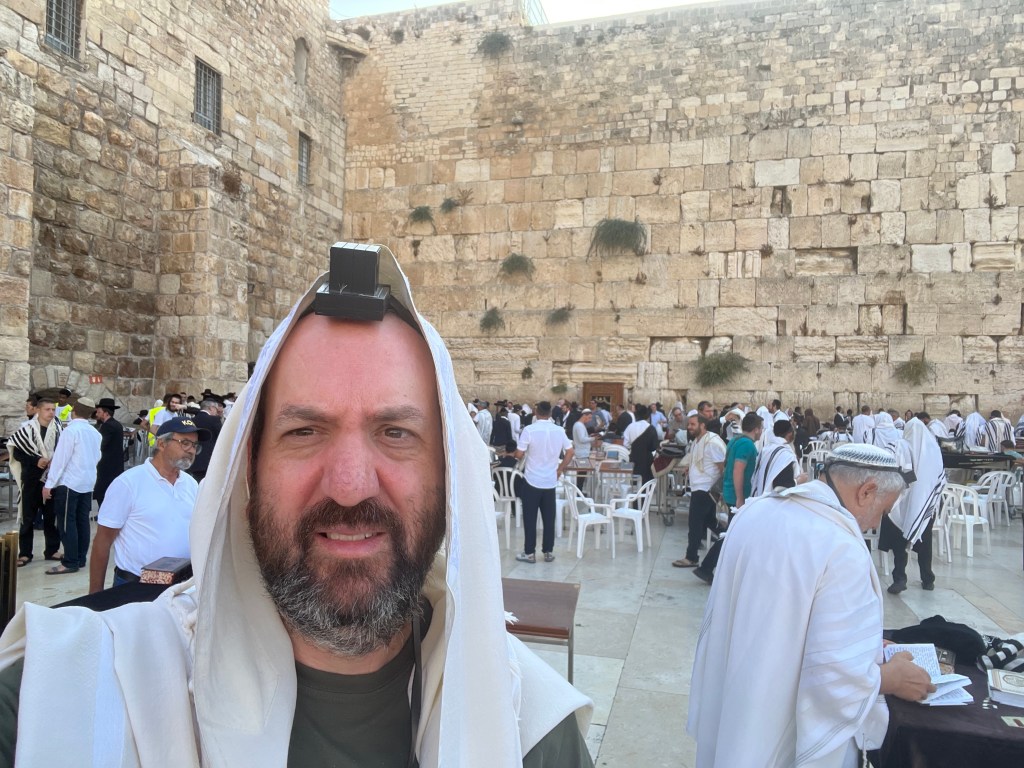
Elul Thoughts: Finding Renewed Ways to Connect

As I continue to reflect on my recent trip to Israel, one of the things that always strikes me when I am there is how comfortable I feel in Israel. This has many layers, from religiously and spiritually as well as I get a sense in certain parts of the country that it is like I am home. This makes travelling less fraught with worries and anxieties. And, this does also have a shadow side.

During this trip, as with most of my trips, I find myself drawn to spend time by the Kotel, the Western Wall. It is a place of prayer and pilgrimage. It is a sacred space. And while historically the physical wall itself was merely one of the four sides of the retaining wall for the Temple Mount, the area has become a spiritual focal point and symbol for so much. And yet, sometimes, the mystique seems to disappear.

During this trip, I had two types of experiences. Some of my sojourns to the wall, I was left with something lacking. I couldn’t find my spiritual comfort zone, struggled to pray with much focus, almost finding myself asking what was even the point of making the trek from the apartment I was staying at. It can be difficult to feel inspired when the sacred space seems commercialized and is overflowing with people. Other times, I found that inspiration. This occurred in two ways. When I went on Shabbat afternoon and found the area pretty empty and quiet, I was able to hear my thoughts better. Other times, even in the midst of massive crowds, context can be key. Being there for a Bar Mitzvah and public Selichot, both times when the place is packed, also inspired me because it was the opportunity to experiences new things in a place I know so well.

I am sharing these thoughts because I came across and was reminded of a beautiful concept drawn from a question about Psalm 27. During the month of Elul, it is customary to recite this chapter twice a day. Reading the Psalm, we can see many themes that tie into the High Holidays. One, which I want to explore, emerges from Verse 4.

אַחַ֤ת ׀ שָׁאַ֣לְתִּי מֵֽאֵת־יְהֹוָה֮ אוֹתָ֢הּ אֲבַ֫קֵּ֥שׁ שִׁבְתִּ֣י בְּבֵית־יְ֭הֹוָה כׇּל־יְמֵ֣י חַיַּ֑י לַחֲז֥וֹת בְּנֹעַם־יְ֝הֹוָ֗ה וּלְבַקֵּ֥ר בְּהֵֽיכָלֽוֹ׃

One thing I ask of the LORD, only that do I seek:
that I may dwell in the House of Hashem all the days of my life, to behold the sweetness of Hashem and to contemplate in His Sanctuary.

There is a fundamental question that arises from this passage. How can we ask Gd to both live in Gd’s house forever and also be visitors “contemplating” his temple? Doesn’t this seem contradictory.

Over Shabbat I was reminded of this question from a Parasha printout called Alei Deshe, which shares the Torah thoughts of R. Shaul Alter, Rosh Yeshiva of Gur. He shared:

The answer given to this seeming contradiction is that our request is to reside permanently in Hashem’s house, and yet maintain the freshness and excitement of one who comes only as a visitor. But how is this possible? After all, a person naturally loses enthusiasm for activities that continue for a lengthy period of time.

In order to understand this, we must look at the words preceding the request for visitor-like excitement: לַחֲז֥וֹת בְּנֹעַם־יְ֝הֹוָ֗ה, to behold the sweetness of Hashem. When one feels the pleasure and beauty of sitting in Hashem’s house and serving Him, he will naturally maintain his enthusiasm for it, and will return day after day feeling as if it were his first day there.

Too often in life, finding ourselves in moments that used to drive us, inspire us, excite us, and suddenly it has little to no meaning. The shiny new toy feels like it loses its shine. When this happens, we get frustrated, we try to find something new. For most of us, it is easier to discard and move on to something new. Yet, perhaps the issue isn’t the lost luster but it starts with us. Did we go in with the wrong expectations? Did we presume to find the same inspiration and joy without playing our part in being present and focusing?

In this preparation season for Rosh Hashanah, are we truly listening to the daily shofar sound, to the added prayers, to our stirring souls which are looking to make meaningful changes to our lives. Have we slowed down to see? Or are we merely heading to the place we always head to because that’s just what we do?

Going back to my personal experiences, I found that if once I could remember inspiration comes just as much from what we put in as from what the moment gives me, I was able to feel that sense of enthusiasm of “visiting” instead of the routine feeling of always being present. It required a refocus, a renewed effort and, at least with the late night trek for Selichot, doing something new and different to help refind that spiritual connection I was seeking all along.

May each us, during these last two weeks leading to Rosh Hashanah, find our things that inspire us and find new ways to put in and take out those drops of inspiration so that we may see in ourselves growth and renewal during this upcoming new year.

Looking to gain further, broader insight in becoming your more authentic, spiritually focused self? Let me help you along this path! Contact New Beginnings Spiritual Coaching and Consulting LLC at 732-314-6758 ext. 100 or via email at newbeginningsspiritualcoach@gmail.com


Context Matters

For the past couple of weeks, I was away in Israel with one of my children. We went to participate and celebrate the Bar Mitzvah of one of his closest friends. During the Bar Mitzvah brunch, the Bar Mitzvah boy’s mother shared that part of her goal for celebrating in Israel was to give context to their Jewish living. I was struck by the word Context, recognizing that in the realm of spirituality and religion, context can, and I believe, needs to be an essential element of growth.

What is context?

If we look at the image above, we can see that our perspectives can be limited if we are only looking at a single frame. We, who see the entire image, of course see the elephant in the room. Yet, for the people in the picture, they only see the frame in front of them. When we think about fostering spiritual growth, the same may apply.

For many, the search for spirituality begins by reading. There is so much available to consume about all faiths, religions, practices, rituals, that we can get lost in the frame of reference we are searching in. Each of us has the limitations of the frame through which we are seeing.

After a while, most realize that reading just isn’t enough. We need to explore, see, feel, experience, the practices and rituals. We want to observe people living life in the manner we have read. This is the pilgrimage moment. And while I might be accused of overstating it a little bit with the word pilgrimage, to me, the physical exploration and exposure is the essence of the term. In biblical terminology, pilgrimage was the three times a year of going to Jerusalem to experience the festivals of Passover, Shavuot and Sukkot, putting into context all the things the people were doing in the areas they were living. To see the ritual in action, to bear witness, was all part of the pilgrimage. As such, when we choose to go beyond the study and reading to the seeing, we too are going on a pilgrimage, and in that pilgrimage we are giving ourselves the contextualization of what we have gained from book learning.

In the Jewish calendar, we are in the midst of Elul, the month prior to Rosh Hashanah, a month of reflection and retrospection. It is a time in which we search for how we can be inspired to grow and change during the next year. Part of this reflection period for many is getting perspective on what has inspired us in the past and trying to see things from a broader perspective, not just from the little frame in front of us but from the wider context.

As we march forward, may each of us find the context in our lives that helps us grow spiritually/religiously.

Looking to gain further, broader insight in becoming your more authentic, spiritually focused self? Let me help you along this path! Contact New Beginnings Spiritual Coaching and Consulting LLC at 732-314-6758 ext. 100 or via email at newbeginningsspiritualcoach@gmail.com

How many drafts does it take

I have been finding a lot of self-reflective material when considering aspects of writing. In writing, like life, it is almost impossible to create the perfect piece in a single sitting. Just like it is important to remember that all goals are made up of a series of single steps, one foot after the other, so too writing is a process of putting one word on paper at a time, in which eventually the string of words becomes a cohesive unit. Along the way, there will be updates to the unit of writing, whether because of a misspelled word, a missing punctuation mark, or information that is lacking because we forget to convey to the reader precisely what we are thinking. Or, perhaps you think it is good, post it on a website, and then get a copy-editor’s eye to read it and circle in yellow the errors in the piece (which luckily is easily fixable in wordpress).

Serious writing is a series of rough drafts, when in a way even the final draft remains an incomplete, imperfect product. Yet, for those of us who persist in writing, the rough draft, the initial go, is often as valuable if not more valuable than the “final product.” The rough draft is the opportunity to try and fail in the craft of formulating an idea. The rough draft is the proof you need to know you have taken the hard first step of engaging in the writing process.

The rough draft is a great metaphor when we consider self-introspection and change. Most of us are searching for do-overs, the opportunity to change what was, whether by scrapping something and moving away from the past or from veering slightly to the right of left to a different turn that we believe will lead us in the direction we really want to go. Like with writing, when we cross out and change words, life gives us countless opportunities to adjust to the moment, to the times by changing, rearranging or erasing elements of our before so as to make the step forward towards a new start.

I came to this thought this afternoon as I was scrolling through a list of some of the blog posts which I have either not completed or have pretty much decided to leave in the draft folder because they don’t resonate for me at this point. Many of the drafts were like the dipping of a toe into a topic and realizing the water was not ready yet or perhaps might never be. The draft folder contains the tried and failed so as to then try again and succeed with any number of other posts.

Every Elul as well as every other demarcation point in one’s year, when we reflect and desire to explore unknown elements of the path going forward, we are reminding ourselves that we remain a “rough” draft in need to further polishing. The polishing can take multiple reads, multiples steps and missteps along the way. We can and do go through many drafts of our lives. The goal is fostering and maintaining the hope that each time we reread and edit, we are succeeding by seeing the incremental and/or monumental improvement over the previous version.

May this be a time of year when we can all look inside and make the necessary edits to improve on the rough drafts we have crafted up until now.

Need help scouring and editing the Rough Drafts of your life: Contact New Beginnings Spiritual Coaching and Consulting LLC at 732-314-6758 ext. 100 or via email at newbeginningsspiritualcoach@gmail.com.

Being the person you want to be takes hard work

With Rosh Hashanah 27 days away, it is an important time to reflect on the work of change. Realistically, one should not treat growth and change like most of us treat tests, a time to cram and get it over with. Rather, one should regularly be in a place of self-improvement so as to have times in which to ramp up the process a bit, such as during this auspicious time leading to a new demarcation, a new year, a New Beginning.

As most of you who have been reading this blog have noticed, much of what I emphasize is incremental growth, small steps, the importance of acknowledging the gains along the path, and other modalities of fostering long term success. I recognize that these ideas can and are difficult. First, we have to begin the journey, which, as which I described in my previous post, is the hardest step. Once we do that, we then have the difficulty of maintaining and taking more steps. This isn’t easy, though if we recognize the accomplishment of the initial step, perhaps we can find the strength to continue along.

I myself continue to consciously work on these approaches in my own growth work, and struggle with the ups and downs that inevitably do come into play when travelling along the waves of life. Yet, if we try to just leap from the bottom to the top, most likely we will just fall right back down. If we put one foot in front of the other, walking or climbing one step at a time, we can always stop on the landing along the way to catch our breath, take stock and reflect on the step we have arrived at before continued “upward.”

Recently, a client sent me an article that struck me as highlighting this point about perspective when things seem challenging. The author, Binyomin Yudin, describes two situations, one logistics, one self-care focused in which to do “right” he had to the hard thing. At the end of his piece, he reflected on the following:

It was during one of these four-mile walks that Rav Steinman’s words came to mind. Walking up a grueling hill near my office, I was getting fairly aggravated, thinking about all of my friends who don’t have to do this, who can eat what they want without worrying about the impact of their choices on their lifespans. As I crested this hill, however, I realized that this was the quintessential example of Rav Steinman’s lesson. I had sweat running down my face; the exercise was clearly tirchah. Just as clearly, though, it was the right thing to do.

“We can do hard things.” Living the life you want to live and being the person you want to be demands hard work, I reminded myself, with Rav Steinman’s words echoing in my ears: “I’ve found that doing the right thing often takes tirchah.”

In this month of Elul, 5782, as we desire to work towards striving to be the person we wish we could be, we should remember, that with growth comes regular work, daily ritual and routine, challenges and moments of needing to foster our drive for continued successes along the way.

Need support as you work on the difficult task of self improvement and growth: Contact New Beginnings Spiritual Coaching and Consulting LLC at 732-314-6758 ext. 100 or via email at newbeginningsspiritualcoach@gmail.com.

Blessings and Curses: reflection on last week’s Torah portion.

Last week, I was struck by a word choice in the book of Job, chapter 1. It states in Job 1:11

וְאוּלָם֙ שְֽׁלַֽח־נָ֣א יָֽדְךָ֔ וְגַ֖ע בְּכל־אֲשֶׁר־ל֑וֹ אִם־לֹ֥א עַל־פָּנֶ֖יךָ יְבָרְכֶֽךָּ׃ 

But lay Your hand upon all that he has and he will surely blaspheme You to Your face.”

In the Hebrew verse, the word used for blaspheme is the word for blessing. In reflecting on the use of the word for blessing as a substitute for the word for cursing, I began wondering if there is a message in using a positive word to denote a negative word when it comes to blessings and curses. This thought led me to Deuteronomy 11:26-28, the first three verses in this past week’s Torah portion. 

רְאֵ֗ה אָנֹכִ֛י נֹתֵ֥ן לִפְנֵיכֶ֖ם הַיּ֑וֹם בְּרָכָ֖ה וּקְלָלָֽה׃

 See, this day I set before you blessing and curse:

אֶֽת־הַבְּרָכָ֑ה אֲשֶׁ֣ר תִּשְׁמְע֗וּ אֶל־מִצות֙ יְהֹוָ֣ה אֱלֹֽהֵיכֶ֔ם אֲשֶׁ֧ר אָנֹכִ֛י מְצַוֶּ֥ה אֶתְכֶ֖ם הַיּֽוֹם׃

blessing, if you obey the commandments of the LORD your God that I enjoin upon you this day;

וְהַקְּלָלָ֗ה אִם־לֹ֤א תִשְׁמְעוּ֙ אֶל־מִצְות֙ יְהֹוָ֣ה אֱלֹֽהֵיכֶ֔ם וְסַרְתֶּ֣ם מִן־הַדֶּ֔רֶךְ אֲשֶׁ֧ר אָנֹכִ֛י מְצַוֶּ֥ה אֶתְכֶ֖ם הַיּ֑וֹם לָלֶ֗כֶת אַחֲרֵ֛י אֱלֹהִ֥ים אֲחֵרִ֖ים אֲשֶׁ֥ר לֹֽא־יְדַעְתֶּֽם׃ {ס}

and curse, if you do not obey the commandments of the LORD your God, but turn away from the path that I enjoin upon you this day and follow other gods, whom you have not experienced.

Moses presents the Israelites with a simple, yet profound choice. One either chooses a blessing or a curse, which are both contingent on one action, following or not following the commandments. In other words, the difference in the positive or negative outcome seems to boil down to a simple equation of listening or not listening. The imagery this closely resembles is describes by Maimonides in the Mishneh Torah, Laws of Repentance 3:1: 

כָּל אֶחָד וְאֶחָד מִבְּנֵי הָאָדָם יֵשׁ לוֹ זְכֻיּוֹת וַעֲוֹנוֹת. מִי שֶׁזְּכֻיּוֹתָיו יְתֵרוֹת עַל עֲוֹנוֹתָיו צַדִּיק. וּמִי שֶׁעֲוֹנוֹתָיו יְתֵרוֹת עַל זְכֻיּוֹתָיו רָשָׁע. מֶחֱצָה לְמֶחֱצָה בֵּינוֹנִי. וְכֵן הַמְּדִינָה אִם הָיוּ זְכֻיּוֹת כָּל יוֹשְׁבֶיהָ מְרֻבּוֹת עַל עֲוֹנוֹתֵיהֶן הֲרֵי זוֹ צַדֶּקֶת. וְאִם הָיוּ עֲוֹנוֹתֵיהֶם מְרֻבִּין הֲרֵי זוֹ רְשָׁעָה. וְכֵן כָּל הָעוֹלָם כֻּלּוֹ: 

Each and every one of the sons of man has virtues and vices. He whose virtues exceed his vices is a just man, and he whose vices exceed his virtues is an evildoer; if both are evenly balanced, he is mediocre. Even so is a state. If the virtues of all of its inhabitants exceeded their vices, it is, indeed, a just state; but if their vices exceeded, it is, indeed, a wicked state. Even such is a standard for the whole world.

Maimonides has us imagining a balanced scale and how one positive action will tip it towards blessing, and one negative action will tip it towards a curse.  This tipping of the scales represents the constant human struggle. In essence, life can always be seen in balance and each choice leads us down one of two paths until our next point of choice, when another path opens up. 

Yet, for most of us, choosing one path over another doesn’t seem like a simple, easy, two sides of a coin decision. Rather, it seems like a huge leap. I think this is symbolized in the immediate aftermath of Moses’ words of choice to the people. Immediately following Deuteronomy 11:26-28, Moses commands the people that upon entering Canaan, they are to stop and offer blessings and curses to each other, standing on the opposite mountains of Mount Gerizim and Mount Eival.  In picturing this communal event, we are left with another image of blessings and curses, namely the chasm between the two, as symbolized by the valley that stands between the two mountains. It is symbolic of huge differences between blessing and cursing.  How do we experience a blessing vs a curse?  What does it mean in life to feel blessed vs cursed?  

To summarize, in examining the images of blessings and curses as being a choice before oneself and something separated by a valley, we get a sense of the dialectic nature of these two terms. They exist simultaneously as both a mirror image of one another and as total opposites with completely different characteristics. 

One potential approach in reflecting on these dual images from a similar duality described in BT Sukkah 52a about the evil inclination:

כִּדְדָרֵשׁ רַבִּי יְהוּדָה לֶעָתִיד לָבֹא מְבִיאוֹ הַקָּדוֹשׁ בָּרוּךְ הוּא לְיֵצֶר הָרָע וְשׁוֹחֲטוֹ בִּפְנֵי הַצַּדִּיקִים וּבִפְנֵי הָרְשָׁעִים צַדִּיקִים נִדְמֶה לָהֶם כְּהַר גָּבוֹהַּ וּרְשָׁעִים נִדְמֶה לָהֶם כְּחוּט הַשַּׂעֲרָה הַלָּלוּ בּוֹכִין וְהַלָּלוּ בּוֹכִין צַדִּיקִים בּוֹכִין וְאוֹמְרִים הֵיאַךְ יָכוֹלְנוּ לִכְבּוֹשׁ הַר גָּבוֹהַּ כָּזֶה וּרְשָׁעִים בּוֹכִין וְאוֹמְרִים הֵיאַךְ לֹא יָכוֹלְנוּ לִכְבּוֹשׁ אֶת חוּט הַשַּׂעֲרָה הַזֶּה וְאַף הַקָּדוֹשׁ בָּרוּךְ הוּא תָּמֵהַּ עִמָּהֶם שֶׁנֶּאֱמַר כֹּה אָמַר ה׳ צְבָאוֹת כִּי יִפָּלֵא בְּעֵינֵי שְׁאֵרִית הָעָם הַזֶּה בַּיָּמִים הָהֵם גַּם בְּעֵינַי יִפָּלֵא

The Gemara answers: This can be understood as Rabbi Yehuda taught: In the future, at the end of days, God will bring the evil inclination and slaughter it in the presence of the righteous and in the presence of the wicked. For the righteous the evil inclination appears to them as a high mountain, and for the wicked it appears to them as a mere strand of hair. These weep and those weep. The righteous weep and say: How were we able to overcome so high a mountain? And the wicked weep and say: How were we unable to overcome this strand of hair? And even the Holy One, Blessed be He, will wonder with them, as it is stated with regard to the eulogy: “So says the Lord of hosts: If it be wondrous in the eyes of the remnant of this people in those days, it should also be wondrous in My eyes” (Zechariah 8:6).

In the above scenario, the imagery of choice making is contingent on the chooser. For some, the choice of not choosing an “evil path” should have been simple, easy, like pushing aside a strand of hair. The choice of blessing and curse was just to flip the coin to the other side. For others, there is a sense that each choice is not simple, but in fact massive, like traversing a valley. 

The choice between blessing and curse is a similar metaphor in that for those who fall into the trap of the curse, there will come a point in which one will sense of how easy it could have been to choose differently, like the strand of hair, like the tightrope.  For those blessed, the grandeur of the blessing will be such that it will be experienced as if one overcame so much to be able to receive this blessing.  

I believe this duality also explains the linguistic question from the book of Job. The text uses the language of blessing to speak of curse so as to cause us all to pause and reflect on the “test.” The goal was to push Job to see life through a darker pair of glasses via taking away all the good he had. Yet, in a backhanded way, I think the word usage, blessing, is implying how small the difference really is between that and a curse (there is another way to explain this with regard to how the Bible at times will avoid using “negative” language – BT Pesachim 3a). 

Today is the first day of Elul, which in the Jewish calendar signifies we are now one month from Rosh Hashanah. The tradition is that this month is a month of soul-searching and introspection, in preparation for the judgment of the world on Rosh Hashanah. Growth and change are hard work like climbing a mountain. For many, this sense of feeling one is fighting an uphill battle is so strong there is a tendency to just give up. Yet if we don’t climb the mountain, we might very well look back and wonder why we didn’t realize how easy it was to actually climb the mountain because the mountain was really not a mountain but rather it was a straight and smooth path.