I came across a recent interview that my colleague and friend Rabbi Dr. Jason Weiner did with Patricia Greenberg. In this video, he describes the essential points of being a chaplain/spiritual care provider, the importance of advance directives, the balance between his personal philosophy and his role as chaplain, as well shares a few vignettes of his work as a healthcare chaplain.
In addition to my recordings on Tanya, (see latest episode – Episode 38, and link to episodes on Apple Podcasts – here), and my occasional, reflective writing as the muse speaks to me, I am planning a couple of other serial postings. Keep on the lookout for new writing projects.
For now, I want to begin with a new series writing and commenting on the spiritual and psychological underpinnings as I see them in from the aphorisms and quotations of Rebbe Nachman of Breslov as culled together in the work, Likkutei Etzot. Based on the sales blurb on breslovbooks.com, Likkutei Etzot is:
The teachings in the Likutey Moharan not only contain novel enlightening concepts but also contain very practical advice and directions on how to implement the wisdom in the teachings. Lekuty Eitzos extracts and summarizes the main practical advice from Rabbi Nachman’s teachings, outlining them in a clear organized fashion. Aside from Lekutey Moharan thoughts are also taken from the sefer Sichos Haran. Now Rebbe Nachman’s guidance is made readably accessible, where one can directly locate and relate to his powerful advice. This work was compiled by Rebbe Nosson. He understood the strong, clear guidance Rebbe Nachman offers and wanted to make it more accessible for the masses. Likutey Eitzos was later reprinted with additions by Rabbi Nachman of Tcherin Lekutay Eitzos is therefore sometimes referred to as the “early” or “later” edition. This book is an amazingly powerful aid for one’s spiritual journey in this world.
I plan to explore selected pieces of advice, in order of the book. The text and translation come from Sefaria. I invite readers to search Sefaria for the original source texts to get a sense of the quotations context. However, my goal is to see the quotes as independent statements requiring our attention and reflection.
The first section is about אֱמֶת וֶאֱמוּנָה, Truth and faith.
א. עִקַּר הַגְּאֻלָּה תְּלוּיָה בָּאֱמוּנָה, כִּי עִקַּר הַגָּלוּת אֵינוֹ אֶלָּא בִּשְׁבִיל חֶסְרוֹן אֱמוּנָה: (לק”א סי’ ז’ אות א’) In essence, redemption is dependent on faith. The root cause of the exile is simply a lack of faith (Likutey Moharan 7:1).
In this first quote, we can surmise a powerful idea in relation to mindset. Many times the sense of personal exile and redemption is one of perception. When we are in a “good place,” which might be a place where we are feeling strong in our faith in something greater than ourselves, we might well feel a freedom and sense of being redeemed from the trials and tribulations of what came before. At other times, this sense of faith will ebb, will shrink, will shatter. This is often in moments of crisis, moments taking us off the path we feel we have set before ourselves. In those moments of exile, part of the mindset of feeling exiled, feeling lost, can be rooted in the ebbing of our sense of order in the ways of the world. It can be rooted in our loss of sense of connection to Gd. Of course, many times it is the opposite, the exile leads to a sense of lost faith, lost trust.
While this statement can and is read as a call to merely strengthen faith and by extension we will find redemption, I would not be so quick to make that leap. I have witnessed those in “crisis,” in a personal exile being stronger and more secure in their faith than those for whom life is “whole” (though very few really have absolute wholeness in life).
In the eyes of my chaplaincy/spiritual coaching work, a statement like this is a good reinforcer to the work we support others in as it relates to their individual sense of belief, faith and spirituality. While things don’t occur so simply, it is in the depth of recognizing personal exile and redemption can have elements of spiritual struggle or the lack thereof that we can explore in our work.
Comments are welcome as we explore the work of Rebbe Nachman together.
Are you struggling with your spiritual growth? Faith? Feeling lost in the midst of the journey of life? Contact New Beginnings Spiritual Coaching and Consulting LLC at 732-314-6758 ext. 100 or via email at newbeginningsspiritualcoach@gmail.com
When you sign on to be a spiritual companion, you enter a two-way street. You invite intimacy, and you share from your own soul. You are a source of strength, but you look to the dying person for inspiration and moments of strength as well.
You open the window for peace to the surround the one who is dying, and you feel its breeze on your face.
You look for truth, for the expression of candid and deep feelings ranging from agony and anger to joy and acceptance, and find you must bare your feelings also.
Both of you will grow. You will care for one another. And you both will find tears to be a healing release and closeness of body, mind, and spirit to be a shelter from the cold night of pain and grief.
p. 2-3
While the chaplain, spiritual coach, spiritual care provider, (pick your title), has the ethical and professional responsibility to maintain boundaries, the ability to accompany a person from a spiritual place requires the professional to enter the sacred space heart and soul. We are the mostly non-anxious presence in the midst of a person’s struggle with the vulnerabilities that come from illness and loss of sense of wholeness. As such, when we enter, we are open to relationship being a two way relationship. While this does increase the risk of compassion fatigue and burnout, when we are meeting people from the place of relationship, we must meet the person as two vulnerable, imperfect human beings, not just in a the hierarchical relationship that is presumed by the professional role the chaplain or spiritual coach brings to the space.
This reminds me of the following passage from the Talmud:
And this is what Rabbi Ḥanina said: I have learned much from my teachers and even more from my friends, but from my students I have learned more than from all of them.
BT Taanit 7a
If you are in the midst of illness or spiritual struggle and are in need of a person to be on this journey with you, Contact New Beginnings Spiritual Coaching and Consulting LLC at 732-314-6758 ext. 100 or via email at newbeginningsspiritualcoach@gmail.com
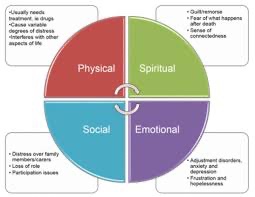
When Amy Greene, director of spiritual care at the Cleveland Clinic, was asked what she thinks people need from chaplains, she responded, “People want someone to see their total pain.”
P. 3
This quote reminds me of the following Talmudic passage:
אָמַר רַבִּי אַחָא בַּר חֲנִינָא כל הַמְבַקֵּר חוֹלֶה נוֹטֵל אֶחָד מִשִּׁשִּׁים בְּצַעֲרוֹ אָמְרִי לֵיהּ אִם כֵּן לִיעַלּוּן שִׁיתִּין וְלוֹקְמוּהּ אֲמַר לֵיהּ כְּעִישּׂוּרְיָיתָא דְּבֵי רַבִּי וּבְבֶן גִּילוֹ Rav Aḥa bar Ḥanina said: Anyone who visits an ill person takes from him one-sixtieth of his suffering. The Sages said to him: If so, let sixty people enter to visit him, and stand him up, and restore him to health. Rav Aḥa bar Ḥanina said to them: It is like the tenths of the school of Rabbi Yehuda HaNasi, who said that each of one’s daughters inherits one-tenth of his possessions. His intent was that each daughter would receive one-tenth of the remainder after the previous daughter took her portion. Here too, each visitor takes from the ill person one-sixtieth of the suffering that remains, and consequently a degree of suffering will always remain with the ill person. Furthermore, visiting is effective in easing the suffering of the ill person only when the visitor is one born under the same constellation as the ill person.
The chaplain is tasked with seeing the whole person, mind, body and soul. The chaplain visit is focused on visiting the person, not just the illness. It is through this seeing, being present to the whole person, that has a fundamentally positive effect. By positive, I mean to say that the time together is one that intrinsically changes the despair and loneliness most often felt when experiencing “total pain.”


 New beginnings: A blog about spirituality, chaplaincy and renewal