How often do we struggle to find success because we are more afraid of success than failure? We spend so much time expressing a fake humility, downplaying our successes because we don’t want to seem arrogant. Ironically, the truly humble are those who know and strive for their successes while also acknowledging the gifts that they have which allowed for this success. In the quote below, we find a similar sentiment about the fear of success.
How do we overcome this fear? Two approaches come to mind.
First – As I have reflected upon in my writings on this page, we work towards breaking down the goals into smaller, manageable steps, working piece by piece to rise to our success. While we might be afraid of success, we are also fearful the process will be too arduous and difficult. If we can eliminate this fear, building to the large goal with countless short term, forward moving, goals, we will stand a better chance of success.
Second – We do not have to go about this task alone. Success in most areas of life doesn’t come by isolating oneself to remove all distractions. Yes, there are times we need to take on a task alone. Yet, more often than not, we forget that others have travelled along similar paths and get help guide us along the journey to our goals, helping us with their strengths to cultivate and support our strengths. If we allow the fear of being imperfect dominate, we will never seek the advice and support needed to achieve our desired goals and dreams.
May this be a week of discovering how you can overcome the fear of success as you embark on the next steps of your journey!
Humility need not cause feelings of worthlessness. Although a zero may be nothing when it stands by itself, adding zeros to another digit can result in a number of astronomical magnitude.
If we stand alone, we are nothing. But when we stand together with G-d and with one another, we constitute a value of infinite proportion…
Humility is the recognition that we need not go at it alone. It is recognizing our place in the greater cosmos, reminding ourselves to be mindful of how we are part of a collective humanity and our lot in the world is not just of our making. Humility is recognizing the gifts we have and the need to use those gifts in a way that is beneficial to all those around us.
Faith is not a passive notion of simply saying “I believe…” It is not something we just “have.” Faith is an active recognition that we are not alone. Faith is the recognition we are working in partnership with a being greater than ourselves.
I believe that one of the biggest challenges to growth is how often we believe in the idea that “I must do this alone.” While it is true that it is the “I” that has to take the first step to change, it is just as true that growth and change take a collective effort. It is through recognizing that we do not have to go forth on our own which can be the difference between success and failure.
May each of us find that sense of connectivity and togetherness along the way of our journeys.
Faith and belief is a funny thing. On the one hand, we know that no matter what we do, no matter how much effort we might put into something, success and failure are more often than not out of our hands. On the other hand, we know that if we just sit and wait, hoping for a miracle, the likelihood of something happening is severely reduced. This message is apparent in Noah’s building of the ark as described at the beginning of this week’s Torah portion.
The ark Noah was to build was to house he, his 3 sons, his wife and their wives as well as 1 or 7 pairs of all land animals and birds, and supplies to survive the flood. In other words, this would need to be a big boat. Commenting on Genesis 6:19, Nachmanides offered the following idea.
…Noah was thus obligated to bring all of them into the ark in order that they may beget their like. If you would gather a full year’s supply of food for all of them, [you would find] that this ark and ten others like it could not hold it! But this was a miracle of a small space containing a great quantity. And in case you suppose that he should have made it [the ark] very small and rely on this miracle, the answer is that the Holy One, blessed be He, saw fit to make it large so that the people of his generation should see it, wonder at it, converse about it, and speak of the subject of the flood and the gathering of the cattle, beast, and fowl into it so that perhaps they would repent. Furthermore, he made it large in order to reduce the miracle for such is the way with all miracles in the Torah or in the Prophets: whatever is humanly possible is done, with the balance left to Heaven…
והנה יצטרך להביא מכלם שיולידו כמותם וכאשר תאסוף לכלם מאכל אשר יאכל לשנה תמימה לא תכיל אותם התיבה הזאת ולא עשר כיוצא בה אבל הוא נס החזיק מועט את המרובה ואם תאמר יעשנה קטנה ויסמך על הנס הזה ראה השם יתברך לעשותה גדולה כדי שיראו אותה בני דורו ויתמהו בה ויספרו עליה וידברו בענין המבול וכנוס הבהמה והחיה והעוף לתוכה אולי יעשו תשובה ועוד עשו אותה גדולה למעט בנס כי כן הדרך בכל הניסים שבתורה או בנביאים לעשות מה שביד אדם לעשות והשאר יהיה בידי שמים
Before overanalyzing Nachmanides’ words, I believe the simplest way to express his idea is from one of the most iconic movie quotes of all time:
Life is a partnership. Nothing can be done alone. I shared one aspect of this idea of not going at it alone in my piece from last week, Humility is recognizing we don’t have to do it alone. Nachmanides now adds another layer. Faith and trust in something greater than ourselves is not just a waiting game. It requires active participation on our part. Nachmanides uses the example of Noah building a reasonably sized ark, yet clearly not an ark big enough to really house all of what would be needed for survival, as evidence for how a miracle is not a one way street.
One of the greatest miracles we experience is the miracle of growth and change. It is extremely difficult to overcome our habits. It is quite challenging to make a lasting change in life, so much so that more often than not, changes don’t always last. Yet, we are always responsible to keep at it, keep trying, keep taking single steps along the path. True faith comes from a sense that if we take the single step, if we open the door to change, we will see the fruits of our labor. Or, in the words of Midrash Shir HaShirim Rabba 5:2 –
“Open for me” – Rabbi Yasa said: The Holy One blessed be He said to Israel: My children, open for Me one opening of repentance like the eye of the needle, and I will open for you openings that wagons and carriages enter through it.”
Today, may each of us find the sense to take that next step, open the door to new opportunity and may we, in partnership, come to find there is more room to change than meets the eye.
Don’t go at it alone. If you or someone you know is looking to start along the journey of change and growth: Contact New Beginnings Spiritual Coaching and Consulting LLC at 732-314-6758 ext. 100 or via email at newbeginningsspiritualcoach@gmail.com.
We are standing on the precipice of another year in the Jewish calendar. As always, it is a time of introspection (it’s never too late to think back over the year). What do we want different? What are our hopes for the upcoming year? Where do we even begin?
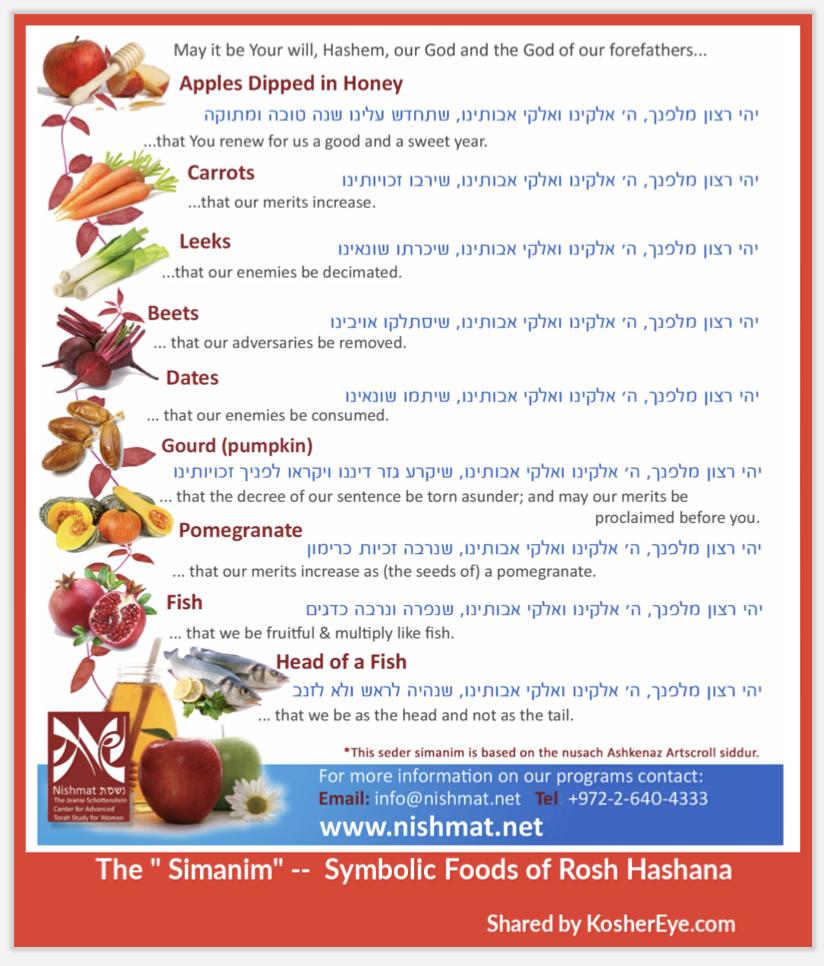
One of the customs many have on Rosh Hashanah is to eat certain foods that symbolize our prayers and hopes for the new year. The source for this custom is mentioned in a couple of places in the Babylonian Talmud:
Horayot 12a and Keritut 6a
אמר אביי השתא דאמרת סימנא מילתא היא [לעולם] יהא רגיל למיחזי בריש שתא קרא ורוביא כרתי וסילקא ותמרי
Abaye said: Now that you said that an omen is a significant matter, a person should always be accustomed to seeing these on Rosh HaShana: Squash, and fenugreek, leeks, and chard, and dates, as each of these grows quickly and serves as a positive omen for one’s actions during the coming year.
In addition to the above mentioned foods, see the chart below for what many do today, which adds to the Talmudic list.
In my pre-Rosh Hashanah reading yesterday, I came across a discussion of this custom. At first glance, many of us would think this is a bit like magic, that somehow my consumption of one food or another has the power to invoke change in our lives. How can it be that by eating an apple dipped in honey I should be able to ask Gd to grant us a sweet new year? Is it merely magical thinking? Is it really that simple?
In response, perhaps we are looking at the custom all wrong. According to the essay I was reading, we need to rethink the word siman(symbol). If we see the notion of symbol in the sense of planting a seed, as in a famous idea about how to read the stories of Genesis as “The actions of our forefathers are symbols for the children,” we can begin to appreciate the practice of these symbolic foods. If our actions become lessons for our children, then in a way, what we do is the equivalent of our planting the seeds for our children to learn from the good and bad in our lives. Hence, we can say symbols are seeds being planted.
On Rosh Hashanah, when we eat these symbolic foods, we are also planting seeds. We are praying, we want the upcoming year to be better, sweeter, with our successes at the forefront and our enemies vanquished. We want a year of positivity, a year in which the naysaying voice in our head is quieted down so we can see and feel the growth we are all experiencing, even when we don’t realize it. Through these foods, we aren’t performing magic tricks. We are taking the first step to real growth, naming what we want and hoping that this first step is a seed that germinates and sprouts for us along our journey of this upcoming year.
Many of my posts have been about the planting of seeds and taking first steps. This is the essential philosophy of New Beginnings. We are always presented an opportunity for a new beginning and while things might seem to be on a continuum, they are also a series of beginnings if we choose for them to be. I truly believe that each day we are doing is a day of growth and change even when we ourselves don’t see it as such. Each pitfall along the way, for there will be setbacks and challenges, are also growth points if and when we are ready to see them as such.
May this year, 5783, be a year in which we see the growth we are all doing, a year of peace in our lives and in the world, a year of less worry over the things we can’t control and most of all, a sweet, good and healthy year to all.
Want to take your hopes and wishes for a new year and really concretize them? Looking to solidify and continue your spiritual growth: Contact New Beginnings Spiritual Coaching and Consulting LLC at 732-314-6758 ext. 100 or via email at newbeginningsspiritualcoach@gmail.com.
Today is my 99th post on this website. Usually, people celebrate the whole numbers, so I am one off from a celebratory moment of writing post 100. Yet, I find the number 99 to be highly significant for a story I will share a little later on. But first…
Last night, I was playing around on Twitter and came across this tweet from a friend:
Aaron Judge, probably the most recognizable #99 in today’s sports fandom, is having a season for the ages. And while I am a Mets fan, with his own #99 –
it is clear that Judge is the better #99. Granted, for me, #99 takes me back to the great one Wayne Gretzky (NHL) and to the eccentrics like Wild Thing Mitch Williams and the infamous Turk Wendell (MLB – if you know, you know), but right now, for Baseball fans, 99 is Aaron Judge, and all the others tend to be glossed over (for a full list of all those in MLB who wore 99, see here).
This got me thinking about the significance of 99, only to recall another 99, but not in terms of sports. I was reminded of a teachable moment from when I was in High School, which I go back to every so often. It was 11th grade Chumash. We had just gotten a test back from our teacher and I noticed that while I got every question correct, I only received a 99 (yes, I admit, I was one of those students, always looking for the extra point). This bothered me as clearly I had earned the 100, the arbitrary perfect score we generally place on tests. I went to the rabbi and asked him why I didn’t get 100 when I clearly got all of the questions correct. To this day, I recall his response:
“Even Moses didn’t know everything, so in my opinion it would be impossible for anyone to achieve a 100.”
I’ll admit, the answer didn’t fully satisfy me. Yet, the lessons are quite apparent and in truth ones I have come to appreciate.
As I wrote about months ago, there is a notion of When 80 Percent is Perfect. We should always strive for the best we can do and recognize that the best will never be 100 percent because the 100 is a long term impossibility. There will always be something that is missed, even when it appears as if you got everything right.
We need to appreciate the beauty and greatness of the 99 within the scale of 100. Truth is, we need to appreciate even more than just the number closest to 100. We need to learn to appreciate all we have gained and not focus on the missing point(s).
Which brings me back to sports. Aaron Judge is having an outstanding season, a season for the ages, since we learn that in sports we focus on the accomplishments when it comes to most statistics as opposed to the failures that are the opposite side of the coin. For example, he has been on base over 40% of the time this year, which means he not been on base a little less than 60% of the time. In other words, his great year includes more failures than successes. Yet, we see the success and ignore the failures. He is having a 99 season (which for sports video game people, is the highest rank a player can get for a season).
If you have made it this far, thank you for reading this 99th post. Writing is a series of failures, deletions and edits until something comes together that is hopefully coherent and interesting. Life is the same. We fail, change course, shift, all in the drive to forge a path for ourselves. We experience many endings and New Beginnings. May each of you find the success within the imperfection and remember the greatness that is a 99.
A couple of my more recent posts have explored the topic of identifying the various components of self identity. In this post, I am…, I included the beginnings of a list of different terms as to who I see myself as and as a paradigm for your personal growth. This practice, of listing the various “I ams” is a crucial component of growth. By looking in the mirror and engaging in the various elements of who we see, we can then explore the deeper characteristics that underlie each of those elements of our self-makeup.
Some of you reading this might question this method. After all, the work of claiming an “I” seemingly flies in the face of many spiritual practices. It is a common misconception that the goal of spiritual practice is an absolute self-nullification, a removal of all “I” elements of life. I would argue that this is a mistaken premise. Self-nullification, losing oneself in greater spiritual growth, is about the work of not allowing any of the identifying elements of the self to become sacred, to become the be all and end all.
Rather, what I am proposing is that the “I am” is a gateway to deep exploration and spiritual work as it relates to growth. This dawned on me in working with a couple of my clients, exploring the underlying meaning of the terms they were using to identify themselves. The exploration was to try to understand what were the drivers behind the particular term that the person used as a definition of self. When we are clear on who we are and what that means to us, we can then travel a road of who we wish to become within or without the term we are exploring.
For example, in my previous post, I identified myself as a “reader.” If I were to break this down further, I might begin by describing what I like to read or the types of books I find myself reading at the moment. I might explore what reading does for me. In fact, here is a rough outline of what saying I am a Reader is to me:
explorer
curious
seeker of knowledge
reading allows me times to escape from the challenges of life
reading is a spiritual practice
growth and change
reading is a gateway to unexplored worlds
reading is helpful in being a writer
I would then take this list and go deeper in this and related topics as it pertains to the goals the person I am working with would like to explore. For example, if I want to explore the notion of reading as a personal spiritual practice in relation to what it means when I define myself as a reader, I would work with the person to deepen their self-notion of what reading as a spiritual practice is. Is it the focus of reading? Is reading really about study and being absorbed in the depths of another’s words? Is it a form of connection to Gd (there is much in religious thought about connecting to the divine through the practice of study, of learning)? The goal of these explorations would be to help foster within the person the richness that comes from insights into the self so as to better foster the growth a person is looking for.
May each of us discover new aspects of ourselves as we consider the “I ams” we bring to the world.
I have been finding a lot of self-reflective material when considering aspects of writing. In writing, like life, it is almost impossible to create the perfect piece in a single sitting. Just like it is important to remember that all goals are made up of a series of single steps, one foot after the other, so too writing is a process of putting one word on paper at a time, in which eventually the string of words becomes a cohesive unit. Along the way, there will be updates to the unit of writing, whether because of a misspelled word, a missing punctuation mark, or information that is lacking because we forget to convey to the reader precisely what we are thinking. Or, perhaps you think it is good, post it on a website, and then get a copy-editor’s eye to read it and circle in yellow the errors in the piece (which luckily is easily fixable in wordpress).
Serious writing is a series of rough drafts, when in a way even the final draft remains an incomplete, imperfect product. Yet, for those of us who persist in writing, the rough draft, the initial go, is often as valuable if not more valuable than the “final product.” The rough draft is the opportunity to try and fail in the craft of formulating an idea. The rough draft is the proof you need to know you have taken the hard first step of engaging in the writing process.
The rough draft is a great metaphor when we consider self-introspection and change. Most of us are searching for do-overs, the opportunity to change what was, whether by scrapping something and moving away from the past or from veering slightly to the right of left to a different turn that we believe will lead us in the direction we really want to go. Like with writing, when we cross out and change words, life gives us countless opportunities to adjust to the moment, to the times by changing, rearranging or erasing elements of our before so as to make the step forward towards a new start.
I came to this thought this afternoon as I was scrolling through a list of some of the blog posts which I have either not completed or have pretty much decided to leave in the draft folder because they don’t resonate for me at this point. Many of the drafts were like the dipping of a toe into a topic and realizing the water was not ready yet or perhaps might never be. The draft folder contains the tried and failed so as to then try again and succeed with any number of other posts.
Every Elul as well as every other demarcation point in one’s year, when we reflect and desire to explore unknown elements of the path going forward, we are reminding ourselves that we remain a “rough” draft in need to further polishing. The polishing can take multiple reads, multiples steps and missteps along the way. We can and do go through many drafts of our lives. The goal is fostering and maintaining the hope that each time we reread and edit, we are succeeding by seeing the incremental and/or monumental improvement over the previous version.
May this be a time of year when we can all look inside and make the necessary edits to improve on the rough drafts we have crafted up until now.
With Rosh Hashanah 27 days away, it is an important time to reflect on the work of change. Realistically, one should not treat growth and change like most of us treat tests, a time to cram and get it over with. Rather, one should regularly be in a place of self-improvement so as to have times in which to ramp up the process a bit, such as during this auspicious time leading to a new demarcation, a new year, a New Beginning.
As most of you who have been reading this blog have noticed, much of what I emphasize is incremental growth, small steps, the importance of acknowledging the gains along the path, and other modalities of fostering long term success. I recognize that these ideas can and are difficult. First, we have to begin the journey, which, as which I described in my previous post,is the hardest step. Once we do that, we then have the difficulty of maintaining and taking more steps. This isn’t easy, though if we recognize the accomplishment of the initial step, perhaps we can find the strength to continue along.
I myself continue to consciously work on these approaches in my own growth work, and struggle with the ups and downs that inevitably do come into play when travelling along the waves of life. Yet, if we try to just leap from the bottom to the top, most likely we will just fall right back down. If we put one foot in front of the other, walking or climbing one step at a time, we can always stop on the landing along the way to catch our breath, take stock and reflect on the step we have arrived at before continued “upward.”
Recently, a client sent me an article that struck me as highlighting this point about perspective when things seem challenging. The author, Binyomin Yudin, describes two situations, one logistics, one self-care focused in which to do “right” he had to the hard thing. At the end of his piece, he reflected on the following:
It was during one of these four-mile walks that Rav Steinman’s words came to mind. Walking up a grueling hill near my office, I was getting fairly aggravated, thinking about all of my friends who don’t have to do this, who can eat what they want without worrying about the impact of their choices on their lifespans. As I crested this hill, however, I realized that this was the quintessential example of Rav Steinman’s lesson. I had sweat running down my face; the exercise was clearly tirchah. Just as clearly, though, it was the right thing to do.
“We can do hard things.” Living the life you want to live and being the person you want to be demands hard work, I reminded myself, with Rav Steinman’s words echoing in my ears: “I’ve found that doing the right thing often takes tirchah.”
In this month of Elul, 5782, as we desire to work towards striving to be the person we wish we could be, we should remember, that with growth comes regular work, daily ritual and routine, challenges and moments of needing to foster our drive for continued successes along the way.
Last week I wrote a personal reflection I Am A Writer, expressing how I see myself as the writer I am and want to be. It was a post about self-definition and about claiming one’s dreams as one’s current reality.
Today, I want to continue in the same vain, with a discussion of the more general statement “I am…” I was inspired by two things. First, while at a local business networking meeting, BNI, giving my 45 second ask, I realized that I was struggling to specify my ideal client. In the course of this challenge, I came to the recognition that understanding the ideal client would also require me to further understand who I am, who do I bring to a session when I am meeting with someone. Second, I had the fortune of connecting with a fellow rabbi/Spiritual coach to discuss how we serve others and how we can continue to grow our respective clientele. During this meeting, he reminded me about the importance of claiming who I am as part of growth for both myself and my business.
Before I answer this question, I want to explore this phrase “I am…” There is a classic situation in which someone asks us to tell them who you are and the initial answer we often give begins with our profession. And while this is one aspect of “I am…,” it is not the core of who we are. Yet, we are that professional as much as we are a parent, child, spouse, individual, a member of a community, faith tradition, etc. At different times we are one or many of these “I am…” descriptions. Further, the definition of “I am…” will inevitably change depending on our life circumstances.
To answer the question of who “I am…” is a moving target, yet it is a composite of all of the various definitions we experience of ourselves in life as it relates to both ourselves and to others. And finally, I think “I am…” can and should also include some of our in process goals and dreams as it can be a means of claiming elements of ourselves that might be incomplete/works in progress. As such, let me share some of my “I am…” statements and invite you to consider the same exercise for yourselves.
I am…
A husband, father, son, grandson, brother (and brother in law), uncle, nephew, cousin.
A Rabbi, chaplain, spiritual coach, teacher, writer, reader, learner.
A friend, colleague, mentor, disciple, student.
And this is just the tip of the iceberg of parts of who I am and helps me recognize how best to work and to serve others. All of these elements both enter a space with me and remain outside the sacred encounter with a client. When we have a deeper sense of self, the good, bad and ugly, we can better sit in the space of the uncomfortable with another.
As such, the answer to my ideal client is… You! You who are searching or engaging the same work of “I am…” You who are trying to foster a New Beginning. You who have experienced loss, death, new challenges and are trying to redefine the “I am…” that is who you are.
Let’s be real. It is much easier to see the negative, the difficult, the “bad” in life. And if you read most self help books, one of the themes that jumps out is the importance of working on seeing the positive, which should help us be more positive. For example, how often do we hear about the importance of smiling even when not happy because it has the physiological effect of eventually helping one to feel more positive (see The Health Benefits of Smiling as an example).
In relating this topic, I am reminded of the opening of this week’s Torah portion, Parashat Re’eh, presents the following choice:
and curse, if you do not obey the commandments of your God יהוה, but turn away from the path that I enjoin upon you this day and follow other gods, whom you have not experienced.
Deuteronomy 11:26-28
Notice that the language of choosing between blessing and curse is the language of sight, “See.” Moses’ exhortation is not just choose but see that the choice is placed before you. And with that choice, via the actions we take, following the commandments or not, will be the driver towards seeing the blessings or the curses of life.
In relation to this verse is an idea I came across from Kedushat Levi, R. Levi of Berditchev, one of the great early Chasidic thinkers. He presents in a variety of locations the following argument. There is an outlier belief quoted in the Babylonian Talmud (Kiddushin 39b) – רַבִּי יַעֲקֹב הִיא דְּאָמַר שְׂכַר מִצְוָה בְּהַאי עָלְמָא לֵיכָּא – It is in accordance with the opinion of Rabbi Ya’akov, who says: There is no reward for performance of a mitzva in this world, as one is rewarded for mitzvot only World-to-Come (often the Talmud quotes singular opinions in relation to the more presumed normative view as a means of recording an opinion that might be a polemical response to other beliefs of the time). R. Levi raised the following question. Does this view work in relation to another adage from Ethics of the Fathers (Pirkei Avot) – שֶׁשְּׂכַר מִצְוָה, מִצְוָה, the reward for performing a commandment is another commandment (4:2)? He suggests that reconciling this contradiction is that more opportunities to do mitzvot is the reward for doing mitzvot.
As I have been ruminating on this particular idea in relation to perspective making, I realize that this message about the reward for mitzvah is another mitzvah is similar to the idea of “smile and it will make you feel happy.” Every incremental action, positive or negative, has a corresponding positive or negative effect. To create blessing, it comes from positive incremental opportunities to do good, to perpetuate the positive.
This is not an easy or simple task. It is a task we have to constantly be working at, to constantly be seeing in front of us. Every opportunity is a choice, the choice to move forward, to take the next step building on the previous step. And if we do fall into a time of curse, a time of negativity, we have to guard ourselves from allowing that path to become the new road. The safeguard is to work to remind ourselves that we can always SEE the choice before us, the choice of turning back to the place of positivity, the place of blessing. Or, as I recently read in the book Now Is the Way: An Unconventional Approach to Modern Mindfulness by Cory Allen:
When we are dedicated to choosing the good, our view of the world changes. It grows into the shape of peace. And so do our lives.
P. 71
May you find the sight to see the positive, and may that sight be the first step along a more blessed path.









 New beginnings: A blog about spirituality, chaplaincy and renewal