In exploring for myself and working with others to help foster spiritual growth and change, I stress time and again the notion of seeing every step as a positive gain even in the midst of one’s pain and suffering. Too often we get caught up in not being in our ideal states instead of embracing the road we are travelling and how far we might have already come.
In this week’s Torah portion, Bereishit, Gd provides perhaps the ultimate example of the importance of taking stock along the way. In the creation story, after Gd establishes something, whether it be light, land, animals and yes, even people, the section includes “And Gd saw that it was good (or very good in the case of day 6).” Gd, if you will, pauses after each major moment and sees that it is good even while still needing to do more. At the same time, Gd doesn’t just stop and say, OK, ‘I’ve created enough.’ The moment is good and then Gd continues until nothing is seemingly left to create.
At the end of this creation process, Gd offers us a second clue as the importance of reflection in the designation of a Sabbath day, the day Gd rested (Genesis 2:1-3). In a comment on verse 2:2, Rashi expresses an interesting read of the phrase וַיְכַ֤ל אֱלֹהִים֙ בַּיּ֣וֹם הַשְּׁבִיעִ֔י, On the seventh day God finished the work. He suggests:
Another explanation: What did the world lack? Rest! Sabbath came — Rest came; and the work was thus finished and completed (Genesis Rabbah 10:9)!
Rashi highlights the importance that rest plays in our creative nature. Without rest, the world is incomplete!
It is not enough to be creative beings, to be action oriented beings. If all we are doing is doing, then the tasks will never end. If we don’t rest, we don’t see the places we have reached. If we don’t take stock along the way, seeing that it was “good,” then what are we really accomplishing.
I believe this notion of rest as the culmination of creation is extremely important to our spiritual work as well. On the one hand, of course it is important to always strive towards greater heights, never “Resting on your laurels.” At the same time, how can any of us know how far we have come without taking stock of our journeys, our processes. If we don’t stop, pause and rest along the way, we miss out on the solidifying of all we have done.
May each of us be blessed to find the opportunities to truly rest along the path, see where we have come, and have the time to plan what the next step will be.
Looking for support as you take a pause, giving yourself the opportunity to “rest” and reflect: Contact New Beginnings Spiritual Coaching and Consulting LLC at 732-314-6758 ext. 100 or via email at newbeginningsspiritualcoach@gmail.com.
It can be quite a challenge to be willing to work together with others. For many of us, it can seem less cumbersome and less stressful to just take on another task instead of seeking help from others. I believe this is particularly true when it comes to fostering our spiritual and emotional growth. Yet, if we allow ourselves to find the person or persons who can hold our hand and lift us up in the process, we will find greater success in all of what we venture out to do.
With the fall Jewish holidays over, the Torah reading cycle starts afresh with Bereishit, Genesis. Chapter one tells the story of creation, in which Gd, and Gd alone, for the most part, brings the world into existence. Yet, there is a single exception, for a mere 26 verses into the Torah, we come across a moment of collaboration in the midst of the story. Verse 1:26 states, in describing the creation of humanity:
And God said, “Let us make humankind in our image, after our likeness. They shall rule the fish of the sea, the birds of the sky, the cattle, the whole earth, and all the creeping things that creep on earth.”
In a departure from the majority of the verses in chapter one, this verse states that Gd seemingly has consulted with other “beings” in the decision to create the human being. In response to this anomaly, Rashi, the great medieval Jewish biblical commentator, suggests a non-literal, ethical read of the text. He states:
נעשה אדם WE WILL MAKE MAN — Although they did not assist Him in forming him (the man) and although this use of the plural may give the heretics an occasion to rebel (i. e. to argue in favour of their own views),yet the verse does not refrain from teaching proper conduct and the virtue of humbleness, namely, that the greater should consult, and take permission from the smaller; for had it been written, “I shall make man”, we could not, then, have learned that He spoke to His judicial council but to Himself. And as a refutation of the heretics it is written immediately after this verse “And God created the man”, and it is not written “and they created” (Genesis Rabbah 8:9)
Quoting midrashic literature, Rashi suggests that the verse is written in plural form to teach that true humility includes not believing one has to do things by oneself. In looking at this comment, it is a reminder of the adage from Ethics of our Fathers,
Joshua ben Perahiah and Nittai the Arbelite received [the oral tradition] from them. Joshua ben Perahiah used to say: appoint for yourself a teacher, and acquire for yourself a companion and judge all favorably.
Pirkei Avot 1:6
Life is about making connections and looking to one another for support and help. If Gd could be presumed to have asked for advice, then for sure each of us needs to find people in our lives who will help lift us up. In fact, like the above picture, one of the underlying premises of New Beginnings Spiritual Coaching and Consulting is to give someone a hand to help lift them up. Being willing to reach out a hand for another to help them up, an act of humility, an act of accepting one’s need for help, is the first step in spiritual growth.
I believe Rashi makes the choice of offering a non-literal read of the use of the plural instead of suggesting the more literal suggestion that the verse is merely using the “royal we” in this particular circumstance. Rashi is tasking the reader to see early on how the Torah can be a moral guide if we pay attention to the subtle nuances and gaps in the text. In this case, we learn this valuable lesson about humility. Of course, western religious literature is full of texts and commentaries that offer us multiple readings of the text to teach us lessons about life. If we pay attention, study the words carefully, and expand our reading to include different and varied approaches to these sacred texts, we are metaphorically putting out our hand to be lifted up spiritually.
As we begin the new Torah reading cycle, may each of us find a true sense of humility in realizing that there are always new opportunities to reach out our hands to be raised higher.
If you are ready to reach out your hand, I am here to help lift you along your journey of spiritual growth: Contact New Beginnings Spiritual Coaching and Consulting LLC at 732-314-6758 ext. 100 or via email at newbeginningsspiritualcoach@gmail.com.
The inspiration for this piece came from a question posed on a WhatsApp group I am part of with friends from my year of study in Israel over 20 years ago.
Genesis 47:8-9 describes a conversation between Pharaoh and Jacob after Jacob and his family arrive in Egypt.
And Jacob answered Pharaoh, “The days of the years of my sojourn [on earth] are one hundred and thirty. Few and hard have been the days of the years of my life, nor do they come up to the life spans of my fathers during their sojourns.”
Rabbi Samson Raphael Hirsch suggests that underlying the question and answer posed in these verses is a lesson about how we view our lives. As he states:
“V. 8 – Still today, royalty, whose time naturally is extremely previous at audiences, as a rule just throw out a few short words or enquiries, the replies to which they are in reality entirely indifferent. But it must be rare indeed for a king to have understood to secure more delicacy in a few interrogative words than Pharaoh did here. And even more seldom has the person addressed expressed more wisdom in a short reply, than Jacob did here. When one counts by years, one does not reckon any more the days. It is only with a few select people that each day is full of importance and is considered by them as having a special meaning. A really true human being does not lives years but days…”
After elaborating on the underlying philosophy behind Pharaoh’s question, Rabbi Hirsch presents his take on Jacob’s response:
” V. 9 – In his reply Jacob differentiates between living and existing. ‘You ask after the days of the years of my life. I have not lived much. I have sojourned on earth during one hundred and thirty years. The days of the years that I can really call my life (on which I really fully carried out all that I should) were in reality only few, and they were just the bitterest and those most full of worry…'”
R. Hirsch is suggesting in his in depth analysis of this dialogue a question for each of us to reflect on. Are we living or merely existing? Do we find each day meaningful in some way or is life merely a series of “groundhog” like days? We desire to make an impact, to live meaningful, fulfilling lives.
In fostering a new beginning, a primary goal is to change the direction of the path we have been cultivating because it seems monotonous. We can do this through a variety of means. We can foster our desire to help others, to reconnect to those we care about, to come back to a latent spirituality and creativity that might have been purposefully left dormant for years.
May each of us experience life as daily living and not merely as existence.
If you or someone you know is trying to foster a renewed sense of living life to the fullest, New Beginnings Spiritual Coaching and Consulting LLC is here to help. For more information, please check out: https://achaplainsnewjourney.wordpress.com/about/
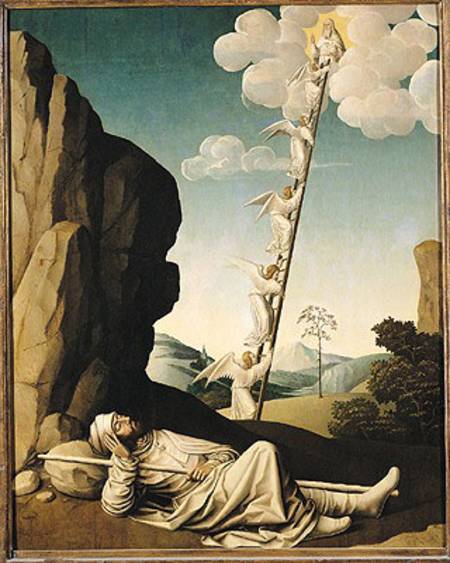
When life thrusts uncertainties at us, we often grasp for a sense of being connected to someone or something. We search for ways to recreate the sense of safety and certainty, either consciously or not. This idea of looking for refocusing on how faith and belief might be a place of safety is exemplified in one of the famous biblical stories, Jacob’s dream in which he envisions a “Stairway to Heaven.”
After running away from Isaac and Rebecca’s home as a means of self preservation because his twin brother Esau planned to take revenge over the stolen birthright, the Torah finds Jacob having stopped overnight to sleep. On this night, Jacob dreams of a ladder going from the land to heaven. The Torah states:
And the LORD was standing beside him and He said, “I am the LORD, the God of your father Abraham and the God of Isaac: the ground on which you are lying I will assign to you and to your offspring.
Your descendants shall be as the dust of the earth; you shall spread out to the west and to the east, to the north and to the south. All the families of the earth shall bless themselves by you and your descendants.
Remember, I am with you: I will protect you wherever you go and will bring you back to this land. I will not leave you until I have done what I have promised you.”
Genesis 28:12-16
Jacob dreams/receives a prophetic message that Gd will be with him and protect him throughout his journey until such time as he returns to the land of Canaan. For Jacob, this reassurance is key to his ability to withstand the trials and tribulations he will come to face during his sojourn. Yet, Jacob maintains uncertain, for a few verses later, as Jacob takes leave of this seemingly holy place, the Torah states:
Jacob then made a vow, saying, “If God remains with me, if He protects me on this journey that I am making, and gives me bread to eat and clothing to wear,
And this stone, which I have set up as a pillar, shall be God’s abode; and of all that You give me, I will set aside a tithe for You.”
Genesis 28:20-22
This latter scene suggests that Jacob was not one hundred percent convinced that Gd would fulfill his promise from the dream, so Jacobs offers the vow that he would provide a percentage of his hoped for accumulated wealth to Gd as a tribute for protection. Why would Jacob not believe wholeheartedly in Gd’s promise? I would suggest that Jacob’s uncertainty is not from a lack of faith but rather from an innate sense of abandonment that he feeling on this night. This is depicted in the first image of the dream, in which the “angels of Gd” ascend and then descend from the ladder. If we consider the image we would expect to see, the angels should have descending first and only then ascending. Yet, the verse flips the actions, leading to the following comment from Rashi:
עלים וירדים ASCENDING AND DESCENDING — It states first ascending and afterwards descending! Those angels who accompanied him in the land of Israel were not permitted to leave the Land: they ascended to Heaven and angels which were to minister outside the Land descended to accompany him (Genesis Rabbah 68:12).
As we know, dreams, even in the prophetic sense that is attributed to them throughout the Bible, contain many images that illustrate our unconscious or conscious concerns. For Jacob, the angels were his protectors, his internal sense of not being alone, which his subconscious highlighted in his vision. While Jacob does have a destination, his uncle’s home and a mission to marry his uncle’s daughter, he is presumably filled with feelings of abandonment and uncertainty about the future. As such, he dreams of angels first ascending, for deep down he knows he is never alone. Furthermore, the entire dream focuses on Gd being with him throughout his journey. The angels represent that Jacob can rest assured that he is not being abandoned at any point.
Regarding his vow after the dreams, the vow speaks to Jacob’s conscious sense of uncertainty. A dream is a dream and even one of a “prophetic” nature can leave someone with doubts. Jacob’s vow/covenant to Gd is a way for Jacob to accept that dream and change his mindset. No longer will he allow himself to be worried about the uncertainties that lie ahead. He knows he will be able to handle them because of Gd’s “promise” and his offer as a means of submission to this new perspective.
Jacob’s vision and response is a powerful example of the challenge we all face when starting on a new journey. Deep down we know there is risk any time we venture into something new. Doubts exist. Yet, if we allow the doubts to overtake us, we will never be able to take the first step. When we acknowledge the doubts and take control of them, recognizing the doubts are part of the journey, not the barrier, we will be able to move forward and find our new beginning.
May we find the ability to change our mindset as we work towards achieving our growth potential and our wishes.
the earth being unformed and void, with darkness over the surface of the deep and a wind from God sweeping over the water—
Genesis 1:1-2
Many different ideas have been learned and extrapolated from these first two verses alone. I would like to offer another thought, one which has been sitting in my heart for some days. It was inspired by a quote fromfrom Torah Studies, an adaptation of lessons delivered by Rabbi Menachem Mendel Schneerson o.b.m. presented by Rabbi Lord Jonathan Sacks o.b.m. (from his days before being Chief Rabbi of Great Britain). (I originally received this book as a Bar Mitzvah gift many years ago and have recently begun reading parts of it again).
In the chronicling of creation, one detail strikes us with the force of mystery: Why was light created before everything else, when there was nothing to benefit from it? The Rabbinical explanation only adds to the mystery, for we are told that the light was immediately “hidden for the righteous in the world to come.” The Rebbe explains the difficulty and elucidates the implications of the creation narrative for the individual and the conduct of his life.
As part of this analysis, R. Schneerson presents a piece regarding a rabbinic idea that when Gd created the world, Gd “looked” into the Torah as if the Torah was the blueprint of the world. In R. Schneerson’s words (as presented by R. Sacks):
To resolve these difficulties we must consider a remark made by the Midrash: “Just as a king wishing to build a palace does not do so spontaneously but consults architect’s plans, so G‑d looked into the Torah and created the world.”
In other words, by examining the order in which a man sets about making something which requires planning and forethought, we can learn something of G‑d’s order in bringing the world into being.
Alternatively, amon means “artisan.” The Torah is saying, “I was the artisan’s tool of Hashem.” In the way of the world, a king of flesh and blood who builds a castle does not do so from his own knowledge, but rather from the knowledge of an architect, and the architect does not build it from his own knowledge, but rather he has scrolls and books in order to know how to make rooms and doorways. So too Hashem gazed into the Torah and created the world. Similarly the Torah says, “Through the reishis Hashem created [the heavens and the earth],” and reishis means Torah, as in “Hashem made me [the Torah] the beginning (reishis) of His way” (Mishlei 8:22).
Genesis Rabbah 1:1
In reading this piece, I was struck with an alternative question to the one that drives the essay. I was wondering, if Gd had used the Torah as a blueprint, how does that jive with the notion of chaos, unformed and void, that we read about in the second verse of the Torah? When a person has a blueprint, while the outcomes might not be known, the picture presented should be clear enough to have some form and substance.
In reflecting on this, I realized that the answer was sitting in from of me. Any creative act we have has multiple blueprints throughout the process. As someone who enjoys writing and tries to present ideas in the word form, this resonated for me in the following manner.
The initial idea for something is a jumble of thoughts in my head with some fundamental connector between the ideas. Often this chaos is so distorted that the words don’t even begin to flow. As I continue to write and reflect, the idea becomes clearer in my conscious. It then begins to take shape into a new blueprint, but even that blueprint is not the complete product. Rather it is a more orderly picture of what message to convey and how to convey it. This continues on and on until the product is “complete.”
The story of Genesis reflects this same creative process to us. Gd has a blueprint. Gd “creates” heaven and earth. The picture becomes clearer but is still chaos. Then Gd begins to place things in a certain order, starting with “light” and concluding with rest (the Sabbath. Rest, the cessation from creation, is the real last created thing described, not the human being, a topic unto itself).
All new beginnings start from an idea, a blueprint, but often a blueprint that is chaos by its nature. In order to achieve, we have to work and work to improve and hone the blueprint to something that is orderly and clear.



 New beginnings: A blog about spirituality, chaplaincy and renewal