Part one of Chapter 29. We discuss the challenge when our heart becomes like stone, when our heart becomes unfeeling. How do we overcome this? I offer a brief foray into the distinction between knowing something and feeling/experiencing it. We discuss the struggle of the beinoni as a source of growth, working through various levels of returning to Gd.
All episodes can also now be heard on Apple Podcasts – here
Do you want to work on taking the actions of your life and find meaning in all you do and who you are? Are you struggling with your spiritual growth. Contact New Beginnings Spiritual Coaching and Consulting LLC at 732-314-6758 ext. 100 or via email at newbeginningsspiritualcoach@gmail.com
Every so often, it is important to come back to certain basics of spiritual growth as a means of reflection. Perhaps, even more than that, it is important to habituate ourselves in practices that enhance our spirituality while at the same time finding ways to make the habits into something that continues to feel new. One of those is the opening words of the Amidah,
ה’ שפתי תפתח ופי יגיד תהילתך
Gd, open up my lips and my mouth will share Your praises.
While we could offer the same thoughts on the entire prayer piece, the Amidah, at least as it pertains to the opening 3 and closing 3 blessings, this line in particular is quite special and meaningful.
First, if we consider the structure of the prayer service as a whole, much of what we have already done before getting to the Amidah is praise of Gd. Second, if the point is that this prayer is like a gateway prayer to further prayer, why here, why now? Third, if we are really in this place of struggle, how can we even presume to open our mouth with a prayer to be able to pray?
As I find myself focused on this line, I would offer that a prayer before prayer is the most profound and important of prayers and that it being in the midst of prayer, not at the very beginning of each service is also of crucial importance. If you are like me, by the time you reach the Amidah, you are of two minds. There is the anticipation of having opportunity built in for more personal reflection while at the same time much energy has hopefully been exuded to reach this place. As such, I would offer that the line introducing the Amidah is the chance to regroup and recharge. It is a chance to remember and reflect on how we can only say these prayers because Gd has granted us the ability to speak these words.
I found the inspiration for this in thinking about something from last week’s Torah portion. As Moses is arguing with Gd about not wanting the job of leading the Israelites from Egypt, he tries one last argument (Exodus 4:10-12):
But Moses said to יהוה, “Please, O my lord, I have never been a man of words, either in times past or now that You have spoken to Your servant; I am slow of speech and slow of tongue.”
Now go, and I will be with you as you speak and will instruct you what to say.”
In addition to the irony of Moses using this as a final argument after seemingly having many words for excuses, what is most interesting is the point that it is not Moses who is able to speech on his own but Moses who is able to speak and argue because Gd allows him to argue.
In other words, we may be praying, expressing praises and wishes to Gd, but it is important to be regroup and ground ourselves time and again in the midst of prayer with the notion that Gd gives us the ability to pray and offer these words. Each prayer service is a journey, and on a journey it is important to take stock and recognize where you have come from, where you are and where you are going.
As we work on spiritual growth as it pertains to our prayerful lives, may we recognize the importance of knowing from Whom our prayers come and to Whom we direct our prayers.
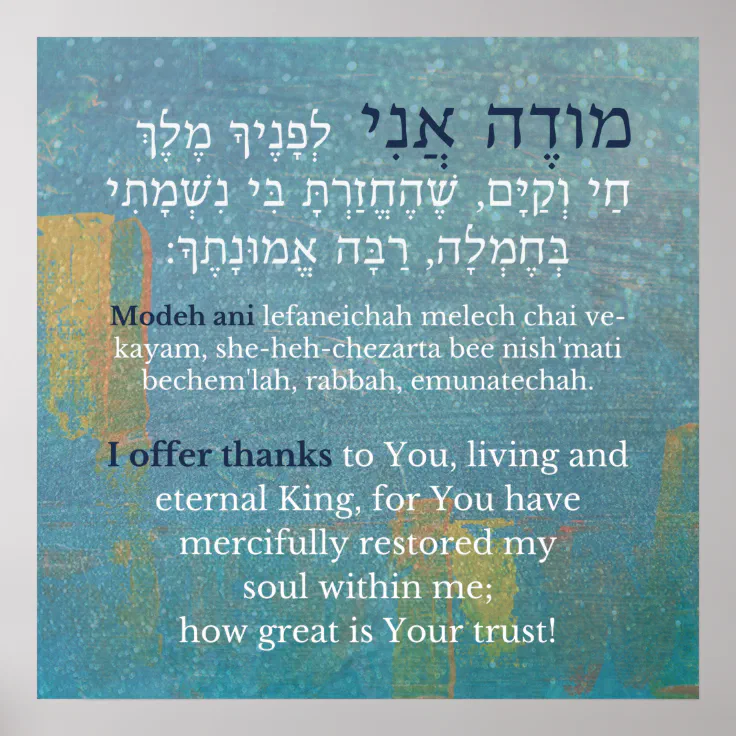
I previously described the Jewish practice that upon awakening, we start our day with words of gratitude for being alive another day, Modeh Ani.
With these words we offer words of recognition for the renewed opportunities we have as we start the day. Each day allows us to press refresh, and as I highlighted in my previous post, if we can overcome the fear of pressing refresh, we can truly take a first step. Today, I want to suggest that are acknowledgment of gratitude each day is part of taking this first step.
I came across a deeper, more mystical approach to this declaration of gratitude. Maharal, Rabbi Judah Loew of Prague, who lived in the 16th and early 17th centuries, suggested that the gratitude we are expressing is more than just about the return of our soul, our life, for another day. It also represents our expressing gratitude for the world being renewed again for another day. In other words, when we go to sleep, from a natural perspective the world continues to exist. Yet, if we take the perspective of ourselves asleep, the world ceases to be. When we wake up, the world comes back into focus, coming back into existence like we do.
I found this deeper level of renewal inspirational. If it is not just us, but the world starting over in our eyes when we start the day, when we wake up from sleep, it means we do not need to live our lives enslaved to what was. Of course, we don’t find ourselves waking up in a different bed, in a different place, but we do have the chance to make the world what we want to each day. By deliberately acknowledging and expressing this gratitude for the opportunity for the new, we always have the chance to take that first step to something new.
May we find each day as an opportunity to reinvest in the opportunities for renewal we have in front of us.
You have the opportunity to start again. If you are struggling to begin the process of starting your next journey in life. Contact New Beginnings Spiritual Coaching and Consulting LLC at 732-314-6758 ext. 100 or via email at newbeginningsspiritualcoach@gmail.com
Enter His gates with praise, His courts with acclamation. Praise Him! Bless His name!
כִּי־ט֣וֹב יְ֭הֹוָה לְעוֹלָ֣ם חַסְדּ֑וֹ וְעַד־דֹּ֥ר וָ֝דֹ֗ר אֱמוּנָתֽוֹ׃ {פ} For the LORD is good; His steadfast love is eternal; His faithfulness is for all generations.
In Rabbi Nissan Mindel’s work My Prayer, he comments, “However, the Hymn of Thanksgiving (Psalm 100) is recited daily because actually we enjoy G-d’s miracles every day, without being aware of them (vol.1 P. 121).” Further, in defining the term miracle, he suggests:
Whats is a “miracle”? We usually think of a “miracle” as something “supernatural,” like the miracles and wonders which G-d performed for our people in ancient Egypt through Mosheh Rabbenu and Aharon. These and similar miracles of which the Torah tells us were certainly “supernatural,” because G-d clearly changed the laws of Nature for our sake. But miracles do not necessarily have to be so extraordinary as to break the laws of Nature. Miracles occur every day in the “normal” course of the every-day life without out being aware of them.
vol. 1 p. 122
Over and over in our prayers, we are reminded that life itself is a miracle. This idea is something we tend not to lose sight of in more static moments of life. Each day, each opportunity is a miracle unto itself. In a way, it is the greater miracle than the single moment, explosive, out of this world, miracles we read about in our past.
As we recall and express gratefulness for life itself, we can build off of the positive vibes that gratitude can provide. With these more positive emotions, we will be better served in attaining our goals and dreams.
May we find the ability to be thankful for every moment, every opportunity, every situation.
If you or someone you know is striving for success in spiritual growth on one’s personal journey, contact New Beginnings Spiritual Coaching and Consulting LLC at 732-314-6758 ext. 100 or email newbeginningsspiritualcoach@gmail.com.
While we are always striving for perfection, reality is that we will always be faced with making mistakes and errors. It in how we learn from these imperfections that can help us truly improve and grow.
In Living Each Day, Rabbi Dr. Abraham Twerski suggests the following interpretation of a little know prayer to be recited before Kiddush on Friday night.
Grant us that we may welcome many Sabbaths amidst much joy, with abundance and honor, and with a minimum of sins
Why pray for a minimum of sins? Why not pray to be completely free of sin?
Sins are mistakes in life, and no person goes through life without making any mistakes.
Mistakes can be valuable experiences and can teach us a great deal, but only if we are open minded and willing to learn, willing to accept both reprimand and guidance.
We can learn just as well from minor mistakes as from very serious mistakes. If we do learn from minor mistakes, we may well be able to prevent major ones. If we dismiss minor mistakes as trivia, as insignificant, then we learn nothing from them, and we render ourselves vulnerable to more serious mistakes.
So we pray for ‘minimal’ mistakes. But we must be wise to know how to benefit from them.
P. 127
If you are someone in the process of creating your own new beginning, trying to negotiate the hazard along your journey, New Beginnings Spiritual Coaching and Consulting LLC is here to help. For more information, please check out: https://achaplainsnewjourney.wordpress.com/about/
Blessed are You, Adonoy our God, King of the Universe, Who gives strength to the weary.
Many of us recite this in the midst of feeling tired, either physically or emotionally, yet within this blessing is a moment of the inspiration to feel energized for the day ahead. I read a short piece that I believe helps frame the deeper sense of this blessing.
Consider: two persons, one young and the other old, walking the same road, or climbing the same mountain, with the goal far out of sight; who will reach it: the young one, starting out with full strength, but with little hope, or the old one, lacking in strength, but full of hope? The youth will soon get out of breath, and, despairing of ever attaining the goal, will give it up in frustration. But the old man will steadily forge ahead constantly renewing his strength by hope and confidence. This is what the prophet tells us: Physical strength will be of no avail, where there is no hope, but “they that hope in Gd will renew their strength (Isaiah 40:31).”
And so, when we start a new day, which may be a difficult one, it is good to bear in mind that it is Gd “who gives strength to the weary.” With hope and trust in Gd, no road is too long or too hard, and no obstacles are too difficult.
My Prayer Volume 1 by Rabbi Nissan Mindel pg. 34-35
So often we burn bright and burn out too fast because we get caught up in the moment and lose sight of the goal and the steadiness goal setting can provide us. If we take a moment to trust that the process is going at the pace it needs to and that we are along the right path, we can maintain the strength needed to forge ahead. The strength comes from the hope in the correctness of the path. This doesn’t mean the path is always the right one, but the path, right or wrong, will lead to the next crossroads and to the next new beginning. In one sense, every day is this opportunity. And so we recognize that when we are weary there is a strength we can draw on each day to strive forward.
For more information about New Beginnings Spiritual Coaching and Consulting LLC, and how we can support you on the journey through the waves of life, please check out: https://achaplainsnewjourney.wordpress.com/about/
There is a relationship between the flame of the candle and prayer. According to Rabbi Nissan Mindel in his introduction to My Prayer:
Our soul has, in fact, been called the “candle of G‑d.” The flame of a candle is restless, striving upwards, to break away, as it were, from the wick and body of the candle; for such is the nature of fire—to strive upwards. Our soul, too, strives upwards, like the flame of the candle. Such is its nature, whether we are conscious of it, or not. This is also one of the reasons why a Jew naturally sways while praying. For prayer is the means whereby we attach ourselves to G‑d, with a soulful attachment of “spirit to spirit,” and in doing so our soul, as it were, flutters and soars upward, to be united with G‑d.
The ideal of prayer is the revelation of what is already living deep within ourselves. By reflecting, saying words and through a bit of movement, we are investing our whole selves into the process. Through this, we can bring light into our day.
Tonight, as you are watching the flames of the Chanukkah lights swaying, reflect on the candle as a symbol of the yearning of your soul, your spirit, to bring light into the world through the words and actions of prayer.
For more information about New Beginnings Spiritual Coaching and Consulting LLC, and how we can support you on the journey through the waves of life, please check out: https://achaplainsnewjourney.wordpress.com/about/
How do we approach prayer? This is a daily question that I grapple with. One answer which resonates is from a verse that is recited most days from Psalm 100:
worship the LORD in joy; come into His presence with shouts of gladness.
Psalm 100:2
It is a goal to worship from a place of gladness, joy, happiness. As we know, this is not an easy task. It is quite a challenge to sustain a sense of gladness in prayer, especially given the difficulty most face in of remaining focused in prayer for a significant period of time. As it is something we should strive towards, we remain questioning how to create within ourselves these two states of gladness and joy.
One approach I want to share is based on a reading of this verse from the Zohar (the following is based on Leviticus 3:8B, found in Vol. 7 of the Pritzker Edition pgs. 37-39). The word joy is associated with the heart, with our emotional/mental state, while gladness is associated with our mouth, with the words we speak and chant. When we approach worship, prayer, we are to strive to approach prayer with a unity between what we say and what we think/feel. Joyfulness in prayer is seemingly when we approach prayer as a whole person, not as a house divided.
This is not a simple task as our lives are full of complications that can take us away from our sense of wholeness. How often do we pay lip service by saying or putting on an external persona that looks one way but in our hearts we are feeling the exact opposite? So often we are in conflict with the person we feel we are and the person others perceive us to be. If this is so, how can we approach prayer as a whole?
Perhaps by approaching prayer as a divided self, it is praying as a whole self. By being our conflicted self, we can pray from the place of division by embracing the internal conflict as that which makes us who we are. If we can find the place to not fight who we are but embrace ourselves, we can come to prayer with joy and contentment.
May each day bring a new opportunity to strive to find the joy and beauty of prayer.
During these past few months, I have been working on a personal goal of slowing down and paying attention, specifically during the three times a day in which I pray. This process has afforded me the opportunity to more deeply connect to the words I recite on a daily basis. At times, I come across something that I have been saying over and over and find myself stuck on the word or phrase, trying to incorporate its message into my remaining prayers and beyond.
The other day, in the midst of reciting the daily blessings in the Siddur (prayerbook), I found myself “stuck” on one blessing
Blessed are You, Adonoy our God, King of the Universe, Who provided me with all my needs.
While I have said this blessing thousands of times, on this day the words resonated more acutely. What does it mean to bless Gd “Who provided me with all my needs?” Am I being true to this blessing when I, like most, spend an inordinate amount of time trying to accumulate, to gain, to “guarantee” I have? Am I truly grateful for what I do have? Perhaps I need to allow this blessing to be a guide to help me cultivate gratitude for all I have.
Almost of the blessings are in the present tense yet this one is expressed in the past tense. Why not say “who gives me all I need?” Oftentimes sadness, hardship, and misfortune may appear to be filling up our lives but it truly is only later, further on down the road, that we can see that it all happened for a reason. Only then can we thank Hashem for what previously seemed to have been bad. A man could have found what seemed to be the perfect job: great pay, great location, and great facilities. He goes in for an interview, thinks he got the job, gets excited, and then finds out that he did not get this position. He is distraught, upset and quite puzzled. Why would he want to thank God for all He does? Only after he gets his new job with better pay, a better location, and better facilities can he thank God for not granting him his originally desired position. Only then can he distinguish the forest for the trees. The Siddur helps give perspective to our lives. (Based on R. A. Twersky).
Koren Ani Tefilla Siddur – Weekday Edition – P. 31
When reciting this blessing, I find it important to take a moment and reflect on how we have arrived at this moment, on this day, to this place in life. By finding that ability to bless, to praise, to be grateful for where we have arrived from, we can find ways to enhance the day ahead, imbuing the day with a renewed sense of purpose. By taking the moment to the see the forest and not just the trees, we can gain an increased sense of gratitude at the more complete, yet always evolving, picture.
May today and everyday be one in which we recognize what was and find ways to enhance the was to further along our new beginnings.
Yom Kippur, the Day of Atonement, is a very terrifying day. While it is an opportunity to start again through confession and regret, there is a sense of urgency that highlights the day. Whether one has spent this time preparing or not, how can a person wipe the entire slate clean in one 25 hour period? Sure, change is ultimately instantaneous, yet in examining the liturgy of the day, the task of repentance and finding forgiveness seems insurmountable.
Throughout Yom Kippur, the liturgy revolves around a formal confession, viddui, which lists a litany of areas we encounter and inevitably fall short of during the year. I find myself overwhelmed by the vastness of our perceived imperfections and our forced listing of them again and again. It can be lonely when confronting one’s shame, one’s failures. How can we even open our mouths to recite these words? It can be too much!
Yet, there is a short phrase in the introduction of the viddui which brings me solace. Before reciting the confession, it says:
Our God and God of our fathers, let our prayer come before you and do not ignore our supplication. For we are not so brazen-faced and stiff-necked to say to you, Adonoy, our God, and God of our fathers, “We are righteous and have not sinned.” But, indeed, we and our fathers have sinned.
When we are confronting our inner self, working to overcome aspects of our lives we wish to change for the better, confessing our imperfections, there is a sense of being alone. And yet, in this phrase, “But, indeed, we and our fathers have sinned” the prayer is offering us strength, in that we are not alone in this process. We enter the auspicious day as part of a chain of tradition. We are here because it is part of our tradition, our legacy, to pause and take stock of what we have fallen short of and what we hope to rise to in the coming year. We are here because our parents, grandparents, etc. also needed a day a year to reframe life’s challenges and struggles. We are not doing this because everyone else is perfect and we are not. Rather, Yom Kippur is a day for all of us to embrace the imperfections for it is through this embrace that we can grow.
One of the struggles with growth and change in life is thinking that those around us don’t understand the struggles we are dealing with. When people are honest about their fears, worries and doubts, many barriers to change are removed. (As an example of a book that speaks about how shame is a barrier to change, see The Gifts of Imperfection: Let Go of Who You Think You’re Supposed to Be and Embrace Who You Are by Brene Brown.)
As we prepare in these final hours for Yom Kippur, may we find the resolve of knowing that we are all striving to be our ideal selves and find ways of reaching for those ideals. And if we fall short, if we err, let us remember that its OK, its part of our being human. It is merely a lonely struggle but it is a struggle we all face. May this Yom Kippur be a day of meaning, a day of introspection and a day of finding something to strive to reach for in the coming year.




 New beginnings: A blog about spirituality, chaplaincy and renewal