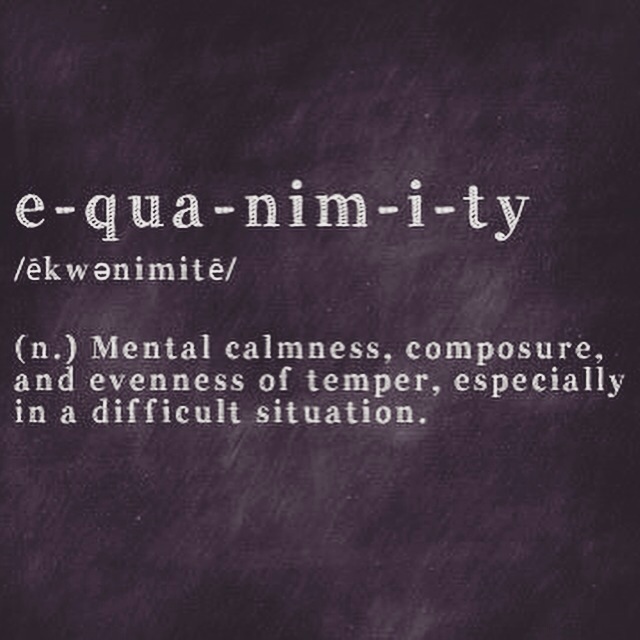
Here is a topic I originally posted on back in June 2010, at a time when I was beginning to explore the next part of my professional and personal journey. How does a person approach change, endings, and beginnings? One approach, which I believe we all should strive towards is a sense of equanimity, the ability to see all situations as somehow equal within our plane of existence. This might be one of the most difficult to cultivate, yet, it would offer a path to handling the downs and ups in a more tranquil way.
This notion of equanimity is described well in the following passage:
In the work, Zeva’at HaRivash, the Baal Shem Tov states;
Shiviti-I have set God before me at all times.” (Psalms 16:8) Shiviti is an expression of hishtavut (equanimity): no matter what happens, whether people praise or shame you, and so, too, with anything else, it is all the same to you. This applies likewise to any food: it is all the same to you whether you eat delicacies or other things. For [with this perspective] the yetzer hara is entirely removed from you. Whatever may happen, say that “it comes from [God], blessed be He, and if it is proper in His eyes…” Your motives are altogether for the sake of Heaven, and as for yourself nothing makes any difference. This [sense of equanimity] is a very high level.
At the time, here is a my proposed read of these words:
For the Baal Shem Tov, Shiviti is the notion of equanimity, which provides the means for allowing G-d to dwell within ourselves. When we are able to rise above ourselves, whether with something good or something bad, we nullify our being, humbling ourselves to a place were G-d then enters. Do we respond to praise and derision in the same manner?
For the Baal Shem Tov, equanimity is not just with regard to our character traits, the internal aspect of our lives, but it is also in the material, the external. Do we see everything in the world having equal value, were the most expensive item and the cheapest item are on equal footing? Shiviti is the ability to reach a place of absolute nullification in the eyes of G-d.
As I look back on this post, I am again struck by the notion of balance. How do we balance the positive and negative in our lives? I was recently reminded of a popular notion that just a little bit of negativity, a shot to our sense of self, requires a lot of positivity to overcome the hurt experienced. There are some who go so far as to suggest we need five times the positive to overcome one negative (see, for example, The Magic Relationship Ratio, According to Science). Perhaps, while so much of our self-work is to find the “positive,” we might be better served to find a more balanced approach, one that doesn’t lift the positive too far up nor allow the negative to drive us down too much.
In relation to this, I am reminded of the adage from Pirkei Avot (4:1):
אֵיזֶהוּ עָשִׁיר, הַשָּׂמֵחַ בְּחֶלְקוֹ, שֶׁנֶּאֱמַר (תהלים קכח) יְגִיעַ כַּפֶּיךָ כִּי תֹאכֵל אַשְׁרֶיךָ וְטוֹב לָךְ. אַשְׁרֶיךָ, בָּעוֹלָם הַזֶּה. וְטוֹב לָךְ, לָעוֹלָם הַבָּא.
Who is rich? He who is content in his lot, as it is said: “You shall enjoy the fruit of your labors, you shall be happy and you shall prosper” (Psalms 128:2) “You shall be happy” in this world, “and you shall prosper” in the world to come.
A person who is content with what they have, in all aspects of life, will be able to experience the richness of life. And, if we consider the notion of finding equanimity as “setting Gd before me at all times,” which is speaking to the ability of endowing our lives with a balanced, day to day spirituality, we will truly find a greater depth and meaning to our day to day existence.
Need support in discovering a sense of equanimity and the richness of life. Contact New Beginnings Spiritual Coaching and Consulting LLC at 732-314-6758 ext. 100 or via email at newbeginningsspiritualcoach@gmail.com.
 New beginnings: A blog about spirituality, chaplaincy and renewal